

As semiconductor devices become increasingly complex and are deployed in more demanding environments, ensuring long-term reliability has become one of the most critical challenges for manufacturers. Modern integrated circuits (ICs), power devices, sensors, and advanced packaging technologies must withstand years of exposure to humidity, temperature fluctuations, and electrical stress without experiencing performance degradation or premature failure.
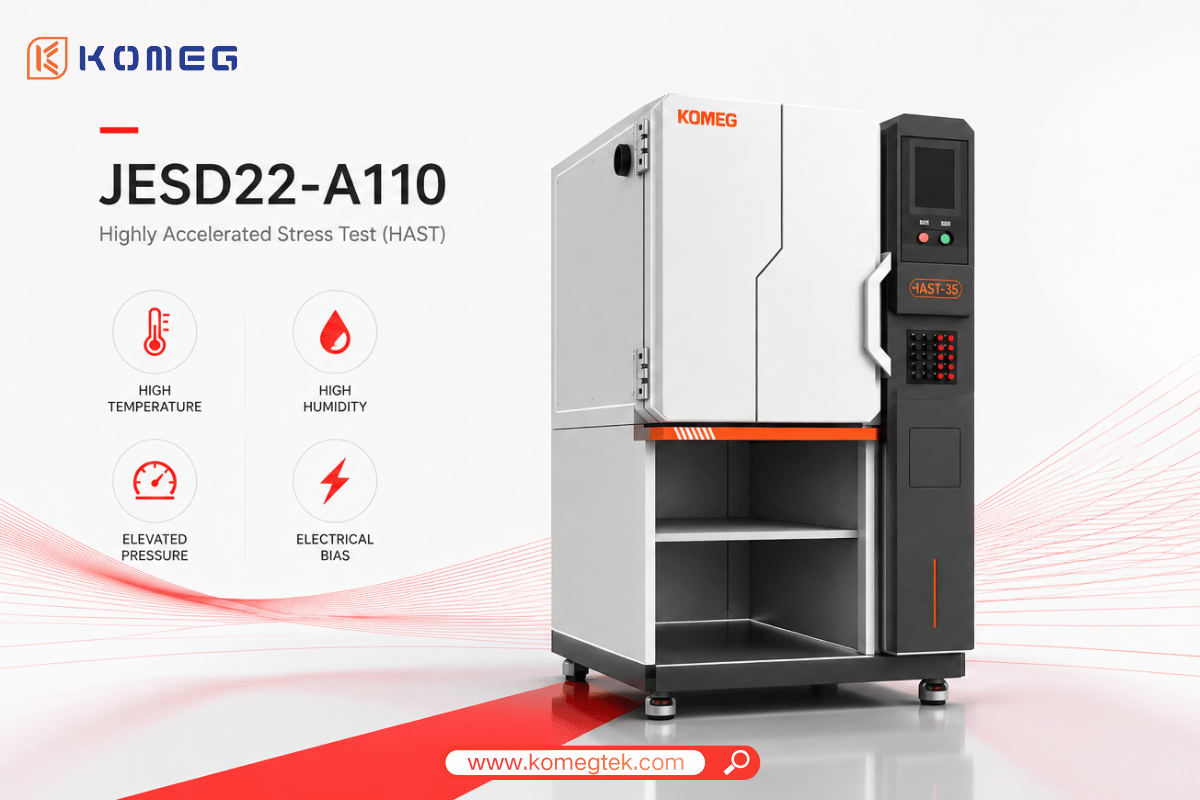
One of the most widely adopted industry standards for evaluating moisture-related reliability is JESD22-A110, a test method developed by JEDEC for conducting Highly Accelerated Stress Testing (HAST).
JESD22-A110 allows manufacturers to simulate years of environmental exposure within a matter of days, helping identify potential weaknesses before products enter mass production. This article explains the purpose, requirements, procedures, applications, and equipment considerations associated with JESD22-A110 HAST testing.
Understanding JESD22-A110
JESD22-A110 is a reliability test standard published by JEDEC (Joint Electron Device Engineering Council) that specifies procedures for conducting Highly Accelerated Temperature and Humidity Stress Testing on semiconductor devices.
The standard was developed to accelerate moisture-induced failure mechanisms that may occur during product operation or storage.
Unlike traditional environmental testing methods that require several months to complete, HAST uses elevated temperature, high humidity, pressure, and electrical bias to accelerate degradation mechanisms and reveal latent defects within a significantly shorter period.
The primary objectives of JESD22-A110 include:
- Evaluating moisture resistance
- Identifying package weaknesses
- Accelerating corrosion mechanisms
- Assessing long-term reliability
- Supporting product qualification
- Verifying manufacturing process stability
Today, JESD22-A110 has become an essential qualification test throughout the semiconductor industry.
Why Moisture Reliability Matters in Semiconductor Devices
Moisture is one of the leading causes of electronic component failure.
Even microscopic amounts of moisture can penetrate semiconductor packages over time and interact with sensitive materials and electrical structures.
Potential consequences include:
Corrosion
Moisture can react with metal conductors, bond wires, lead frames, and solder joints, causing oxidation and degradation.
Electrochemical Migration
Electrical bias combined with moisture can cause metal ions to migrate across insulating surfaces, creating conductive paths.
Increased Leakage Current
Water molecules can reduce insulation resistance and increase parasitic current flow.
Delamination
Moisture absorption can weaken adhesion between package materials, resulting in separation of interfaces.
Die Cracking
Thermal expansion differences combined with absorbed moisture may generate mechanical stress within the package.
Short Circuits
Dendritic growth caused by moisture exposure can eventually bridge conductors and create catastrophic failures.
JESD22-A110 was specifically designed to accelerate these failure mechanisms and evaluate product robustness before field deployment.
What Is HAST Testing?
HAST stands for Highly Accelerated Stress Test.
It is an environmental reliability test performed under elevated temperature and humidity conditions inside a pressurized chamber.
The test accelerates moisture penetration into semiconductor packages while simultaneously exposing devices to electrical stress.
Typical HAST conditions include:
- Temperature: 110°C to 140°C
- Relative Humidity: 85% RH
- Elevated Pressure Environment
- Continuous Electrical Bias
Under these conditions, moisture-related failures that may take years in real-world operation can occur within days.
This accelerated testing approach significantly reduces product qualification time while maintaining meaningful reliability insights.
How JESD22-A110 Accelerates Failure Mechanisms
The effectiveness of HAST comes from the combined influence of four stress factors:
Elevated Temperature
Higher temperatures accelerate chemical reactions according to Arrhenius acceleration principles.
High Humidity
Moisture penetrates package materials more rapidly.
Pressure
Pressurization allows humidity to remain stable even at temperatures exceeding the boiling point of water.
Electrical Bias
Voltage applied during testing accelerates electrochemical failure mechanisms.
By combining these stresses, JESD22-A110 creates a highly aggressive environment that exposes latent defects much faster than traditional testing methods.
Typical JESD22-A110 Test Conditions
Although test parameters may vary depending on qualification requirements, several conditions are commonly used.
Condition A
- 110°C
- 85% RH
- 264 hours
Condition B
- 130°C
- 85% RH
- 96 hours
Condition C
- 140°C
- 85% RH
- 96 hours
The selected condition depends on:
- Device technology
- Package structure
- Customer specifications
- Automotive requirements
- Reliability objectives
Higher stress levels generally produce faster results but may introduce failure mechanisms not typically observed during actual service conditions.
Biased HAST vs Unbiased HAST
There are two primary forms of HAST testing.
Biased HAST
In Biased HAST, devices remain electrically powered during testing.
Advantages include:
- Simulates real operating conditions
- Accelerates corrosion mechanisms
- Detects leakage current failures
- Evaluates insulation performance
- Preferred for product qualification
Biased HAST is the method most commonly referenced under JESD22-A110.
Unbiased HAST
In Unbiased HAST, devices are exposed to temperature and humidity without applied voltage.
Advantages include:
- Simpler test setup
- Lower testing cost
- Useful for material evaluation
- Suitable for package screening
However, it may not reveal all electrical failure mechanisms.
JESD22-A110 vs THB Testing
A common question among reliability engineers is whether HAST should replace traditional THB testing.
THB (Temperature Humidity Bias)
Typical Conditions:
- 85°C
- 85% RH
- 1000 Hours
Advantages:
- Long-established methodology
- Closely simulates real-world environments
Disadvantages:
- Long test duration
- Slower qualification cycles
HAST
Typical Conditions:
- 130°C
- 85% RH
- 96 Hours
Advantages:
- Faster results
- Higher productivity
- Reduced development cycle
Disadvantages:
- A more aggressive environment
- Requires specialized chambers
For modern semiconductor development, HAST is often used as a rapid qualification tool, while THB may still be used for long-term validation.
Industries That Use JESD22-A110 Testing
Semiconductor Manufacturing
Used for:
- Microprocessors
- Memory devices
- Analog ICs
- Logic devices
- RF components
Automotive Electronics
Automotive applications require exceptional reliability due to long service life expectations.
Typical devices include:
- Engine Control Units (ECUs)
- ADAS Systems
- Power Management ICs
- Battery Management Systems
JESD22-A110 is frequently used alongside AEC-Q100 qualification programs.
Aerospace and Defense
Electronic systems used in aerospace environments must demonstrate resistance to severe environmental stresses.
HAST testing supports qualification of:
- Flight control electronics
- Satellite components
- Communication systems
Power Electronics
Including:
- IGBT modules
- SiC MOSFETs
- GaN power devices
- Inverters
These devices often operate in high-temperature environments where moisture reliability becomes critical.
Data Centers and AI Hardware
Modern AI servers and high-performance computing systems contain densely packaged semiconductor devices that generate significant heat.
HAST testing helps verify package integrity and long-term reliability under demanding operating conditions.
Equipment Requirements for JESD22-A110 Testing
Reliable testing requires specialized HAST chambers capable of maintaining stable and repeatable conditions.
Key chamber features include:
Precise Temperature Control
Maintaining consistent temperatures between 110°C and 140°C.
Accurate Humidity Control
Stable 85% RH conditions throughout the test duration.
Pressure Vessel Design
Supporting saturated humidity environments above atmospheric boiling conditions.
Electrical Bias Capability
Allowing powered testing during stress exposure.
Uniform Chamber Distribution
Ensuring all devices receive equivalent environmental stress.
Safety Protection Systems
Including:
- Over-temperature protection
- Over-pressure protection
- Water level monitoring
- Emergency shutdown functions
Common Failure Mechanisms Detected During HAST Testing
JESD22-A110 frequently reveals:
- Bond wire corrosion
- Lead frame oxidation
- Die attach degradation
- Package delamination
- Conductive anodic filament growth
- Insulation resistance reduction
- Leakage current increases
- Solder joint degradation
Identifying these issues early helps manufacturers improve product reliability and reduce warranty costs.
Future Trends in HAST Testing
As semiconductor packaging technologies continue evolving toward:
- Chiplet architectures
- 2.5D packaging
- 3D packaging
- Silicon photonics
- AI accelerators
- Advanced automotive electronics
Moisture reliability challenges are becoming more complex.
Future HAST testing will likely involve:
- Higher integration levels
- More sophisticated bias conditions
- Enhanced monitoring systems
- Automated data analysis
- Digital twin reliability modeling
JESD22-A110 will remain a foundational qualification standard for advanced semiconductor technologies.
JESD22-A110 is one of the most important reliability standards in the semiconductor industry, providing a proven methodology for accelerating moisture-related failure mechanisms through Highly Accelerated Stress Testing.
By combining elevated temperature, humidity, pressure, and electrical bias, HAST enables manufacturers to identify weaknesses in semiconductor packages, materials, and processes within days instead of months.
As electronics continue to become smaller, more powerful, and more complex, JESD22-A110 testing will play an increasingly critical role in ensuring long-term product reliability, reducing field failures, and accelerating time-to-market.