

Modern products are expected to operate reliably in increasingly demanding environments. A semiconductor chip may experience rapid temperature changes inside a data center. An automotive electronic control unit (ECU) can face freezing winter mornings followed by engine-compartment temperatures exceeding 120°C. Aerospace components undergo extreme thermal transitions during takeoff, high-altitude flight, and landing.
These rapid temperature fluctuations create mechanical and thermal stresses that can significantly affect product reliability. To evaluate a product’s ability to withstand such conditions, manufacturers rely on thermal shock testing.
Thermal shock testing is one of the most important environmental reliability tests used across the electronics, semiconductor, automotive, aerospace, defense, and battery industries. It helps engineers identify weaknesses in materials, assemblies, solder joints, and package structures before products reach the field.
This guide explains how thermal shock testing works, why it matters, applicable standards, common applications, and how to choose the right thermal shock test chamber.
What Is Thermal Shock Testing?
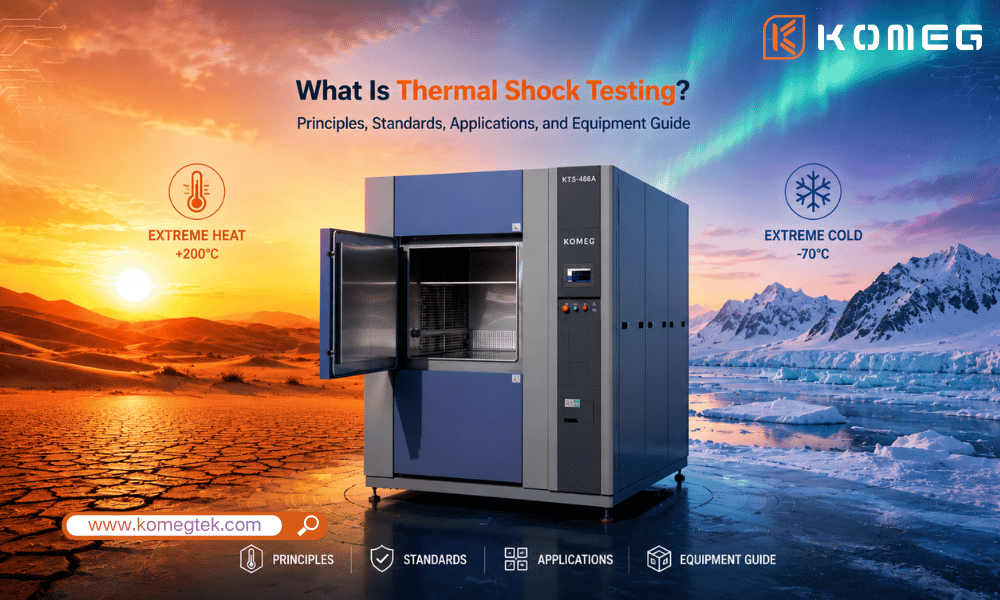
Thermal shock testing is an accelerated environmental test that exposes a product to sudden transitions between extremely high and extremely low temperatures.
Unlike conventional temperature cycling, which changes temperature gradually, thermal shock testing transfers specimens rapidly between hot and cold environments. The purpose is to create severe thermal stress within materials and assemblies, thereby accelerating failure mechanisms that would otherwise take months or years to appear.
Typical thermal shock conditions may include:
| Parameter | Typical Range |
|---|---|
| Hot Zone Temperature | +150°C to +200°C |
| Cold Zone Temperature | -40°C to -70°C |
| Transfer Time | Less than 10 seconds |
| Recovery Time | Less than 5 minutes |
By repeatedly exposing products to these rapid temperature changes, engineers can evaluate long-term reliability in a compressed timeframe.
Why Is Thermal Shock Testing Important?
Temperature changes cause materials to expand and contract. Different materials expand at different rates, a property quantified by their coefficient of thermal expansion (CTE). When components with different CTE values are assembled together, thermal stress develops during rapid temperature changes. Over time, this stress can cause:
- Solder Joint Fatigue – Repeated expansion and contraction can crack solder joints, leading to intermittent or permanent electrical failures.
- Package Cracking – Semiconductor packages may develop microscopic cracks that allow moisture ingress, leading to corrosion and premature failure.
- Delamination – Internal layers within electronic packages can separate, compromising electrical and mechanical integrity.
- Bond Wire Failure – Thermal stress can weaken or break wire bonds, causing open circuits.
- Seal Failure – Mechanical seals and gaskets may lose integrity, allowing contamination.
- Material Deformation – Plastic and composite materials may warp or distort over many cycles.
Thermal shock testing accelerates these failure mechanisms, allowing engineers to detect potential problems before products enter production.
How Thermal Shock Testing Works
A thermal shock test chamber typically contains separate hot and cold zones. The test process follows a repeating cycle:
- Hot Exposure – The specimen is stabilized at an elevated temperature for a specified dwell time.
- Rapid Transfer – The test basket moves quickly to the opposite zone (typically within 10 seconds).
- Cold Exposure – The specimen remains at the low temperature for a specified dwell period.
- Continuous Cycling – The process repeats for hundreds or thousands of cycles.
This repeated thermal expansion and contraction creates highly accelerated mechanical stress that can quickly reveal design or process weaknesses.
Thermal Shock Testing vs. Temperature Cycling
Many engineers confuse thermal shock testing with temperature cycling testing. Although similar, they evaluate different failure mechanisms and are suited for different purposes. Temperature Cycling is characterized by gradual temperature transitions (typically 5°C to 15°C per minute) and lower thermal gradients. It simulates long-term environmental exposure and is commonly used for product life testing, reliability qualification, and field condition simulation. Thermal Shock Testing, in contrast, features extremely rapid temperature transitions (transfer times under 10 seconds) and much higher thermal gradients. It creates accelerated mechanical stress and is used for failure mechanism identification, package qualification, and solder reliability evaluation. In general, thermal shock testing is more aggressive than temperature cycling and is better suited for identifying structural and mechanical weaknesses, while temperature cycling is more appropriate for simulating real-world usage patterns.
Common Thermal Shock Testing Standards
Several international standards define thermal shock testing procedures. The choice of standard depends on your industry, application, and geographic region.
| Standard | Scope | Typical Applications |
|---|---|---|
| JESD22-A106 | Semiconductor qualification | IC packages, surface-mount devices, package reliability |
| MIL-STD-883 Method 1010 | Military electronics | Defense electronics, aerospace systems, high-reliability components |
| IEC 60068-2-14 | International environmental testing | General thermal shock procedures, acceptance criteria |
| MIL-STD-810H | Military equipment qualification | Extreme environmental durability, operational readiness |
| AEC-Q100 | Automotive IC qualification | Automotive-grade integrated circuits often include thermal shock |
Always consult the specific revision of the standard applicable to your device and market.
Industries That Use Thermal Shock Testing
Semiconductor Industry
Applications include IC packages, memory devices, processors, AI accelerators, and silicon photonics. Thermal shock testing identifies package-level reliability risks before mass production.
Automotive Electronics
Vehicle components experience continuous thermal variation. Examples include ECUs, sensors, power modules, ADAS systems, and battery management systems. Thermal shock testing helps ensure compliance with automotive reliability requirements such as AEC-Q100.
Aerospace and Defense
Aircraft and spacecraft encounter rapid environmental transitions. Thermal shock testing evaluates avionics, radar systems, guidance electronics, and communication modules against MIL-STD specifications.
Battery Industry
Lithium-ion battery systems experience significant thermal stress during charging and discharging. Thermal shock testing helps assess cell integrity, module reliability, and pack durability.
Consumer Electronics
Products such as smartphones, laptops, wearables, and networking equipment undergo thermal shock testing to improve long-term reliability and reduce warranty claims.
Two-Zone vs. Three-Zone Thermal Shock Chambers
Two-Zone Thermal Shock Chambers
In a two-zone system, separate hot and cold chambers are positioned vertically or horizontally, and a product basket transfers between zones.
Advantages: Faster transition times, stronger thermal stress, lower operating cost.
Best suited for: Semiconductor testing, electronics reliability testing, and applications requiring the most aggressive thermal gradients.
Three-Zone Thermal Shock Chambers
A three-zone chamber adds a third zone (typically ambient temperature) between the hot and cold zones, or uses a stationary test area with moving air. The product remains stationary while hot and cold air are directed into the test area.
Advantages: Reduced mechanical movement, suitable for delicate specimens or those with connected instrumentation.
Best suited for: Large assemblies, automotive components, and complex test setups where moving the specimen is impractical.
Key Specifications to Consider
When selecting a thermal shock chamber, engineers should evaluate the following specifications:
Temperature Range – Typical range is -70°C to +200°C. Ensure the range covers your test requirements.
Transfer Time – Industry preference is ≤10 seconds. Faster transfer creates more severe thermal stress.
Recovery Time – Industry preference is ≤5 minutes. This is the time required for the specimen to stabilize at the target temperature after transfer.
Temperature Uniformity – Ensures consistent testing conditions across the entire workspace. Typical uniformity is ±2°C or better.
Basket Capacity – Must support the size, weight, and number of specimens you intend to test.
Controller Functions – Look for touchscreen operation, data logging, Ethernet connectivity, and remote monitoring capabilities.
Safety Systems – Including over-temperature protection, refrigeration system protection, and emergency shutdown.
Common Failure Modes Revealed by Thermal Shock Testing
Thermal shock testing commonly uncovers:
Solder joint cracking
PCB trace separation
Wire bond failures
Package cracking
Delamination between material layers
- Seal degradation
- Connector failures
- Material fatigue
These defects often remain hidden during normal inspections but become apparent under thermal stress. Identifying them early allows corrective actions before products ship to customers.
Future Trends in Thermal Shock Testing
As industries adopt AI computing, advanced semiconductor packaging (such as chiplets and 3D stacking), electric vehicles, renewable energy systems, and high-density electronics, thermal shock testing requirements are becoming increasingly stringent.
Future testing trends include:
- Wider temperature ranges to accommodate new materials
- Faster transfer times for more aggressive acceleration
- Larger test capacities for full-system or battery pack testing
- Automated failure analysis integrated with test equipment
- Real-time monitoring with predictive analytics
- Integration with digital twin technologies for virtual testing and correlation
Thermal shock testing is a critical reliability evaluation method used to determine how products respond to rapid temperature transitions. By exposing materials and assemblies to repeated thermal stress, manufacturers can identify weaknesses, improve product durability, and reduce field failures.
Whether applied to semiconductors, automotive electronics, batteries, aerospace systems, or consumer devices, thermal shock testing remains one of the most effective tools for validating long-term product reliability in today’s demanding environments.