

Walk-in temperature and humidity chambers are widely used across industries such as electronics, semiconductors, automotive, aerospace, pharmaceuticals, renewable energy, and research laboratories. These chambers simulate controlled environmental conditions to evaluate product reliability, durability, and performance.
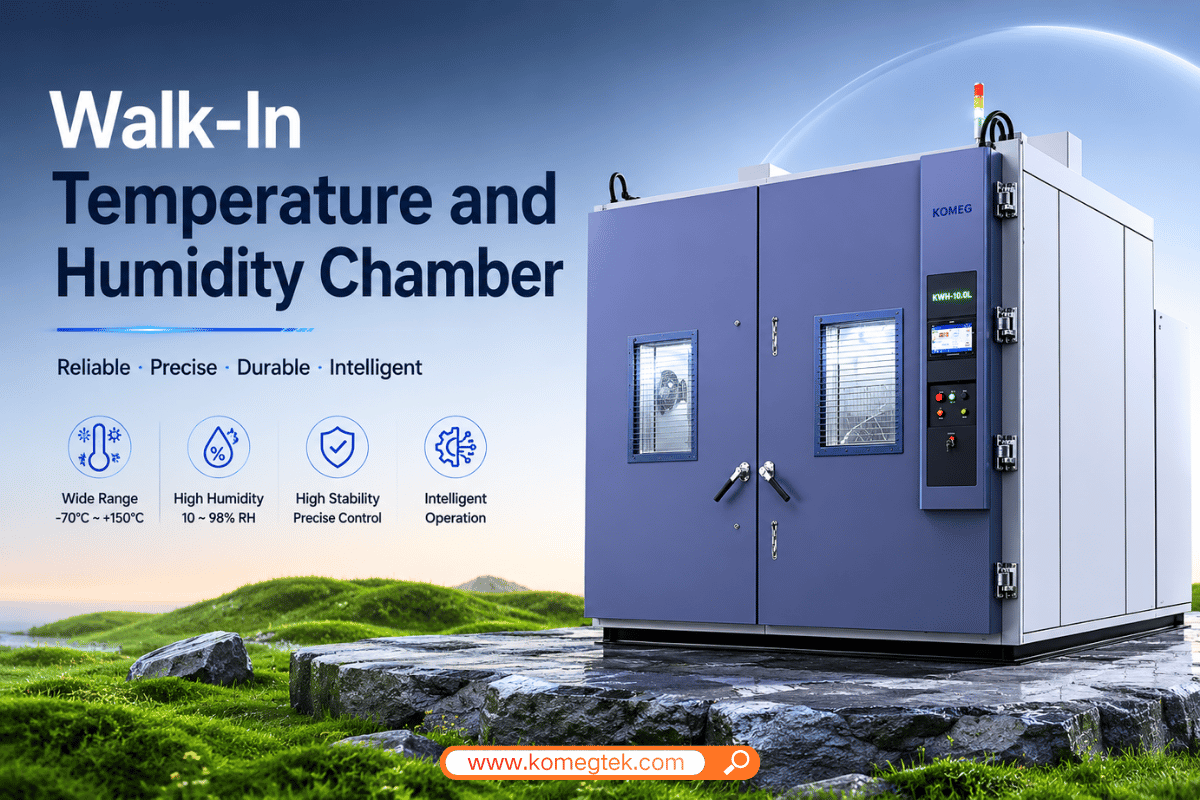
However, even the most advanced environmental chamber can gradually drift from its specified accuracy due to sensor aging, airflow changes, refrigeration wear, controller deviations, and long-term operation. This is why regular calibration is essential.
Proper calibration ensures accurate temperature and humidity control, compliance with ISO, IEC, MIL, and customer requirements, reliable and repeatable test results, CNAS and ISO/IEC 17025 laboratory compliance, reduced measurement uncertainty, and long-term chamber performance.
This guide explains the standards, calibration procedures, equipment requirements, and best practices for calibrating walk-in temperature and humidity chambers.
Why Calibration Is Necessary
Environmental testing relies entirely on accurate environmental conditions. If the actual chamber temperature differs from the displayed value by only a few degrees, test results may become invalid.
For example, consider a lithium battery tested at a setpoint of 85°C when the actual chamber temperature is only 80°C. The battery may pass a reliability test that should have failed under true 85°C conditions. Similarly, humidity deviations can significantly affect corrosion testing, electronic reliability testing, accelerated aging tests, battery validation, and material performance evaluation. Regular calibration ensures that test conditions truly match specified requirements.
Relevant Calibration Standards
Different industries follow different calibration standards, each with specific requirements for chamber verification.
The IEC 60068 Series is widely used for environmental testing worldwide. It provides guidance for temperature testing, humidity testing, and environmental stress testing.
ISO/IEC 17025 is the international standard for testing and calibration laboratories. It requires traceable measurements, comprehensive calibration records, and detailed measurement uncertainty analysis.
ASTM Standards are frequently used in North America, particularly for materials testing, environmental conditioning, and accelerated aging tests.
GB/T Standards, commonly used in China, include GB/T 5170 and GB/T 2423, which specify environmental chamber verification methods for the Chinese market.
Always consult the specific standard applicable to your industry and geographic region before performing calibration.
Calibration Equipment Required
Professional calibration requires certified reference instruments with documented traceability to national or international standards.
Precision temperature data loggers are used to measure actual chamber temperatures. These instruments typically offer accuracy of ±0.1°C or even ±0.05°C for high-precision applications.
Humidity calibration sensors provide humidity verification with a typical accuracy of ±1% RH or ±2% RH, depending on the sensor grade.
Multi-channel data acquisition systems enable simultaneous monitoring at multiple chamber locations. This capability is especially important for large walk-in chambers, where temperature distribution can vary significantly across the workspace.
Calibration software is used for data collection, statistical analysis, and calibration reporting, helping to automate the process and reduce human error.
Temperature Calibration Procedure
Step 1: Chamber Preparation
Before calibration begins, prepare the chamber by cleaning the interior, verifying airflow operation, checking refrigeration performance, and inspecting door seals for leaks or damage. Once these checks are complete, allow the chamber to stabilize at ambient conditions.
Step 2: Sensor Placement
Temperature sensors should be distributed throughout the working volume to capture spatial variations. For smaller chambers, the 9-point method is commonly used, with sensors placed at the eight corners and one center point of the workspace. For walk-in chambers, the 15-point method provides better spatial analysis and is more appropriate given the larger volume. For large chambers and accredited laboratories, the 27-point method offers comprehensive temperature mapping and is often required for ISO/IEC 17025 compliance.
Step 3: Stabilization
Set the chamber to the target temperature. Typical calibration points include -40°C, -20°C, 25°C, 85°C, and 150°C, depending on your test requirements. Allow the chamber to stabilize at each setpoint. Stabilization typically requires 30 to 60 minutes, though larger walk-in chambers may need significantly longer to reach thermal equilibrium.
Step 4: Data Collection
Record temperature values continuously at each sensor location. Data collection typically lasts 30 to 120 minutes per setpoint, with a sampling interval of one minute or less to capture short-term fluctuations.
Step 5: Data Analysis
After data collection, calculate three key performance metrics.
Temperature uniformity is the difference between the highest and lowest measured temperatures across all sensor locations. It is calculated as the maximum temperature minus the minimum temperature.
Temperature deviation is the difference between the average measured temperature and the setpoint. It is calculated as the average temperature minus the setpoint.
Temperature fluctuation is the variation at a single sensor location over time. It is calculated as the maximum reading at that location minus the minimum reading at that location.
These three metrics together define the thermal performance of the chamber.
Humidity Calibration Procedure
Humidity calibration follows a similar approach to temperature calibration but adds another layer of complexity. Common calibration points include 20% RH, 50% RH, 85% RH, and 95% RH.
Before performing humidity calibration, the chamber must first reach stable temperature conditions. Because humidity depends heavily on temperature stability, temperature calibration should always be verified before humidity calibration. Any temperature drift will directly affect humidity readings.
Once the temperature is stable, place humidity sensors throughout the workspace following the same multi-point distribution used for temperature calibration. Allow the chamber to stabilize at each humidity setpoint, then record data continuously for 30 to 120 minutes per point. Calculate uniformity, deviation, and fluctuation for humidity using the same formulas as for temperature.
Temperature Mapping for Walk-In Chambers
Large walk-in chambers present unique challenges that smaller benchtop chambers do not face. Factors affecting temperature distribution include chamber size, airflow design, fan capacity, product loading, and shelf configuration.
Temperature mapping helps identify hot spots, cold spots, and airflow dead zones within the workspace. This is particularly important for applications such as EV battery testing, where temperature uniformity directly affects cell performance and safety; aerospace component testing, where strict specifications require documented evidence of chamber capability; and pharmaceutical stability studies, where regulatory bodies expect validated temperature distribution.
For walk-in chambers, temperature mapping should be performed under both empty and loaded conditions, as product loading can significantly alter airflow patterns and temperature distribution.
Calibration Frequency Recommendations
Calibration intervals depend on usage frequency, industry regulations, and internal quality requirements.
For high-usage laboratories that operate chambers daily or continuously, calibration every six months is generally recommended. Manufacturing facilities with moderate usage often calibrate every twelve months. CNAS or ISO/IEC 17025-accredited laboratories must follow their laboratory accreditation requirements, which typically specify calibration intervals of six to twelve months.
After major repairs, immediate recalibration is strongly recommended. This includes sensor replacement, controller replacement, or any work on the refrigeration system. Even if the chamber appears to be functioning correctly, repair work can alter calibration characteristics.
Common Calibration Errors
Many organizations make avoidable mistakes during calibration.
Insufficient stabilization time is a frequent error. Large walk-in chambers may require several hours to reach thermal equilibrium, not just 30 minutes. Rushing this step produces invalid data.
Poor sensor placement can distort results. Sensors placed too close to chamber walls, heating elements, or cooling coils will not represent the true working volume conditions.
Ignoring product load effects is another common oversight. An empty chamber behaves differently from a loaded chamber. For most applications, calibration should be performed under representative loading conditions.
Using uncertified instruments invalidates calibration results. Every reference instrument must have current calibration certificates traceable to national or international standards.
Failure to record measurement uncertainty is a particular problem for accredited laboratories. ISO/IEC 17025 requires documented uncertainty analysis for all calibration results.
Best Practices for Accurate Calibration
To achieve reliable calibration results, follow these best practices.
Use traceable reference instruments with current calibration certificates. Perform full temperature mapping, not just single-point verification, especially for walk-in chambers. Verify airflow performance before and during calibration to ensure proper circulation. Calibrate under representative operating conditions, including typical product loading and shelf configurations. Maintain detailed calibration records that include raw data, uncertainty calculations, and environmental conditions during calibration. Follow ISO/IEC 17025 principles even if your laboratory is not formally accredited. Schedule routine preventive maintenance between calibration intervals to keep chambers operating within specification.
These practices improve both chamber accuracy and testing confidence, reducing the risk of invalid test results.
Calibration is a critical part of maintaining the accuracy and reliability of walk-in temperature and humidity chambers. A properly calibrated chamber ensures that environmental tests produce trustworthy and repeatable results while meeting industry and accreditation requirements.
Whether used for battery testing, semiconductor qualification, automotive validation, aerospace applications, or pharmaceutical stability studies, regular chamber calibration helps organizations reduce risk, improve product quality, and maintain compliance with international standards.
For laboratories and manufacturers seeking the highest level of environmental testing accuracy, a structured calibration program is not just recommended—it is essential.