

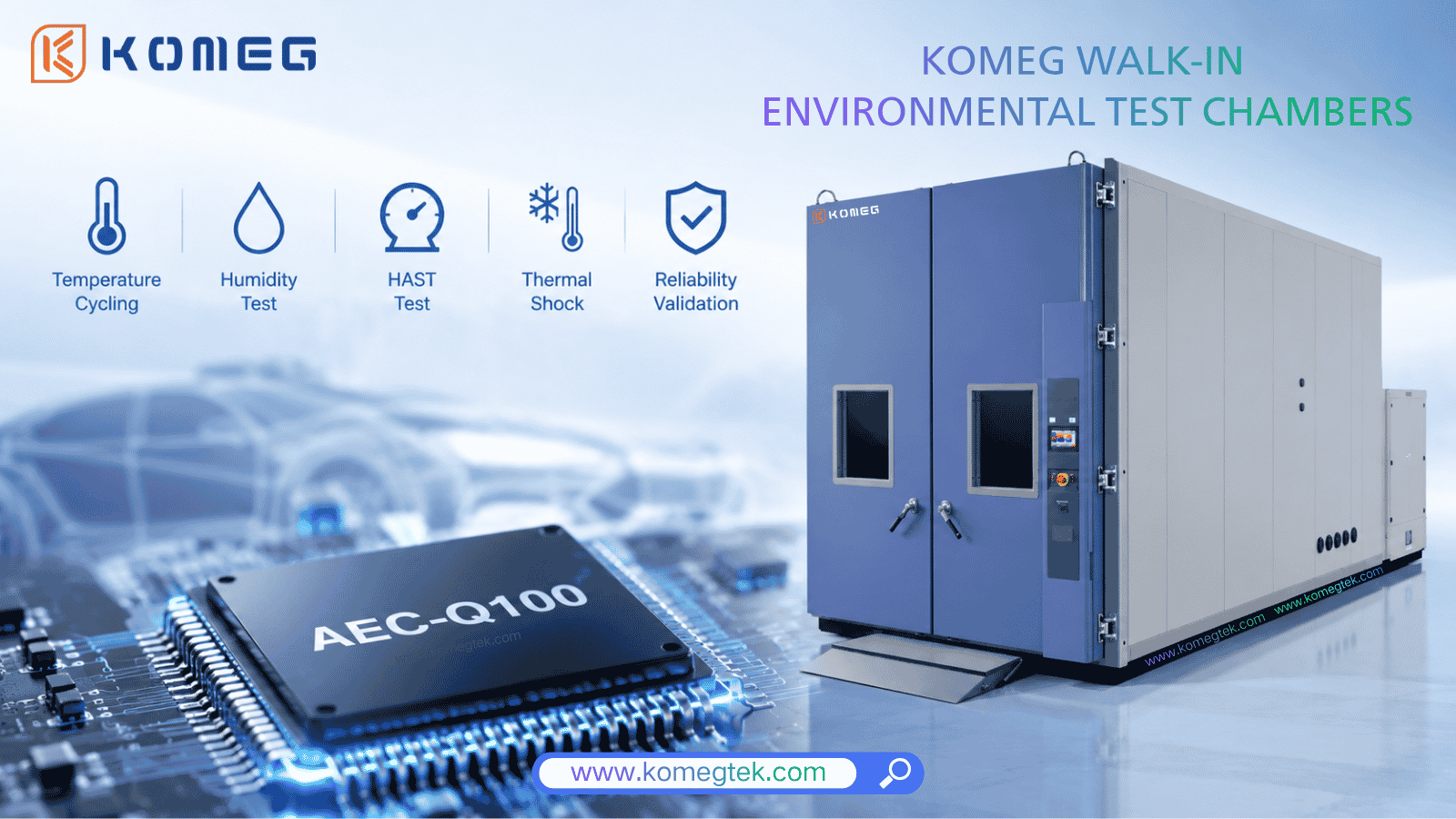
As modern vehicles become increasingly dependent on electronic systems, semiconductor reliability has become one of the most critical concerns in the automotive industry. From advanced driver assistance systems (ADAS) and electric vehicle power modules to onboard sensors, infotainment systems, and battery management units, automotive semiconductors are now expected to operate reliably under extremely demanding environmental conditions.
Unlike consumer electronics, automotive semiconductor devices must withstand:
- Extreme high and low temperatures
- Rapid thermal cycling
- High-humidity environments
- Mechanical vibration
- Long operational lifetimes
- Harsh under-hood conditions
Even minor semiconductor failures can lead to severe system malfunctions, safety risks, or costly recalls. To ensure long-term reliability, automotive integrated circuits (ICs) must pass a series of rigorous qualification tests before entering the market.
One of the most widely recognized reliability standards for automotive semiconductors is AEC-Q100.
AEC-Q100 defines environmental stress test requirements for automotive-grade integrated circuits and has become a critical benchmark for semiconductor manufacturers worldwide. Environmental test chambers play a central role in performing these reliability evaluations, enabling manufacturers to simulate years of real-world environmental stress within controlled laboratory conditions.
This article explains AEC-Q100 testing in detail, including the standard itself, major environmental stress tests, reliability objectives, testing equipment, and how environmental chambers support automotive semiconductor qualification.
What Is AEC-Q100?
AEC-Q100 is a reliability qualification standard developed by the Automotive Electronics Council (AEC) for integrated circuits used in automotive applications.
The standard establishes stress test qualification requirements for semiconductor devices intended for automotive environments.
AEC-Q100 is widely used by:
- Automotive semiconductor manufacturers
- Automotive OEMs
- Tier 1 automotive suppliers
- Reliability laboratories
- Electronics manufacturers
The purpose of the standard is to ensure semiconductor devices can survive the harsh environmental conditions encountered in vehicles throughout their operational lifetime.
AEC-Q100 qualification involves a series of accelerated environmental and electrical stress tests designed to identify potential failure mechanisms before products are released to the market.
Why Automotive Semiconductor Reliability Matters
Modern vehicles contain hundreds or even thousands of semiconductor devices controlling essential systems such as:
- Engine control units (ECUs)
- Powertrain electronics
- Battery management systems
- Autonomous driving systems
- Infotainment modules
- Radar sensors
- LiDAR systems
- Electric vehicle power modules
These systems often operate in severe environments involving:
- Engine heat
- Outdoor humidity
- Thermal shock
- Continuous vibration
- Voltage fluctuations
Automotive semiconductors must maintain stable performance for many years despite constant environmental stress.
Unlike consumer electronics, automotive IC failures may directly affect vehicle safety and operational stability. For this reason, automotive-grade semiconductor qualification standards are far more stringent than standard commercial electronics testing.
AEC-Q100 Temperature Grades
AEC-Q100 classifies semiconductor devices into different temperature grades based on operating temperature ranges.
Grade 0
- Operating range:
-40°C to +150°C
Typically used in high-temperature automotive applications such as engine compartments and power electronics.
Grade 1
- Operating range:
-40°C to +125°C
Widely used in automotive control systems and under-hood electronics.
Grade 2
- Operating range:
-40°C to +105°C
Suitable for moderate automotive environments.
Grade 3
- Operating range:
-40°C to +85°C
Often used for interior electronics and infotainment systems.
Grade 4
- Operating range:
0°C to +70°C
Primarily used in limited automotive environments.
Environmental Stress Testing in AEC-Q100
Environmental stress testing is one of the core components of the AEC-Q100 qualification.
These tests expose semiconductor devices to accelerated environmental conditions to simulate years of operational stress within a shortened timeframe.
The primary objectives include:
- Identifying latent defects
- Evaluating long-term reliability
- Accelerating failure mechanisms
- Verifying package integrity
- Assessing thermal durability
Environmental chambers are essential tools for performing these qualification tests.
Temperature Cycling Test
Temperature cycling is one of the most important tests in AEC-Q100 qualification.
The test repeatedly exposes semiconductor devices to alternating high and low temperatures.
Typical conditions may include:
- -55°C to +125°C
- -40°C to +150°C
The purpose is to evaluate thermal fatigue caused by the repeated expansion and contraction of semiconductor materials.
Temperature cycling helps identify failures such as:
- Solder fatigue
- Package cracking
- Delamination
- Bond wire damage
- Interconnect degradation
Thermal cycling chambers used for AEC-Q100 testing must provide:
- Accurate temperature control
- Stable ramp rates
- Excellent temperature uniformity
- Reliable long-term operation
Thermal Shock Testing
Thermal shock testing subjects semiconductor devices to extremely rapid temperature transitions between hot and cold environments.
Unlike standard thermal cycling, thermal shock minimizes transition time between temperature extremes.
This testing accelerates mechanical stress and helps reveal hidden structural weaknesses within semiconductor packages.
Thermal shock testing is particularly useful for evaluating:
- Package integrity
- Die attach reliability
- Material compatibility
- Mechanical durability
Thermal shock chambers used for automotive semiconductor testing require fast transfer systems and stable zone temperature control.
High Temperature Operating Life (HTOL)
HTOL testing evaluates semiconductor reliability under elevated temperature and electrical bias conditions over extended periods.
The test simulates long-term operational stress and accelerates aging mechanisms.
HTOL helps evaluate:
- Device wear-out mechanisms
- Long-term electrical stability
- Reliability lifetime prediction
High temperature stability is critical because temperature directly affects semiconductor degradation rates.
Environmental chambers used for HTOL testing must maintain highly stable temperature conditions for hundreds or thousands of testing hours.
High Temperature Storage Life (HTSL)
HTSL testing exposes semiconductor devices to high temperatures without electrical bias.
The objective is to evaluate material stability and package durability during long-term thermal exposure.
HTSL testing may reveal:
- Material degradation
- Oxidation
- Package instability
- Die attach problems
High-temperature ovens and environmental chambers are commonly used for this testing.
Temperature Humidity Bias (THB) Testing
THB testing combines:
- Elevated temperature
- High humidity
- Electrical bias
to accelerate moisture-related failure mechanisms.
Typical testing conditions may include:
- 85°C
- 85%RH
- Continuous electrical bias
THB testing evaluates:
- Corrosion resistance
- Moisture penetration
- Insulation reliability
- Electrochemical migration
Temperature-humidity chambers used for THB testing require highly stable humidity and temperature control.
HAST Testing
Highly Accelerated Stress Testing (HAST) is widely used in automotive semiconductor reliability validation.
HAST testing combines:
- High temperature
- High humidity
- High pressure
to accelerate moisture-induced degradation.
Compared with traditional THB testing, HAST significantly shortens testing time.
HAST chambers are commonly used for:
- IC package reliability
- Moisture resistance testing
- Corrosion analysis
- Failure mechanism acceleration
AEC-Q100 qualification frequently includes HAST-related testing procedures for moisture-sensitive semiconductor devices.
Power Temperature Cycling (PTC)
Power temperature cycling evaluates semiconductor reliability under repeated self-heating and cooling conditions.
This testing is especially important for:
- Power semiconductors
- IGBT modules
- EV power electronics
PTC testing helps identify:
- Solder fatigue
- Thermal interface degradation
- Wire bond failures
Power cycling reliability is increasingly critical for electric vehicle applications.
Environmental Chambers Used for AEC-Q100 Testing
Environmental chambers are essential for performing AEC-Q100 qualification tests.
Several chamber types are commonly used.
Temperature Humidity Chambers
These chambers support:
- THB testing
- Humidity reliability testing
- Combined climatic stress testing
Key performance requirements include:
- Stable temperature control
- Precise humidity regulation
- Excellent chamber uniformity
Thermal Cycling Chambers
Thermal cycling chambers simulate repeated temperature changes under controlled ramp rates.
These systems require:
- Efficient refrigeration systems
- Accurate PID control
- Optimized airflow circulation
Thermal Shock Chambers
Thermal shock systems use separate hot and cold zones for rapid temperature transitions.
They are widely used for accelerated package stress testing.
HAST Chambers
HAST chambers generate:
- High pressure
- High temperature
- Saturated humidity conditions
These systems are essential for advanced automotive semiconductor reliability testing.
Importance of Precise Temperature Control
Temperature stability is one of the most critical factors in AEC-Q100 testing.
Even minor temperature deviations can affect:
- Failure acceleration rates
- Test repeatability
- Reliability prediction accuracy
Environmental chambers used for semiconductor qualification must provide:
- Stable temperature fluctuation
- Excellent uniformity
- Fast response speed
- Consistent long-term operation
Advanced PID control systems and optimized airflow engineering help achieve these performance requirements.
Airflow Design in Semiconductor Reliability Testing
Airflow design directly affects chamber temperature uniformity and testing consistency.
Poor airflow may cause:
- Hot spots
- Uneven stress exposure
- Inconsistent failure results
Modern environmental chambers often use CFD airflow simulation technology to optimize air circulation and improve thermal stability throughout the workspace.
Uniform environmental conditions are especially important during high-density semiconductor testing.
Refrigeration Systems in AEC-Q100 Testing Chambers
Low-temperature AEC-Q100 tests require advanced refrigeration systems.
Cascade refrigeration systems are commonly used to achieve:
- Ultra-low temperatures
- Stable thermal performance
- Fast cooling rates
Refrigeration system performance directly affects:
- Temperature recovery speed
- Ramp rate accuracy
- Energy efficiency
High-performance refrigeration technology is critical for reliable automotive semiconductor qualification testing.
Common Failure Mechanisms Identified During AEC-Q100 Testing
AEC-Q100 environmental testing helps identify multiple semiconductor failure mechanisms.
Common failures include:
- Delamination
- Solder cracking
- Corrosion
- Electromigration
- Wire bond lifting
- Thermal fatigue
- Package deformation
- Moisture penetration
Accelerated stress testing helps manufacturers improve semiconductor package design and long-term reliability.
AEC-Q100 and Electric Vehicle Semiconductor Reliability
Electric vehicles place even greater reliability demands on automotive semiconductors.
EV power electronics experience:
- High current loads
- Rapid thermal changes
- Elevated operating temperatures
AEC-Q100 qualification has become increasingly important for:
- SiC power modules
- IGBT modules
- Battery management ICs
- Charging systems
- Motor control electronics
Environmental testing chambers play a crucial role in validating EV semiconductor durability.
Future Trends in Automotive Semiconductor Reliability Testing
As automotive technologies continue evolving, AEC-Q100 testing requirements are becoming more demanding.
Future trends include:
- AI automotive processors
- Autonomous driving systems
- Advanced EV power electronics
- Higher thermal density chips
- Advanced semiconductor packaging
- More aggressive thermal cycling conditions
Environmental testing systems must continue evolving to support next-generation automotive semiconductor technologies.
AEC-Q100 has become one of the most important reliability qualification standards for automotive semiconductors.
Environmental stress testing plays a central role in verifying semiconductor durability under harsh automotive operating conditions. From temperature cycling and thermal shock to HAST and THB testing, advanced environmental chambers are essential for accurate and repeatable automotive semiconductor qualification.
As vehicle electronics become more advanced and reliability requirements continue increasing, high-performance environmental testing solutions are becoming increasingly important throughout the automotive semiconductor industry.
Manufacturers seeking reliable AEC-Q100 testing solutions should prioritize environmental chambers with:
- Precise temperature control
- Stable humidity performance
- Advanced airflow engineering
- Reliable refrigeration systems
- Long-term operational stability
These capabilities are critical for ensuring accurate semiconductor reliability validation and long-term automotive performance.
Learn more about KOMEG environmental testing solutions for automotive semiconductor reliability: