

As products become larger, more complex, and more sensitive to environmental stress, traditional benchtop or reach-in test chambers are no longer sufficient for many industrial testing applications. Industries such as automotive, batteries, semiconductors, aerospace, electronics, renewable energy, and defense increasingly require large-scale environmental simulation systems capable of testing full assemblies, large components, or multiple products simultaneously.
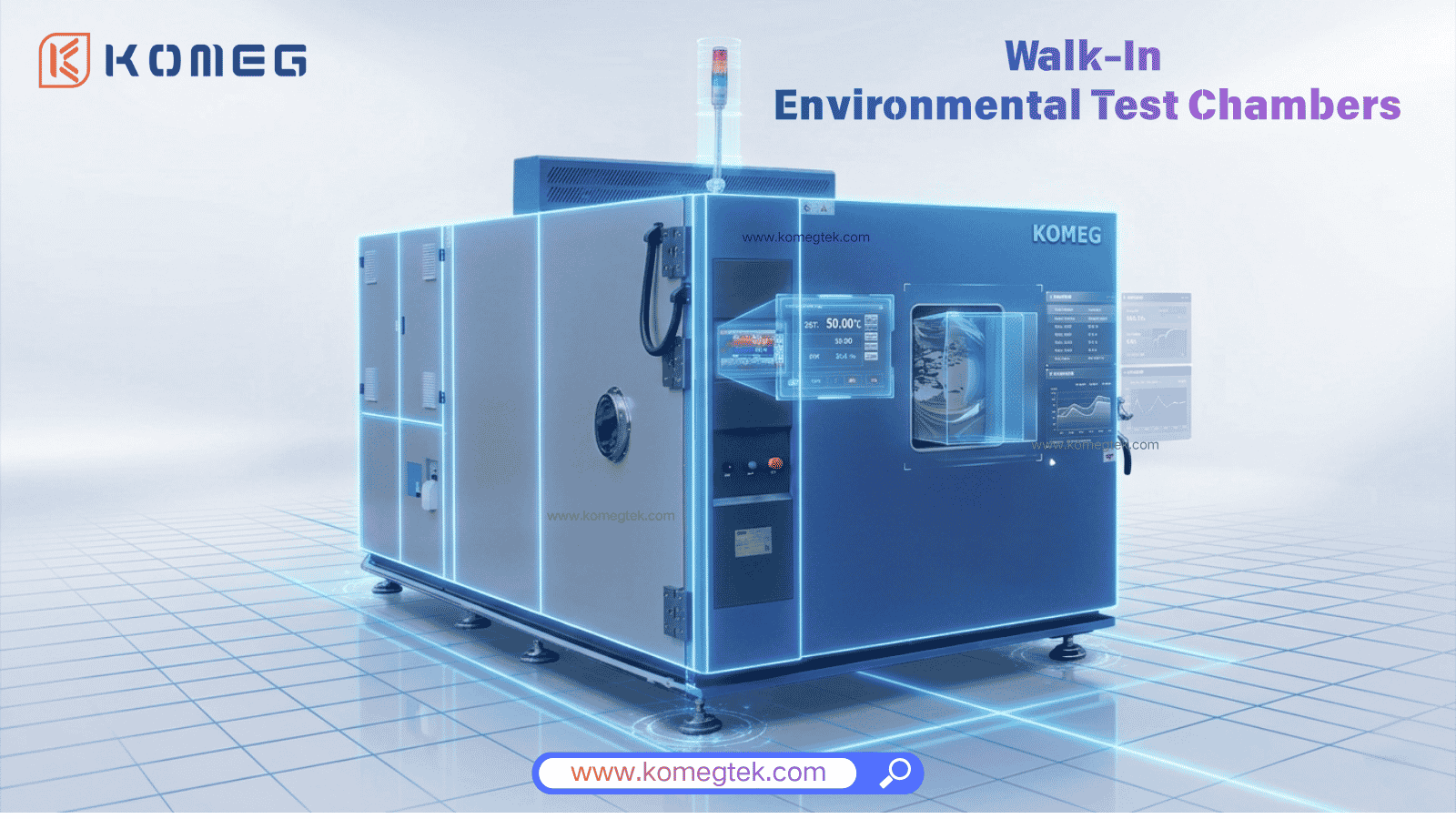
This is where walk-in Environmental Test Chambers play a critical role.
A walk-in Environmental Test Chamber is a large environmental testing system designed to simulate controlled temperature, humidity, altitude, or thermal cycling conditions within a spacious room-sized environment. Unlike standard test chambers, walk-in chambers allow operators to physically enter the chamber and test oversized products or large batches under highly controlled environmental conditions.
Modern walk-in Environmental Test Chambers are widely used for:
- Battery testing
- EV component testing
- Semiconductor reliability testing
- Aerospace validation
- Automotive testing
- Electronics reliability testing
- ESS testing
- Aging and burn-in testing
- Military environmental simulation
This guide explains everything you need to know about walk-in Environmental Test Chambers, including working principles, chamber types, applications, refrigeration systems, airflow design, humidity control, testing standards, common problems, and how to choose the right system for your application.
What Is a Walk-In Environmental Test Chamber?
A walk-in Environmental Test Chamber is a large-scale environmental simulation room that creates precisely controlled climatic conditions for testing products under various environmental stresses.
Unlike small laboratory chambers, walk-in chambers provide enough internal space for:
- Large products
- Complete assemblies
- Multiple test samples
- Vehicle components
- Battery packs
- Industrial equipment
- Full-system validation
Walk-in chambers can be configured as:
- Temperature chambers
- Temperature humidity chambers
- ESS chambers
- Thermal cycling chambers
- Altitude chambers
- Battery explosion-proof chambers
KOMEG manufactures both modular panel walk-in chambers and fully welded solid walk-in chambers for industrial environmental testing applications.
How Walk-In Environmental Test Chambers Work
Walk-in Environmental Test Chambers operate by controlling multiple environmental systems simultaneously to simulate real-world climatic conditions.
The chamber integrates several core systems:
- Refrigeration system
- Heating system
- Humidity control system
- Airflow circulation system
- Insulation structure
- PID control system
- Safety protection system
These systems work together to maintain precise environmental conditions throughout the chamber workspace.
Refrigeration System
The refrigeration system removes heat from the chamber to achieve low-temperature conditions.
Most industrial walk-in chambers use:
- Mechanical compression refrigeration
- Cascade refrigeration systems
- Air-cooled or water-cooled condensers
KOMEG walk-in chambers support temperature ranges from high temperature conditions down to ultra-low temperatures such as -60°C.
Advanced refrigeration systems improve:
- Cooling speed
- Temperature stability
- Energy efficiency
- Long-term operational reliability
Heating System
The heating system raises the chamber temperature for high-temperature testing.
Industrial-grade heaters combined with PID algorithms help maintain:
- Stable temperature control
- Fast response speed
- Minimal overshoot
- Accurate thermal cycling
Humidity Control System
Walk-in temperature humidity chambers use humidification and dehumidification systems to maintain controlled moisture levels.
Typical humidity ranges may reach:
- 20%RH to 98%RH
Humidity control is essential for:
- Semiconductor testing
- Corrosion testing
- Electronics reliability
- Battery validation
KOMEG walk-in chambers support precise humidity control with humidity fluctuation as low as ±2.0%RH.
Airflow Circulation System
Airflow design is one of the most important engineering aspects of a walk-in chamber.
The airflow system distributes conditioned air evenly throughout the chamber to ensure:
- Temperature uniformity
- Humidity consistency
- Stable environmental conditions
Poor airflow design may create:
- Hot spots
- Cold spots
- Condensation areas
- Uneven stress conditions
Advanced airflow engineering and CFD optimization are often used to improve chamber performance.
Types of Walk-In Environmental Test Chambers
Walk-in chambers are available in multiple configurations depending on testing requirements.
Walk-In Temperature Chambers
These chambers perform high- and low-temperature testing without humidity control.
Applications include:
- Thermal aging
- Temperature cycling
- Component validation
- Material testing
Walk-In Temperature Humidity Chambers
These chambers combine temperature and humidity control for comprehensive climatic testing.
Applications include:
- Electronics testing
- Semiconductor reliability
- Automotive testing
- Battery testing
KOMEG walk-in temperature humidity chambers support programmable control, customized configurations, and explosion-proof options for battery testing.
Walk-In ESS Chambers
Environmental Stress Screening (ESS) chambers accelerate defect detection by exposing products to thermal stress.
ESS chambers are commonly used for:
- Electronics manufacturing
- Military equipment
- Aerospace systems
- Automotive electronics
KOMEG walk-in ESS chambers support rapid temperature changes and customized screening configurations.
Walk-In Thermal Cycle Chambers
Thermal cycle chambers repeatedly expose products to alternating high and low temperatures.
Applications include:
- Thermal fatigue testing
- Automotive component testing
- Semiconductor package validation
KOMEG walk-in thermal cycle chambers support both air-cooled and water-cooled refrigeration systems.
Walk-In Altitude Chambers
Altitude chambers simulate low-pressure high-altitude environments.
These chambers are widely used in:
- Aerospace testing
- Aviation systems
- Drone testing
- Military applications
KOMEG walk-in altitude chambers support combined temperature, humidity, and altitude testing.
Walk-In Chambers for Battery Testing
Battery testing is one of the fastest-growing applications for walk-in Environmental Test Chambers.
Large EV battery packs and energy storage systems require spacious environmental testing rooms with advanced safety systems.
Battery walk-in chambers often include:
- Explosion-proof windows
- Pressure relief ports
- Gas detectors
- Smoke detectors
- Fire suppression systems
KOMEG battery walk-in chambers support customizable safety configurations for lithium battery testing.
Semiconductor Applications of Walk-In Chambers
Semiconductor reliability testing increasingly requires large environmental testing systems.
Applications include:
- IC package validation
- Burn-in testing
- Reliability aging
- Thermal cycling
- Humidity testing
Walk-in chambers provide stable environmental conditions for high-volume semiconductor testing and accelerated reliability evaluation.
Walk-In Chambers for Automotive Testing
Automotive components must withstand harsh environmental conditions during long-term operation.
Walk-in chambers are commonly used for testing:
- EV systems
- Automotive electronics
- Sensors
- Batteries
- Wiring harnesses
- Control systems
Automotive testing standards often require:
- High-low temperature cycling
- Humidity testing
- Rapid thermal transitions
- Long-duration aging
Walk-In Chambers for Drone Testing
Drone manufacturers use walk-in chambers to evaluate UAV performance under extreme environmental conditions.
KOMEG has developed custom walk-in chambers for drone testing with large internal spaces and programmable temperature humidity control.
Typical drone testing conditions include:
- High temperature
- Low temperature
- Humidity exposure
- Altitude simulation
Key Performance Parameters of Walk-In Chambers
Several parameters determine the performance of a walk-in Environmental Test Chamber.
Temperature Range
Common temperature ranges include:
- -70°C to +150°C
- -40°C to +150°C
- -20°C to +85°C
The required range depends on industry standards and product applications.
Temperature Uniformity
Temperature uniformity refers to consistency throughout the workspace.
Typical specifications include:
- ≤2.0°C uniformity
- ±0.5°C fluctuation
Uniform airflow distribution is essential for achieving stable thermal conditions.
Humidity Range
Temperature humidity chambers commonly support:
- 20%RH to 98%RH
Precise humidity control is critical for moisture-related reliability testing.
Ramp Rate
Ramp rate refers to heating and cooling speed.
Rapid temperature change chambers may support:
- 3°C/min
- 5°C/min
- 10°C/min or higher
Higher ramp rates require advanced refrigeration and airflow systems.
Walk-In Chamber Construction and Design
Walk-in chambers typically use modular insulated panel construction.
Common materials include:
- SUS304 stainless steel
- Galvanized steel
- Polyurethane insulation panels
KOMEG walk-in chambers use rigid polyurethane foam insulation and stainless steel interior structures for durability and thermal stability.
Modular vs Solid Walk-In Chambers
There are two main structural designs for walk-in chambers.
Modular Panel Chambers
Modular chambers use insulated panels for flexible installation and transportation.
Advantages include:
- Easy assembly
- Expandable design
- Faster installation
- Lower transportation cost
Solid Welded Chambers
Solid chambers use fully welded structures for enhanced durability and high-temperature applications.
These chambers are suitable for:
- Large industrial systems
- High-temperature environments
- Permanent installations
KOMEG manufactures both panel-type and solid-type walk-in chambers.
Common Problems in Walk-In Environmental Test Chambers
Large Environmental Test Chambers may encounter several operational issues over time.
Common problems include:
- Temperature fluctuation
- Humidity instability
- Frost accumulation
- Refrigeration failure
- Airflow imbalance
- Condensation
- Sensor drift
Most problems are related to:
- Improper maintenance
- Poor airflow design
- Refrigeration system issues
- Excessive test loads
Preventive maintenance is essential for stable long-term performance.
Energy Efficiency in Walk-In Chambers
Because of their large size, walk-in chambers consume significant amounts of energy.
Modern systems now incorporate:
- Variable-frequency compressors
- Intelligent refrigeration control
- Energy-saving airflow systems
- Eco-friendly refrigerants
KOMEG walk-in chambers support intelligent energy-saving refrigeration control to reduce operational energy consumption.
Industry Standards for Walk-In Environmental Testing
Walk-in chambers are commonly used for testing according to international standards such as:
- IEC 60068
- MIL-STD-810
- ISO 16750
- JEDEC
- AEC-Q100
These standards define environmental conditions for:
- Temperature testing
- Humidity testing
- Thermal cycling
- Reliability validation
How to Choose the Right Walk-In Environmental Test Chamber
Selecting the correct walk-in chamber depends on several factors.
Important considerations include:
- Product size
- Temperature range
- Humidity requirements
- Cooling rate
- Test standards
- Safety requirements
- Chamber installation space
- Energy consumption
Applications such as battery testing and semiconductor testing often require highly customized configurations.
Future Trends in Walk-In Environmental Test Chambers
Environmental testing technology continues to evolve rapidly.
Future trends include:
- Intelligent automation
- Remote monitoring
- AI-based diagnostics
- Energy-efficient refrigeration
- Eco-friendly refrigerants
- Smart airflow optimization
- Advanced safety systems
As reliability testing requirements become more demanding, walk-in Environmental Test Chambers will continue becoming more advanced and specialized.
Walk-in Environmental Test Chambers play a vital role in modern product reliability testing and environmental simulation.
From automotive systems and batteries to semiconductors and aerospace applications, these chambers provide the large-scale controlled environments necessary for accurate environmental validation.
Advanced walk-in chambers integrate sophisticated refrigeration systems, airflow engineering, humidity control technologies, and intelligent PID control systems to achieve stable and repeatable testing conditions.
As industries continue demanding higher reliability and stricter environmental validation, high-performance walk-in Environmental Test Chambers are becoming increasingly important across global manufacturing sectors.
For companies seeking customized large-scale environmental testing solutions, selecting a reliable walk-in chamber manufacturer with strong engineering capabilities and industry experience is essential.
Learn more about KOMEG walk-in Environmental Test Chamber solutions: