

Environmental test chambers are widely used in industries such as electronics, automotive, aerospace, semiconductors, batteries, telecommunications, and scientific research to simulate controlled temperature and humidity conditions. These chambers play a critical role in reliability testing, quality verification, accelerated aging, and product validation.
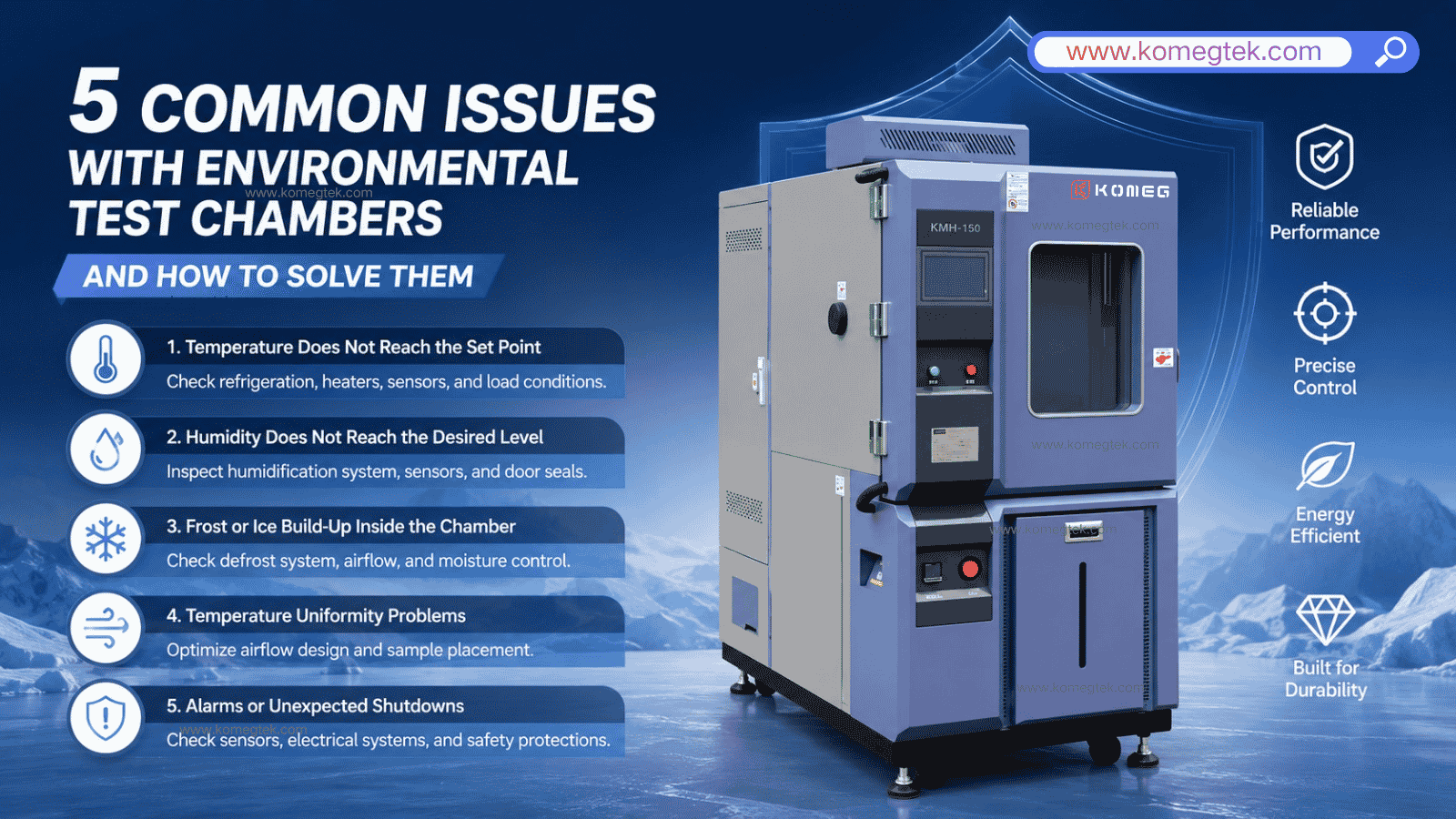
However, even high-performance environmental chambers may encounter operational issues over time. Problems such as unstable temperature, humidity control failure, frosting, airflow imbalance, or refrigeration abnormalities can significantly affect testing accuracy and reliability.
When environmental chamber issues are not addressed promptly, they may lead to:
- Inaccurate test results
- Product validation failure
- Production delays
- Increased maintenance costs
- Reduced equipment lifespan
- Failed compliance testing
Understanding the root causes of these issues is essential for maintaining stable chamber performance and ensuring repeatable testing conditions.
This article explores five of the most common environmental test chamber problems, their causes, troubleshooting methods, and practical solutions for improving long-term reliability and operational stability.
1. Temperature Does Not Reach the Set Point
One of the most common environmental chamber problems is the inability to achieve the target temperature.
This issue may occur during both heating and cooling operations. In some cases, the chamber temperature rises or drops very slowly. In other situations, the system may stop before reaching the programmed set point.
This problem directly affects testing accuracy and may interrupt critical validation procedures.
Possible Causes
Several factors may cause insufficient temperature performance.
Refrigeration System Problems
For low-temperature testing, refrigeration system issues are among the most common causes.
Potential refrigeration-related problems include:
- Refrigerant leakage
- Compressor malfunction
- Blocked condenser
- Expansion valve failure
- Insufficient cooling capacity
If the refrigeration system cannot remove heat efficiently, the chamber may fail to achieve low-temperature conditions.
Heater Failure
In high-temperature testing, damaged heating elements or electrical control failures may prevent the chamber from reaching elevated temperatures.
Common heating problems include:
- Burned-out heaters
- Faulty solid-state relays
- Loose electrical wiring
- PID control abnormalities
Excessive Test Load
Large or high-thermal-mass samples may absorb significant amounts of heat, slowing the chamber’s thermal response.
Improper sample placement may also block airflow circulation, reducing heating and cooling efficiency.
Solutions
To solve temperature control problems:
- Inspect refrigeration pressure and refrigerant levels
- Clean the condenser regularly
- Check compressor operation
- Verify heater resistance and electrical connections
- Reduce excessive test loads
- Improve airflow circulation around samples
- Calibrate temperature sensors and PID parameters
Preventive maintenance is essential for stable long-term temperature performance.
2. Humidity Does Not Reach the Desired Level
Humidity instability is another frequently reported issue in environmental chambers.
Users may observe:
- Humidity lower than the set value
- Slow humidity response
- Excessive fluctuation
- Unstable humidity readings
Humidity control problems are especially critical in semiconductor, electronics, and battery reliability testing.
Possible Causes
Humidification System Failure
Humidity generation systems may experience issues such as:
- Low water supply
- Damaged humidifiers
- Blocked steam pipes
- Water pump failure
Without proper moisture generation, the chamber cannot maintain the desired humidity level.
Sensor Inaccuracy
Humidity sensors naturally drift over time.
Aging or contaminated sensors may provide inaccurate feedback to the controller, causing unstable humidity regulation.
Air Leakage
Door seal leakage can allow moisture to escape or external air to enter the chamber.
This significantly affects humidity stability, especially during high-humidity testing.
Improper Airflow Design
Poor airflow circulation may create uneven humidity distribution inside the chamber.
Localized dry zones or condensation regions may develop if air circulation is insufficient.
Solutions
To improve humidity performance:
- Inspect humidification components
- Use purified water
- Replace aging humidity sensors
- Check the door gasket sealing
- Optimize airflow circulation
- Clean humidification pipelines regularly
- Calibrate humidity control systems periodically
Stable humidity control requires proper coordination between refrigeration, heating, airflow, and humidification systems.
3. Frost or Ice Build-Up Inside the Chamber
Frost accumulation is a common issue during low-temperature testing.
Ice may appear on:
- Evaporators
- Air ducts
- Chamber walls
- Sample surfaces
Excessive frost reduces airflow efficiency and negatively affects cooling performance.
Possible Causes
Moisture Intrusion
Frequent door opening introduces humid ambient air into the chamber.
When moisture contacts cold surfaces, condensation and frost formation occur.
Defrost System Failure
Many environmental chambers use automatic defrost systems.
If the defrost cycle malfunctions, ice accumulation may continue over time.
Poor Airflow Circulation
Insufficient airflow may create cold spots where moisture freezes more easily.
Blocked airflow also reduces evaporator heat exchange efficiency.
High Humidity Testing at Low Temperatures
Operating under high humidity and low temperature simultaneously naturally increases frost formation risk.
Solutions
To reduce frost build-up:
- Minimize unnecessary door opening
- Check defrost heater operation
- Inspect airflow circulation fans
- Clean evaporator surfaces
- Verify drain line functionality
- Optimize humidity programming conditions
Proper chamber sealing and airflow design are critical for frost prevention.
4. Temperature Uniformity Problems
Temperature uniformity refers to the consistency of temperature distribution throughout the chamber workspace.
Poor temperature uniformity can create hot spots and cold spots that compromise testing reliability.
This issue becomes especially important for:
- Semiconductor testing
- Automotive electronics
- Aerospace components
- Large sample testing
Possible Causes
Airflow Imbalance
Airflow design is one of the most important factors affecting temperature uniformity.
Uneven circulation may cause certain areas to receive more conditioned air than others.
Improper Sample Placement
Large samples may obstruct airflow paths.
Dense loading arrangements often create localized thermal zones.
Fan Failure
Circulation fans are essential for maintaining consistent airflow distribution.
Damaged or underperforming fans reduce circulation efficiency.
Sensor Location Problems
Improper sensor positioning may cause inaccurate environmental feedback.
The controller may regulate based on localized conditions rather than overall chamber conditions.
Solutions
To improve temperature uniformity:
- Optimize airflow duct design
- Avoid blocking air outlets and returns
- Distribute test samples evenly
- Inspect the circulation fan performance
- Use CFD-optimized airflow systems
- Recalibrate chamber sensors
Uniform airflow distribution is essential for reliable environmental testing.
5. Environmental Chamber Alarms or Unexpected Shutdowns
Unexpected alarms or automatic shutdowns can interrupt testing and reduce productivity.
Modern environmental chambers include multiple protection systems to prevent equipment damage and ensure operator safety.
Possible Causes
Overtemperature Protection
Excessive chamber temperature may trigger safety shutdowns.
Possible causes include:
- Heater relay failure
- PID malfunction
- Sensor abnormalities
Compressor Overload
High compressor temperature or pressure may activate overload protection.
Common reasons include:
- Dirty condenser
- Refrigerant imbalance
- Poor ventilation
Electrical Problems
Voltage instability or electrical component failure may cause abnormal alarms.
Sensor Failure
Broken or disconnected sensors may trigger system faults.
Solutions
To resolve chamber alarms:
- Inspect alarm history records
- Check the electrical supply stability
- Clean condenser systems
- Verify sensor operation
- Inspect safety protection devices
- Perform routine preventive maintenance
Never bypass chamber protection systems without identifying the root cause.
The Importance of Preventive Maintenance
Many environmental chamber problems can be prevented through regular maintenance.
Preventive maintenance improves:
- Equipment reliability
- Temperature stability
- Humidity accuracy
- Energy efficiency
- Component lifespan
Routine maintenance tasks should include:
- Cleaning condensers
- Inspecting airflow systems
- Checking refrigerant pressure
- Calibrating sensors
- Verifying door sealing
- Testing safety systems
A well-maintained environmental chamber delivers more stable and repeatable testing performance.
How Advanced Chamber Design Reduces Common Problems
Modern environmental chambers incorporate advanced engineering technologies to reduce operational issues.
These technologies may include:
- Intelligent PID control systems
- CFD airflow optimization
- Cascade refrigeration systems
- Variable-frequency compressors
- Advanced humidity control algorithms
- Automatic fault diagnostics
Well-designed chambers provide improved stability, faster response, and lower maintenance requirements.
Environmental test chambers are highly sophisticated systems that depend on the coordination of refrigeration, airflow, heating, humidity control, sensors, and intelligent control systems.
Issues such as temperature instability, humidity problems, frosting, poor uniformity, and unexpected alarms can significantly affect testing accuracy and operational efficiency.
Understanding the root causes of these problems is essential for maintaining reliable environmental testing performance.
With proper maintenance, optimized chamber design, and timely troubleshooting, most environmental chamber issues can be effectively prevented or resolved.
Looking for reliable environmental test chambers with advanced control systems and stable long-term performance?
Contact KOMEG today to explore customized environmental testing solutions for demanding industrial applications.