

Environmental chambers play a critical role in reliability testing, product validation, and environmental simulation across industries such as electronics, semiconductors, automotive, aerospace, batteries, and materials research. These chambers are designed to create controlled temperature and humidity conditions that simulate real-world environments.
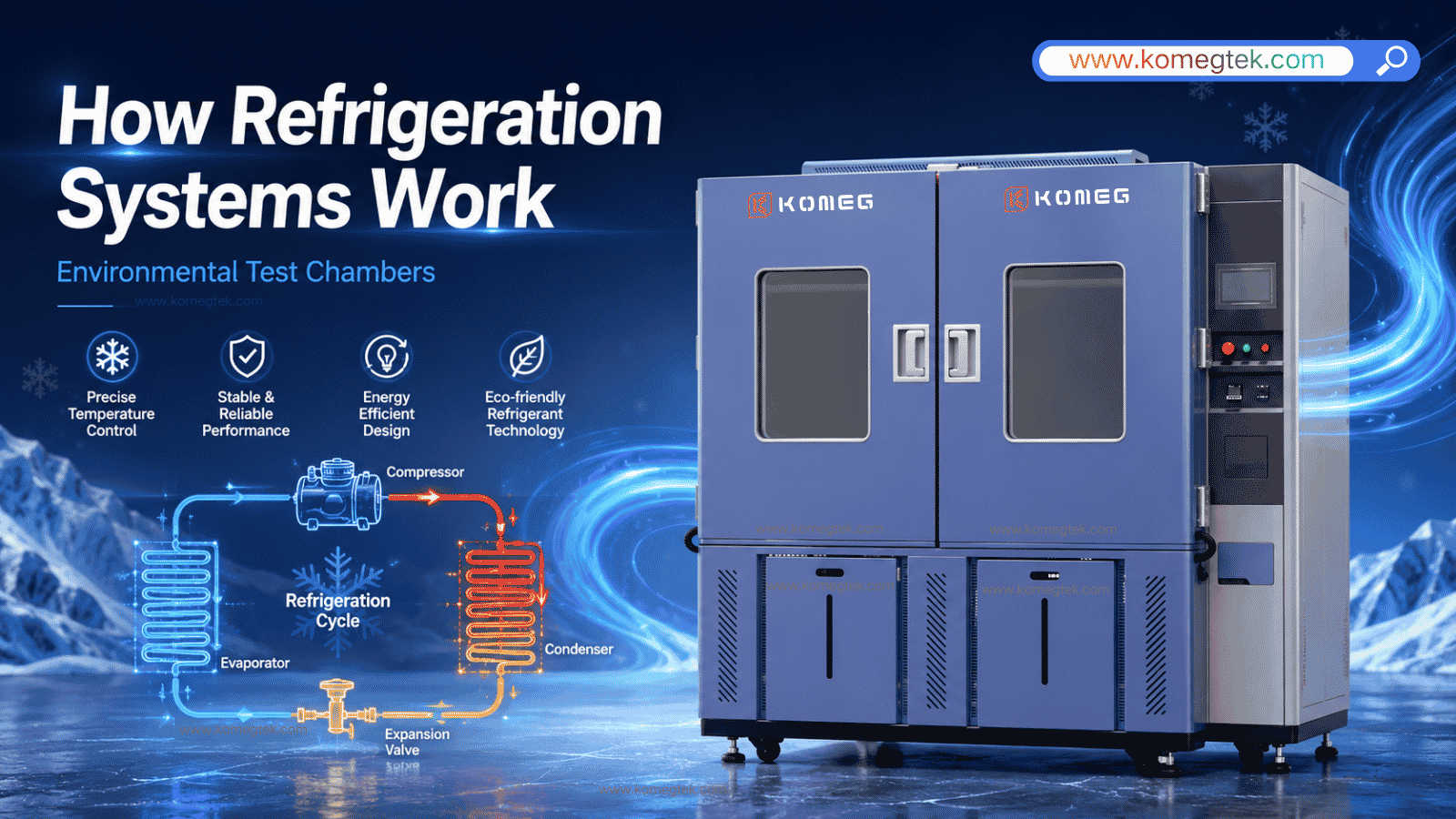
Among all core technologies inside an environmental chamber, the refrigeration system is one of the most important and technically complex components. It directly determines the chamber’s cooling capability, temperature stability, pull-down speed, temperature uniformity, energy efficiency, and long-term operational reliability.
Without a properly designed refrigeration system, an environmental chamber cannot achieve stable low-temperature performance or maintain demanding thermal cycling conditions.
This article provides a detailed engineering-level explanation of how refrigeration systems work in environmental chambers, including their operating principles, major components, refrigeration cycles, system configurations, and the latest technological developments in the industry.
Why Refrigeration Systems Are Important in Environmental Chambers
The refrigeration system is responsible for removing heat from the chamber workspace to achieve and maintain low temperatures.
Environmental testing often requires extreme temperature conditions, such as:
- Low-temperature storage testing
- Thermal cycling
- Rapid temperature change testing
- Temperature humidity testing
- Thermal shock testing
To simulate these environments accurately, the refrigeration system must continuously extract heat from the chamber while compensating for heat entering from multiple sources, including:
- Ambient surroundings
- Internal heaters
- Test samples
- Fans and motors
- Humidification systems
The refrigeration system must maintain stable performance even during rapid temperature transitions and long-duration testing cycles.
Basic Principles of Refrigeration
Environmental chambers typically use vapor-compression refrigeration systems.
The fundamental principle of refrigeration is heat transfer. Instead of “creating cold,” the refrigeration system removes heat from the chamber interior and transfers it to the external environment.
This process is achieved through the continuous circulation of refrigerant within a closed-loop system.
The refrigeration cycle involves four primary processes:
- Compression
- Condensation
- Expansion
- Evaporation
Together, these processes allow the system to absorb heat from the chamber and release it outside.
The Main Components of a Refrigeration System
Compressor
The compressor is often referred to as the heart of the refrigeration system.
Its primary function is to compress low-pressure refrigerant vapor into high-pressure, high-temperature gas.
This compression increases the refrigerant’s pressure and temperature, enabling it to release heat effectively in the condenser.
Environmental chambers may use different types of compressors depending on performance requirements, including:
- Hermetic compressors
- Semi-hermetic compressors
- Scroll compressors
- Reciprocating compressors
The compressor directly influences cooling capacity, system efficiency, and operational stability.
Condenser
After compression, the refrigerant enters the condenser.
The condenser’s role is to release heat absorbed from the chamber plus the heat generated during compression.
As heat is removed, the high-pressure refrigerant gas condenses into liquid form.
Environmental chambers are commonly used:
- Air-cooled condensers
- Water-cooled condensers
Efficient condenser performance is critical for maintaining stable refrigeration operation and reducing energy consumption.
Expansion Valve
The expansion valve controls refrigerant flow into the evaporator.
When refrigerant passes through the expansion valve, its pressure drops rapidly, causing a significant temperature decrease.
This low-temperature refrigerant is then ready to absorb heat inside the evaporator.
Precise expansion valve control is essential for stable cooling performance and system efficiency.
Evaporator
The evaporator is the component where actual cooling occurs.
Inside the evaporator, low-pressure refrigerant absorbs heat from the chamber air and evaporates into gas.
As heat is removed from the chamber, the internal temperature decreases.
The evaporator works closely with the chamber airflow system to distribute cooling evenly throughout the workspace.
Proper evaporator design is essential for:
- Temperature uniformity
- Cooling efficiency
- Frost prevention
- Stable airflow circulation
How the Refrigeration Cycle Works Step by Step
The refrigeration cycle begins when low-pressure refrigerant vapor enters the compressor.
The compressor increases the refrigerant pressure and temperature before sending it to the condenser.
Inside the condenser, the refrigerant releases heat to the surrounding environment and transforms into high-pressure liquid.
The liquid refrigerant then passes through the expansion valve, where pressure drops suddenly, producing a low-temperature refrigerant mixture.
This cold refrigerant enters the evaporator and absorbs heat from the chamber air. As heat is absorbed, the refrigerant evaporates into vapor again.
The vapor returns to the compressor, and the cycle repeats continuously.
This continuous circulation enables the chamber to maintain precise low-temperature conditions.
Single-Stage vs Cascade Refrigeration Systems
Environmental chambers use different refrigeration configurations depending on the required temperature range.
Single-Stage Refrigeration Systems
Single-stage systems are typically used for moderately low-temperature applications.
They are suitable for temperature ranges such as:
- 0°C
- -20°C
- -40°C
Single-stage systems are relatively simple, compact, and energy efficient.
However, their cooling capability becomes limited at extremely low temperatures.
Cascade Refrigeration Systems
For ultra-low-temperature applications, environmental chambers often use cascade refrigeration systems.
Cascade systems combine two independent refrigeration circuits:
- High-stage refrigeration system
- Low-stage refrigeration system
The high-stage system cools the condenser of the low-stage system, allowing the chamber to achieve much lower temperatures.
Cascade refrigeration is commonly used for:
- -70°C testing
- -80°C testing
- Thermal shock chambers
Although more complex, cascade systems provide superior low-temperature performance and stability.
Refrigeration Systems in Temperature Humidity Chambers
Temperature-humidity chambers present additional refrigeration challenges.
The refrigeration system must not only cool the chamber but also work together with the humidity control system.
During humidity testing, the evaporator often performs dehumidification by condensing moisture from the air.
This interaction requires careful balancing between:
- Cooling
- Heating
- Humidification
- Dehumidification
Improper refrigeration control can cause:
- Humidity instability
- Excessive condensation
- Frost formation
- Temperature fluctuations
Advanced control systems are essential for maintaining stable temperature and humidity simultaneously.
Rapid Temperature Change Chambers and Refrigeration Performance
Rapid temperature change chambers place extremely high demands on refrigeration systems.
These chambers may require ramp rates of:
- 5°C/min
- 10°C/min
- 15°C/min
- Even higher
To achieve such performance, the refrigeration system must provide:
- High cooling capacity
- Fast thermal response
- Efficient airflow circulation
- Stable compressor operation
Advanced refrigeration engineering becomes critical in high-speed thermal cycling applications.
Thermal Shock Chambers and Dual-Zone Refrigeration
Thermal shock chambers use a different refrigeration approach.
Instead of gradually changing temperature, thermal shock chambers rapidly transfer test samples between hot and cold zones.
The cold zone refrigeration system must maintain extremely stable low temperatures even during repeated thermal loading.
This requires:
- High refrigeration stability
- Fast recovery performance
- Optimized airflow management
- Precise thermal balance
Thermal shock applications are among the most demanding refrigeration scenarios in environmental testing.
Common Refrigeration Problems in Environmental Chambers
Refrigeration systems may experience various operational issues over time.
Common problems include:
- Insufficient cooling capacity
- Slow pull-down speed
- Compressor overheating
- Frost accumulation
- Refrigerant leakage
- Temperature instability
- High energy consumption
Many of these issues are related to:
- Poor maintenance
- Improper airflow
- Refrigerant imbalance
- Condenser contamination
- Expansion valve malfunction
Early diagnosis and preventive maintenance are essential for reliable operation.
The Role of Airflow in Refrigeration Efficiency
The refrigeration system and airflow system are closely interconnected.
Even a powerful refrigeration system cannot achieve stable chamber performance without proper airflow distribution.
Airflow affects:
- Heat transfer efficiency
- Temperature uniformity
- Cooling response speed
- Frost prevention
- Sensor accuracy
Modern environmental chambers use optimized airflow systems to maximize refrigeration efficiency and environmental stability.
Energy Efficiency and Modern Refrigeration Technology
Energy efficiency has become increasingly important in environmental chamber design.
Traditional refrigeration systems often consume large amounts of electricity, especially during low-temperature or rapid cycling operation.
Modern environmental chambers now incorporate technologies such as:
- Variable-frequency compressors
- Intelligent refrigeration control
- Electronic expansion valves
- Optimized heat exchangers
- CFD airflow optimization
These technologies improve efficiency while reducing operational costs.
CO₂ Refrigeration Technology in Environmental Chambers
As global environmental regulations become stricter, the industry is shifting toward environmentally friendly refrigerants.
CO₂ refrigerant, also known as R744, has gained significant attention due to its ultra-low Global Warming Potential (GWP).
Compared with traditional refrigerants, CO₂ systems offer:
- Lower environmental impact
- Improved sustainability
- Regulatory compliance
- Future-ready refrigeration solutions
CO₂ refrigeration technology is becoming an important trend in next-generation environmental chambers.
Choosing the Right Refrigeration System for Environmental Testing
Selecting the appropriate refrigeration system depends on multiple factors, including:
- Required temperature range
- Cooling rate
- Chamber size
- Test load
- Humidity requirements
- Energy efficiency goals
Applications such as semiconductor reliability testing, battery testing, and aerospace validation often require advanced refrigeration configurations to ensure stable and repeatable testing conditions.
Understanding refrigeration system design helps users choose equipment that meets both current and future testing demands.
Conclusion
The refrigeration system is one of the most critical technologies in environmental chambers. It determines the chamber’s ability to achieve accurate low-temperature control, stable thermal performance, and reliable environmental simulation.
From compressors and evaporators to cascade refrigeration and advanced energy-saving technologies, every aspect of refrigeration engineering directly influences testing performance and reliability.
As environmental testing requirements continue to evolve, refrigeration systems are becoming more sophisticated, efficient, and environmentally sustainable.
Looking for high-performance environmental test chambers with advanced refrigeration technology?
Contact KOMEG today to explore customized testing solutions designed for demanding industrial applications.