

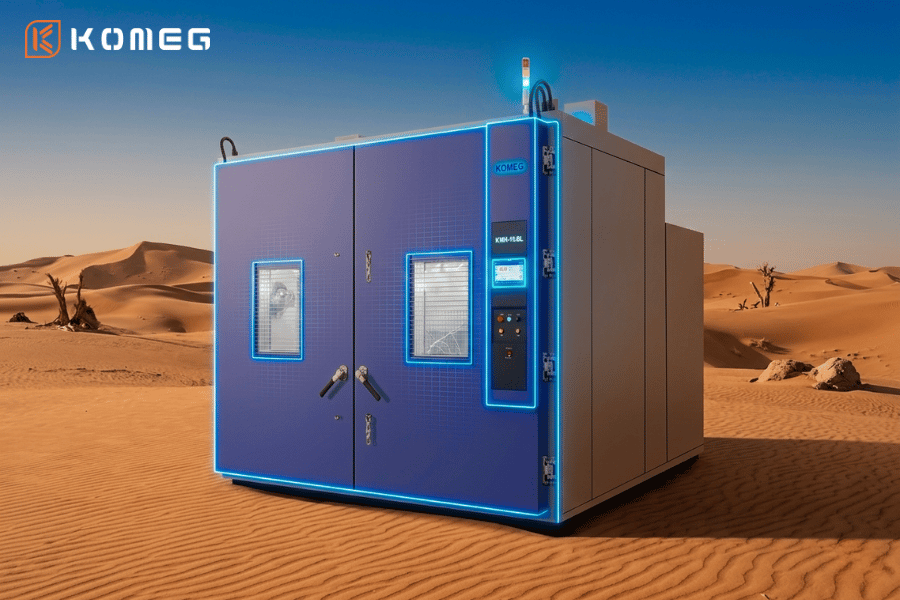
Accurate humidity control is a fundamental requirement in environmental testing, especially for industries such as semiconductors, automotive electronics, aerospace, and materials engineering. Test standards and reliability validation procedures often require strict humidity conditions to simulate real-world environments.
However, one of the most frequently reported issues in environmental chambers is the inability to reach or maintain the programmed humidity setpoint. This problem not only affects test accuracy but can also lead to repeated test failures, extended validation cycles, and increased operational costs.
This article provides a comprehensive engineering-level analysis of why humidity cannot reach the set value in a temperature-humidity chamber, along with practical troubleshooting strategies and long-term solutions.
Understanding the Fundamentals of Humidity Control
Before diagnosing the problem, it is essential to understand how humidity is controlled inside a chamber.
Humidity in environmental testing is typically expressed as relative humidity (RH), which represents the ratio of actual water vapor content in the air to the maximum amount the air can hold at a given temperature.
This relationship makes humidity control inherently dependent on temperature. As the temperature increases, the air’s capacity to hold moisture rises significantly. As a result, achieving high relative humidity at elevated temperatures requires a much greater amount of water vapor.
In practical terms, a chamber must balance three core systems simultaneously:
The humidification system, which introduces moisture
The heating system, which raises the temperature
The cooling system, which can remove moisture through condensation
Any imbalance among these systems can prevent humidity from reaching the desired level.
Primary Causes of Humidity Not Reaching the Set Value
Insufficient Humidification Capacity Under High-Temperature Conditions
The most critical factor affecting humidity performance is whether the humidification system can supply enough moisture for the target condition.
At elevated temperatures, especially above 60°C or in common test points such as 85°C / 85% RH, the demand for water vapor increases exponentially. If the steam generator or humidification unit is undersized, scaled, or partially malfunctioning, it will not be able to keep up with the demand.
In many cases, the chamber may reach a plateau where humidity stabilizes below the setpoint. This is not a control issue but a capacity limitation.
Air Leakage and Chamber Sealing Integrity
Humidity is extremely sensitive to leakage. Even minor air exchange between the chamber interior and the external environment can significantly reduce humidity levels.
Leakage typically occurs at door seals, cable ports, or structural joints. Over time, sealing materials may degrade, harden, or deform, reducing their effectiveness.
When leakage occurs, moisture continuously escapes, and the humidification system must work harder just to maintain equilibrium. If the leakage rate exceeds the humidification capacity, the setpoint will never be reached.
Thermodynamic Limitations at High Temperature
A critical but often overlooked factor is the thermodynamic relationship between temperature and humidity.
At higher temperatures, the saturation vapor pressure increases, meaning the air can hold significantly more moisture. Therefore, to achieve the same relative humidity at higher temperatures, the absolute moisture content must increase substantially.
If the chamber is not designed for high-temperature humidity performance, or if the humidification response is slow, the system will struggle to reach high RH values.
This is why many standard chambers perform well at moderate conditions but fail under demanding test profiles.
Humidity Sensor Drift and Measurement Errors
Accurate measurement is as important as actual performance. Humidity sensors are subject to drift, contamination, and aging over time.
If a sensor becomes inaccurate, it may report a lower humidity value than the actual condition. This can lead to unnecessary adjustments, incorrect troubleshooting, or the false assumption that the chamber is underperforming.
Sensor contamination is especially common in high-humidity environments where condensation or impurities may accumulate on the sensing element.
Control System and PID Tuning Limitations
Modern environmental chambers rely on PID (Proportional-Integral-Derivative) control algorithms to regulate temperature and humidity.
Improper tuning of these parameters can lead to slow response, overshooting, or insufficient output. In some cases, the system may intentionally limit humidification output to prevent condensation or protect internal components.
These control constraints can prevent the chamber from reaching the desired humidity level efficiently.
Interaction Between Cooling and Humidification Systems
The cooling system plays an indirect but critical role in humidity control.
When cooling is active, it can condense water vapor into liquid form, effectively removing moisture from the air. If the cooling system is too aggressive or not properly balanced with humidification, it can counteract the humidification process.
This creates a situation where moisture is continuously added and removed at the same time, preventing humidity from increasing.
Impact of Test Samples and Load Conditions
The presence of test samples inside the chamber can significantly influence humidity performance.
Materials such as plastics, composites, and electronic assemblies can absorb moisture. This absorption reduces the amount of free water vapor in the air, slowing down the rise in humidity.
Large or dense loads can also affect airflow and temperature distribution, further complicating humidity control.
In many cases, a chamber may perform well under no-load conditions but fail to reach humidity setpoints when fully loaded.
Systematic Troubleshooting Approach
To effectively diagnose the issue, engineers should follow a structured approach rather than relying on guesswork.
Start by verifying the basic operation of the humidification system. Ensure that the water supply is stable, the steam generator is functioning properly, and no scaling or blockage is present.
Next, evaluate the sealing condition of the chamber. Inspect door gaskets, cable ports, and structural joints for any signs of leakage.
Then, perform a comparative test by lowering the temperature while keeping the same humidity setpoint. If humidity can be achieved at lower temperatures, the issue is likely related to humidification capacity.
Sensor calibration should also be verified using reference instruments to ensure measurement accuracy.
Finally, assess the impact of the test load by comparing empty chamber performance with loaded conditions.
Long-Term Solutions and Preventive Measures
To avoid recurring humidity control issues, it is important to adopt both operational and equipment-level improvements.
Regular maintenance of the humidification system is essential. This includes cleaning the steam generator, using high-quality water to minimize scaling, and inspecting key components such as heating elements and valves.
Periodic calibration of humidity sensors ensures measurement accuracy and reliable control.
From an equipment perspective, selecting a chamber designed for high-performance humidity control is critical. Advanced systems are engineered with sufficient humidification capacity, optimized airflow design, and intelligent control algorithms to handle demanding test conditions.
Choosing the Right Environmental Test Chamber
Not all temperature-humidity chambers are capable of delivering stable performance under high-temperature and high-humidity conditions.
For industries such as semiconductor manufacturing, automotive electronics, and advanced materials testing, it is essential to use equipment that can maintain precise environmental conditions without fluctuation or delay.
Key considerations include humidification capacity, temperature uniformity, control accuracy, and system stability under load conditions.
Investing in the right equipment not only improves test reliability but also reduces long-term operational costs and minimizes the risk of product failure.
The inability of a temperature-humidity chamber to reach the set humidity value is a multifactor issue involving thermodynamics, system capacity, equipment condition, and operational parameters.
By understanding the underlying mechanisms and applying a structured troubleshooting approach, engineers can identify the root cause and implement effective solutions.
Reliable environmental testing depends not only on proper operation but also on the quality and capability of the equipment used.
Facing humidity control challenges in your test chambers? In need of high-performance testing solutions? Contact KOMEG today to explore our customized environmental test chambers, engineered specifically for rigorous applications. Discover >> KOMEG Temperature and Humidity Test Chambers.