

Environmental test chambers are designed to simulate controlled climatic conditions for product reliability testing, quality validation, and research applications. While parameters such as temperature range, humidity control, and cooling capacity often receive the most attention, one critical factor is frequently underestimated: airflow design.
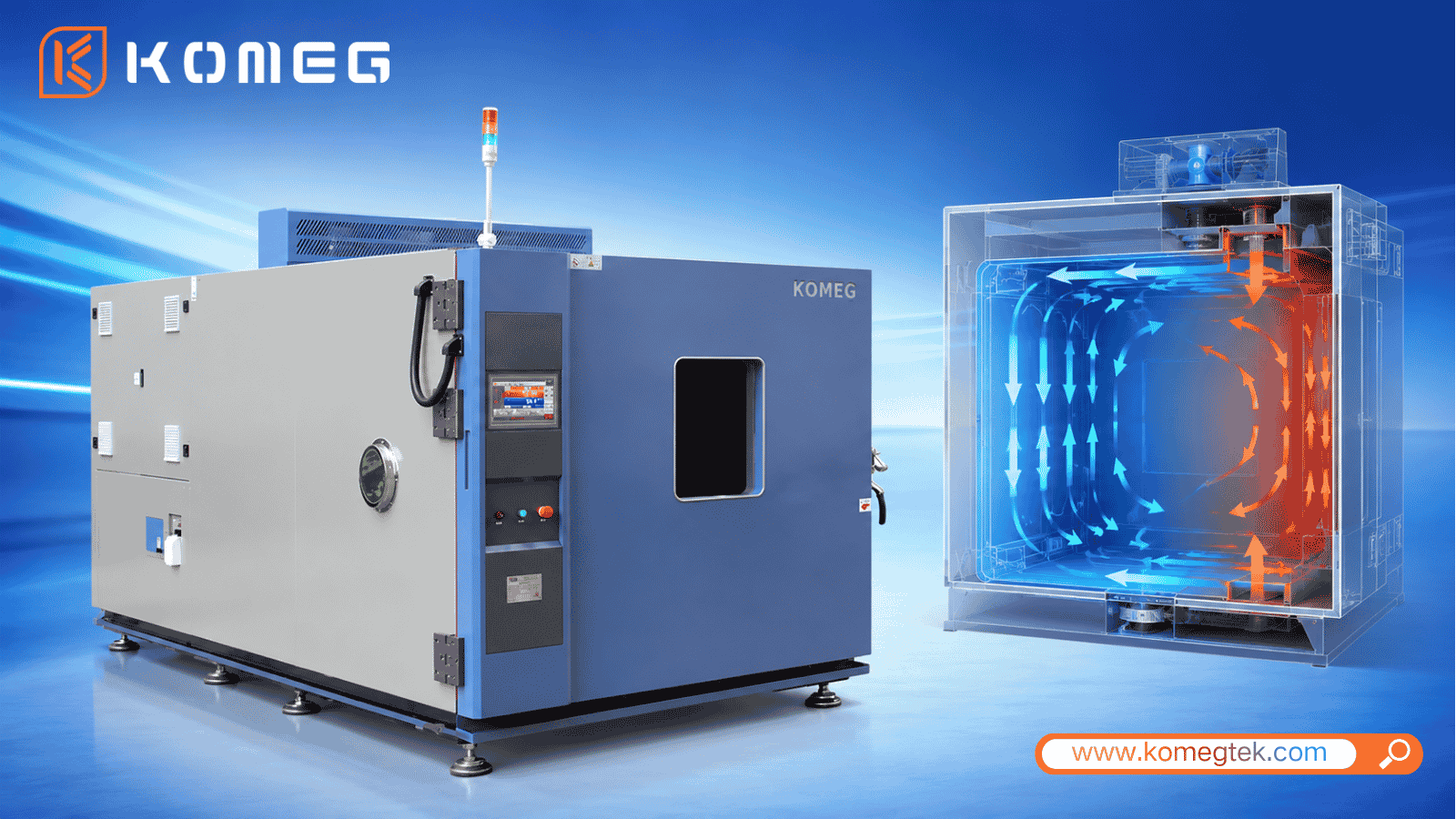
In reality, airflow design is one of the most important engineering elements in an environmental chamber. It directly affects temperature uniformity, humidity stability, heating and cooling efficiency, test repeatability, and even the accuracy of test results.
A poorly designed airflow system can cause uneven temperature distribution, unstable humidity control, excessive fluctuations, condensation problems, and inconsistent testing outcomes. Even a chamber equipped with advanced refrigeration and control systems cannot achieve optimal performance if airflow circulation is inadequate.
This article explores how airflow design affects environmental chamber performance, the engineering principles behind airflow systems, common airflow-related issues, and how advanced chamber design improves testing reliability.
Why Airflow Design Matters in Environmental Testing
The primary purpose of airflow inside an environmental chamber is to ensure that conditioned air is distributed evenly throughout the workspace.
Environmental testing depends on creating a stable and uniform environment. If some areas inside the chamber are hotter, colder, wetter, or drier than others, test samples may experience different conditions at the same time. This leads to unreliable and non-repeatable test results.
Airflow design determines how efficiently air circulates through the chamber and how effectively temperature and humidity are maintained across the entire testing area.
A well-designed airflow system ensures:
- Uniform temperature distribution
- Stable humidity control
- Fast heating and cooling response
- Efficient heat exchange
- Reduced temperature fluctuation
- Consistent testing conditions
- Improved recovery after door opening
Without proper airflow circulation, even high-end chambers may struggle to meet demanding testing standards.
The Basic Principles of Airflow Circulation in Environmental Chambers
Environmental chambers typically operate using forced air circulation.
Air is drawn through a circulation system where it passes across heating elements, cooling coils, humidifiers, or dehumidification systems. The conditioned air is then redistributed into the chamber workspace through specially designed ducts and airflow channels.
The process continuously repeats to maintain stable environmental conditions.
The effectiveness of this circulation depends on several engineering factors, including:
- Fan design and airflow volume
- Air duct structure
- Air outlet and return placement
- Chamber size and geometry
- Load positioning
- Internal airflow resistance
The goal is to create balanced airflow throughout the chamber without dead zones, excessive turbulence, or uneven distribution.
How Airflow Affects Temperature Uniformity
Temperature uniformity is one of the most important performance indicators in environmental testing.
Uniformity refers to how consistent the temperature is across different points inside the chamber. Poor airflow design is one of the leading causes of temperature non-uniformity.
If airflow distribution is uneven, some areas receive more conditioned air than others. This creates hot spots and cold spots inside the chamber.
For example:
- Areas near air outlets may become colder during cooling cycles
- Corners with weak circulation may become warmer
- Large test samples may block airflow paths
These variations may seem small, but even a few degrees of difference can significantly affect sensitive electronic components, semiconductor devices, batteries, or material testing.
Advanced airflow systems are designed to maintain continuous circulation across all areas of the chamber to minimize temperature variation.
The Relationship Between Airflow and Humidity Control
Humidity control is even more sensitive to airflow performance than temperature control.
To maintain stable humidity conditions, moisture must be distributed evenly throughout the chamber. Inadequate airflow can create localized humidity differences and increase the risk of condensation.
Poor circulation often results in:
- Uneven humidity distribution
- Slow humidity response
- Excessive condensation
- Moisture accumulation near walls
- Inaccurate humidity readings
At high-temperature and high-humidity conditions, proper airflow becomes especially critical because moisture distribution requires continuous and balanced circulation.
If airflow velocity is too low, humid air may stagnate in certain areas. If airflow is too aggressive, excessive evaporation or drying may occur.
Optimized airflow design helps maintain stable relative humidity while preventing moisture imbalance inside the chamber.
Airflow Design and Heating/Cooling Efficiency
Airflow directly influences how quickly a chamber can heat up or cool down.
During temperature transitions, conditioned air must transfer thermal energy efficiently to the workspace and test samples. Poor airflow reduces heat transfer efficiency, slowing temperature response.
This problem becomes more significant in rapid temperature change chambers or thermal cycling applications where fast ramp rates are required.
Efficient airflow improves:
- Heating response speed
- Cooling response speed
- Temperature recovery time
- Thermal stability during transitions
Proper airflow design also reduces energy waste because the system can achieve target conditions more efficiently.
Airflow Velocity and Its Impact on Test Results
Airflow velocity inside the chamber must be carefully controlled.
Excessive airflow velocity can create unrealistic stress conditions that do not represent real-world environments. On the other hand, insufficient airflow may lead to unstable environmental conditions.
In some applications, airflow itself becomes part of the testing requirement.
For example:
- Electronic devices may experience different cooling behavior under varying airflow speeds
- Battery testing may require controlled thermal dissipation
- Material drying behavior may change with airflow conditions
Therefore, airflow velocity must be optimized based on the intended testing application.
Common Airflow Problems in Environmental Chambers
Many chamber performance issues are actually airflow-related.
One common problem is the presence of airflow dead zones. These are areas where air circulation is weak or stagnant. Dead zones often develop near chamber corners, behind large test samples, or in poorly designed duct systems.
Another issue is airflow short-circuiting, where conditioned air returns directly to the circulation system without fully passing through the workspace. This reduces effective circulation and creates uneven environmental conditions.
Turbulence is another challenge. Excessive turbulence can destabilize sensors, increase fluctuations, and reduce control accuracy.
Improper airflow balance may also cause direct airflow impingement on test samples, exposing them to concentrated cooling or heating rather than uniform environmental conditions.
How Test Samples Affect Airflow Distribution
The chamber itself is only part of the airflow system. Test samples also significantly influence airflow behavior.
Large or densely packed samples can block circulation paths and create localized thermal zones.
Improper sample placement may:
- Restrict airflow
- Create uneven temperatures
- Slow humidity stabilization
- Increase recovery time
This is especially important in semiconductor testing, automotive electronics, and battery testing where multiple samples are often tested simultaneously.
Proper loading design is essential for maintaining airflow efficiency.
Airflow Design in Walk-In Environmental Chambers
Airflow engineering becomes even more complex in walk-in environmental chambers due to their larger internal volume.
Large chambers require:
- Higher airflow capacity
- Multiple circulation zones
- Balanced duct systems
- Advanced airflow management
Without proper design, large chambers can develop major temperature gradients between different locations.
Advanced walk-in chambers often use specially engineered air supply systems combined with optimized return airflow channels to maintain stable conditions throughout the entire room.
Advanced Airflow Technologies in Modern Environmental Chambers
Modern environmental chambers use advanced airflow technologies to improve performance and reliability.
These technologies may include:
- Computational Fluid Dynamics (CFD) airflow simulation
- Multi-directional airflow systems
- Optimized air duct geometry
- Variable-speed circulation fans
- Intelligent airflow control systems
CFD analysis is particularly important because it allows engineers to simulate airflow behavior before manufacturing the chamber.
This helps identify:
- Dead zones
- Turbulence regions
- Airflow imbalance
- Temperature distribution issues
By optimizing airflow digitally, manufacturers can significantly improve chamber performance.
How Airflow Design Impacts Industry Applications
Different industries place different demands on airflow design.
In semiconductor testing, highly stable temperature and humidity conditions are critical for reliability validation.
In battery testing, airflow affects heat dissipation and thermal runaway risk management.
In automotive testing, airflow stability influences sensor performance and material durability evaluation.
In aerospace applications, environmental simulation accuracy depends heavily on circulation uniformity.
As testing standards become stricter, airflow engineering becomes increasingly important for compliance and reliability.
Choosing an Environmental Chamber with Proper Airflow Design
When selecting an environmental chamber, airflow design should never be overlooked.
Many buyers focus only on temperature range or chamber size while ignoring circulation performance. However, airflow quality often determines whether the chamber can deliver accurate and repeatable results.
Important considerations include:
- Temperature uniformity specifications
- Airflow circulation method
- Chamber loading recommendations
- Recovery performance
- Humidity stability
- Internal airflow structure
Choosing a chamber with advanced airflow engineering helps ensure reliable long-term testing performance.
Airflow design is one of the most critical yet underestimated aspects of environmental chamber performance.
It affects nearly every aspect of environmental testing, including temperature uniformity, humidity stability, heating and cooling efficiency, recovery speed, and overall test reliability.
A well-designed airflow system ensures that environmental conditions remain stable, uniform, and repeatable across the entire workspace. Poor airflow design, on the other hand, can compromise test accuracy and reduce confidence in test results.
As environmental testing requirements continue to evolve, advanced airflow engineering is becoming increasingly important in achieving high-performance and reliable testing solutions.
Looking for a high-performance environmental test chamber with optimized airflow design and precise environmental control?
Learn more about KOMEG environmental test chambers today to discover customized testing solutions engineered for demanding industrial applications.