

Environmental testing plays a critical role in product reliability validation across industries such as electronics, semiconductors, automotive, aerospace, medical devices, batteries, and renewable energy. As product structures become more complex and reliability requirements continue to increase, manufacturers must select the right environmental testing equipment to simulate real-world operating conditions accurately.
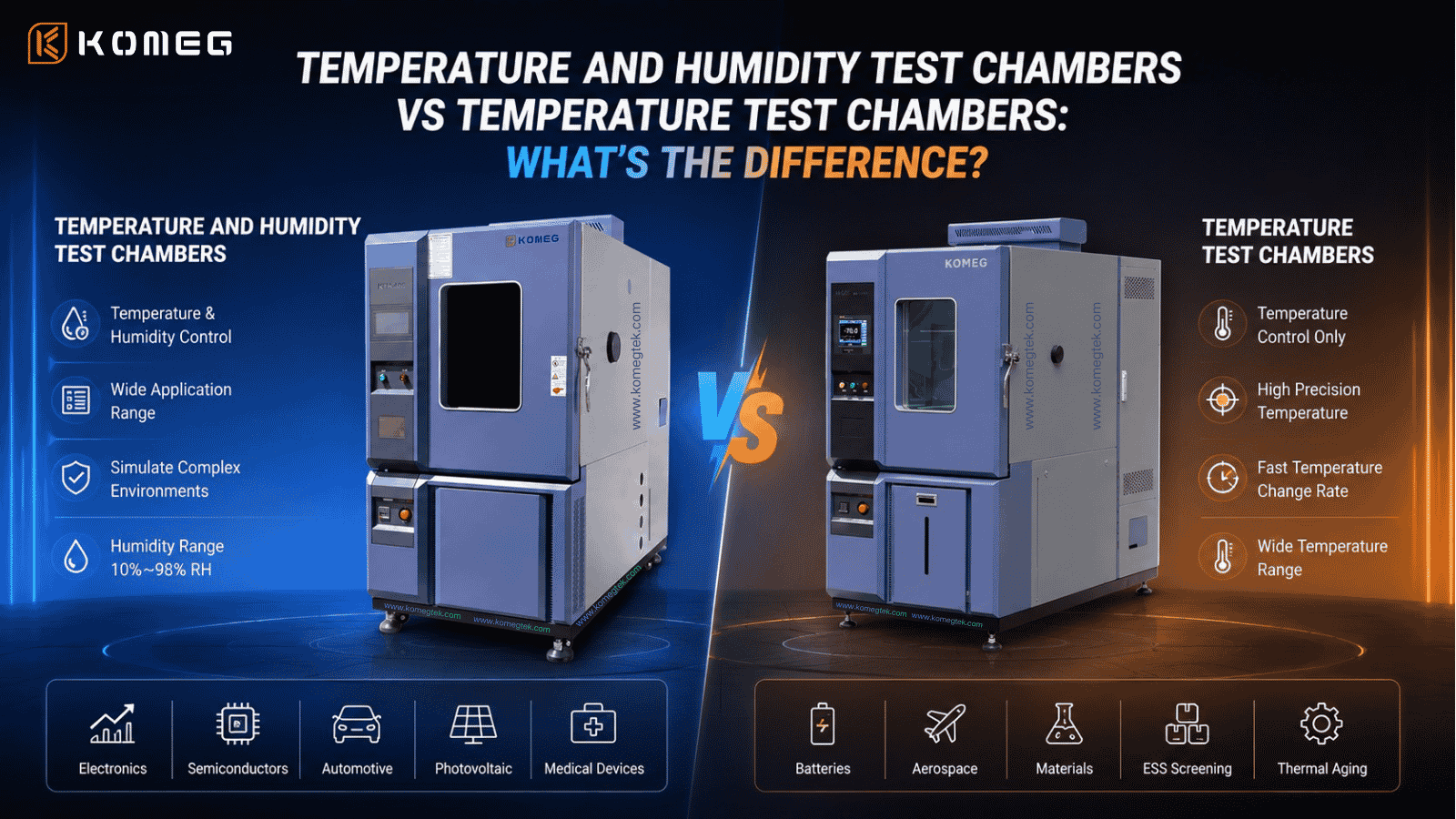
Two of the most commonly used systems are:
Although these chambers may appear similar externally, their testing capabilities, internal structures, applications, and environmental simulation functions are significantly different. Understanding these differences is essential for engineers, laboratory managers, and procurement teams when selecting the most suitable chamber for product validation, reliability testing, and international compliance standards. This article explains the key differences, applications, advantages, limitations, and selection considerations between temperature-only chambers and temperature-humidity chambers.
What Is a Temperature Test Chamber?
A temperature test chamber is an environmental testing system designed to simulate controlled high-temperature, low-temperature, or temperature cycling conditions without humidity control.
These chambers are widely used for:
- High-temperature aging tests
- Low-temperature storage tests
- Thermal cycling tests
- Thermal shock preparation
- Material thermal expansion studies
- Semiconductor burn-in testing
- ESS (Environmental Stress Screening)
Temperature chambers focus entirely on precise thermal control and rapid temperature response.
Typical testing conditions include:
- High-temperature exposure
- Low-temperature exposure
- Rapid temperature changes
- Long-duration thermal aging
Unlike climate chambers, temperature test chambers do not actively regulate humidity levels inside the workspace.
What Is a Temperature and Humidity Test Chamber?
A temperature and humidity test chamber, also called a climate chamber or constant temperature humidity chamber, can simultaneously control both temperature and relative humidity.
These chambers simulate complex environmental conditions involving:
- Heat
- Cold
- Moisture
- Condensation
- Damp heat
- Humidity cycling
Temperature and humidity chambers are commonly used for:
- 85°C / 85% RH testing
- Damp heat testing
- Moisture resistance testing
- Reliability testing
- Corrosion studies
- Stability testing
- Accelerated aging tests
Because moisture is one of the leading causes of electronic product failure, humidity control has become increasingly important in modern reliability engineering.
Why Humidity Testing Matters
Many products can withstand temperature stress but fail prematurely when exposed to heat combined with moisture.
Humidity can penetrate materials and trigger:
- Corrosion
- Delamination
- Electrochemical migration
- Insulation degradation
- Optical fogging
- Connector oxidation
- Leakage current increases
- Mold growth
For modern electronics and semiconductor devices, humidity-related failures are often more dangerous than thermal stress alone.
This is why industries such as automotive electronics, photovoltaics, semiconductors, and consumer electronics rely heavily on temperature humidity chambers.
Main Differences Between the Two Chambers
Environmental Simulation Capability
The biggest difference lies in environmental simulation capability.
Temperature Test Chambers
Can simulate:
- High temperature
- Low temperature
- Temperature cycling
- Thermal aging
Cannot simulate:
- Humidity
- Condensation
- Moisture exposure
Temperature and Humidity Chambers
Can simulate:
- Heat and humidity simultaneously
- Damp heat environments
- Condensation effects
- Moisture aging
- Humidity cycling
This makes them suitable for much broader reliability testing applications.
Structural Design Differences
Temperature and humidity chambers are significantly more complex internally.
Temperature Test Chambers Usually Include:
- Refrigeration system
- Heating system
- Air circulation system
- Temperature sensors
- Thermal insulation structure
Temperature Humidity Chambers Additionally Require:
- Humidification system
- Water supply system
- Dehumidification control
- Humidity sensors
- Steam generation system
- Drainage system
- Anti-condensation protection
Because of these additional systems, climate chambers are more sophisticated and require more precise engineering.
Humidity Control Is Technically Challenging
Controlling humidity accurately is much more difficult than controlling temperature alone.
Humidity control requires balancing:
- Air temperature
- Water vapor concentration
- Dew point
- Airflow
- Surface condensation
For example, low-temperature humidity testing becomes increasingly difficult because cold air holds less moisture.
Advanced chambers must use:
- Precision steam humidification
- Intelligent PID algorithms
- Dynamic airflow control
- High-accuracy humidity sensors
Poor humidity control may cause:
- Condensation on samples
- Inaccurate RH values
- Sensor drift
- Unstable testing conditions
This is one reason high-quality humidity chambers are more expensive than temperature-only chambers.
Temperature Range Comparison
Temperature Test Chambers
Because they focus solely on thermal performance, temperature chambers often provide wider temperature ranges and faster ramp rates.
Typical ranges include:
- -70°C to +180°C
- -80°C ultra-low temperature options
- Fast ramp rates up to 15°C/min or higher
These chambers are ideal for aggressive thermal cycling applications.
Temperature and Humidity Chambers
Humidity control limits operational ranges because moisture control becomes unstable at extremely low temperatures.
Typical operating ranges include:
- -40°C to +150°C
- 20% RH to 98% RH
- Standard humidity control range: +20°C to +85°C
Advanced systems may support lower humidity conditions through specialized dehumidification systems.
Applications of Temperature Test Chambers
Temperature-only chambers are commonly used in industries where moisture is not a major reliability factor.
Common Applications Include:
Semiconductor Testing
- Burn-in testing
- Thermal cycling
- IC reliability screening
Metal and Material Testing
- Thermal expansion studies
- Heat resistance testing
- Cold storage simulation
Aerospace Components
- High-altitude thermal simulation
- Low-temperature operational testing
Battery Testing
- Thermal runaway studies
- Storage testing
- Temperature cycling
Electronics ESS Testing
Environmental stress screening helps detect early manufacturing defects through rapid thermal transitions.
Applications of Temperature and Humidity Chambers
Climate chambers are essential for products exposed to moisture during real-world operation.
Common Applications Include:
Automotive Electronics
- ECU reliability
- Sensor testing
- ADAS module durability
Consumer Electronics
- Smartphones
- Wearables
- Tablets
- Smart home devices
LED and Optical Products
Humidity can affect optical coatings, lenses, and encapsulation materials.
Photovoltaic Modules
PV systems undergo damp heat testing to evaluate long-term outdoor durability.
Medical Devices
Moisture-sensitive medical electronics require stable environmental validation.
Semiconductor Packaging
Humidity testing helps evaluate package sealing integrity and electrochemical reliability.
Cost Comparison
Temperature Test Chambers
Generally have:
- Lower initial purchase cost
- Lower operating cost
- Lower maintenance requirements
- Reduced energy consumption
Because the system structure is simpler, maintenance is easier, and long-term operating costs are lower.
Temperature and Humidity Chambers
Typically involves:
- Higher equipment cost
- Water supply requirements
- Additional maintenance
- Higher energy consumption
- Humidity sensor calibration
- Water treatment management
However, they provide significantly broader testing capabilities.
Maintenance Differences
Humidity systems require regular maintenance to ensure long-term reliability.
Additional Maintenance in Humidity Chambers Includes:
- Water tank cleaning
- Humidifier inspection
- Drainage maintenance
- Humidity sensor calibration
- Mineral buildup prevention
- Water quality management
Using purified or deionized water is strongly recommended.
Without proper maintenance, humidity performance may become unstable.
Which Chamber Is Better for Reliability Testing?
The answer depends entirely on the product’s real-world operating environment.
Choose a Temperature Test Chamber If:
- Moisture exposure is not critical
- Fast temperature ramp rates are required
- Thermal cycling is the main objective
- Budget optimization is important
- Simpler testing conditions are acceptable
Choose a Temperature and Humidity Chamber If:
- Products operate in humid environments
- Moisture resistance must be validated
- Industry standards require humidity testing
- Corrosion risks exist
- Long-term reliability testing is needed
- Condensation simulation is important
In many industries, humidity testing is now considered essential rather than optional.
Common Mistakes When Selecting a Chamber
Focusing Only on Temperature Range
Many buyers ignore humidity requirements during initial equipment selection.
This often leads to insufficient testing capability later.
Ignoring Future Testing Needs
Future product upgrades may require humidity validation.
Selecting a chamber with expandable capabilities can reduce long-term investment costs.
Underestimating Installation Requirements
Humidity chambers require:
- Water supply
- Drainage systems
- Proper ventilation
- Stable environmental conditions
Installation planning is critical.
Overlooking Uniformity and Stability
Environmental uniformity directly affects testing accuracy and repeatability.
Low-quality chambers may create inconsistent results.
Temperature Chamber vs Climate Chamber: Which One Do You Need?
When selecting between these systems, consider the following questions:
Does your product encounter moisture in real-world environments?
If yes, humidity testing is strongly recommended.
Are you testing electronics or semiconductor products?
Most modern electronic products benefit from humidity reliability testing.
Do you need compliance with industry standards?
Many standards require humidity testing, including:
- IEC 60068
- JESD22
- AEC-Q100
- ICH stability standards
Is condensation a possible field failure risk?
If yes, temperature and humidity chambers are necessary.
Future Trends in Environmental Testing
Environmental testing technology continues to evolve rapidly.
Emerging trends include:
- AI-based chamber diagnostics
- Remote monitoring systems
- Energy-efficient refrigeration
- Smart humidity control algorithms
- Multi-stress environmental simulation
- EV battery reliability testing
- Semiconductor advanced packaging validation
As product reliability standards continue to increase, climate simulation systems are becoming more advanced and intelligent.
Although temperature test chambers and temperature-humidity test chambers may appear similar, they serve very different purposes in environmental reliability testing.
Temperature chambers are ideal for thermal-only applications such as thermal cycling, ESS testing, and material evaluation. They offer faster ramp rates, wider temperature ranges, and lower operating costs.
Temperature and humidity chambers provide more comprehensive environmental simulation capabilities by combining heat, cold, and moisture control. These systems are essential for industries where humidity-related failures can affect product safety, durability, and long-term reliability.
Selecting the right chamber depends on your product type, industry standards, environmental exposure conditions, and long-term testing objectives.
KOMEG provides advanced temperature test chambers and temperature-humidity chambers designed for semiconductor, automotive, electronics, aerospace, battery, and industrial reliability testing applications worldwide.