

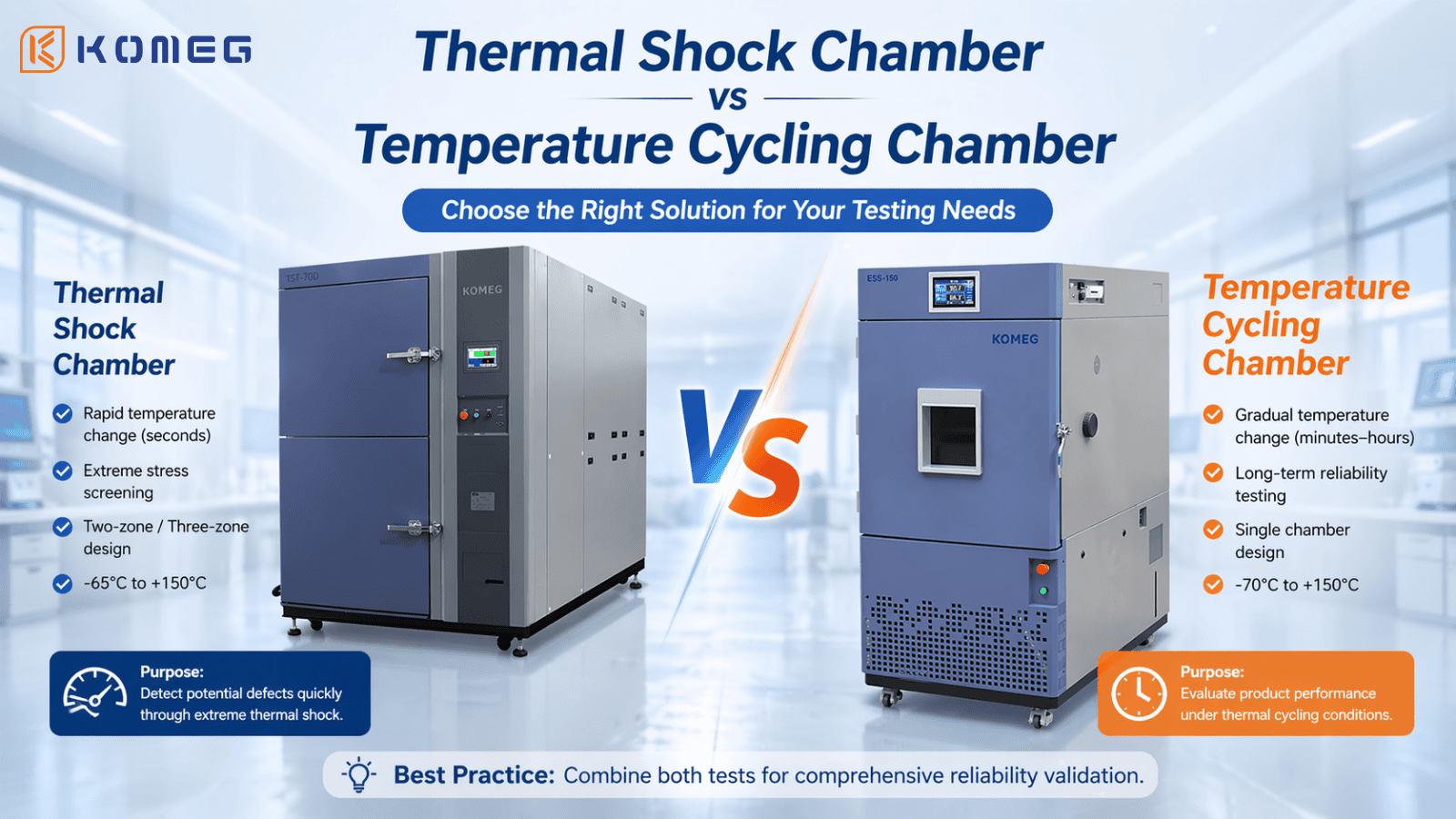
What Is a Thermal Shock Chamber?
- Material cracking
- Delamination
- Solder joint failure
- Structural weaknesses
- Performance degradation caused by sudden temperature fluctuations
Modern systems, such as those developed by KOMEG, use two-zone or three-zone designs to achieve rapid transitions while maintaining precise control, with a low failure rate and stable performance trusted by global customers.
👉 Explore KOMEG solutions: KOMEG Thermal Shock Chambers
What Is a Temperature Cycling Chamber?
- Product lifespan testing
- Material fatigue analysis
- Stability evaluation under repeated temperature changes
- Quality inspection for electronics, automotive, aerospace, and consumer goods
These tests are often performed using KOMEG temperature and humidity chambers (also called climatic test chambers), which support programmable control, wide temperature/humidity ranges, and stable uniformity for accurate cycling tests.
👉 Explore KOMEG solutions: KOMEG Temperature & Humidity Test Chambers
Key Differences Between Thermal Shock and Temperature Cycling
Temperature Change Rate
Thermal Shock: Instant, extreme transitions (completed in seconds)
Temperature Cycling: Gradual changes (ramp rates in minutes to hours)
Purpose of Testing
Thermal Shock: Detect immediate structural failures and hidden defects
Temperature Cycling: Evaluate long-term durability and fatigue resistance
Stress Level
Thermal Shock: High, abrupt thermal stress
Temperature Cycling: Moderate, repetitive cyclic stress
Equipment Design
Thermal Shock Chambers: Multi-zone (2/3-zone) systems with fast temperature switching
Temperature Cycling Chambers: Single integrated chamber with controllable ramp/soak rates
Test Environment
Thermal Shock: Pure temperature extreme shock (no humidity involved)
Temperature Cycling: Can integrate humidity simulation (per IEC60068 standards)
When Should You Use Each Method?
- Quickly identify hidden defects in components or finished products
- Test extreme instantaneous temperature tolerance
- Perform Environmental Stress Screening (ESS) for mass production quality control
- Verify reliability under sudden environmental temperature shocks (e.g., aerospace, defense, semiconductor)
- Simulate real-world natural environmental conditions (day/night, seasonal shifts)
- Evaluate long-term product reliability and service life
- Analyze material fatigue and performance decay over repeated temperature cycles
- Conduct stability tests with optional humidity control (electronics, automotive, batteries, etc.)
Which One Is Better?
- Thermal shock for early defect detection and stress screening
- Temperature cycling for long-term validation and lifespan prediction