

Environmental test chambers are essential tools for reliability testing in industries such as semiconductors, automotive electronics, aerospace, batteries, pharmaceuticals, telecommunications, and consumer electronics. These chambers simulate extreme environmental conditions, including temperature, humidity, thermal shock, and rapid thermal cycling, to validate product durability and performance.
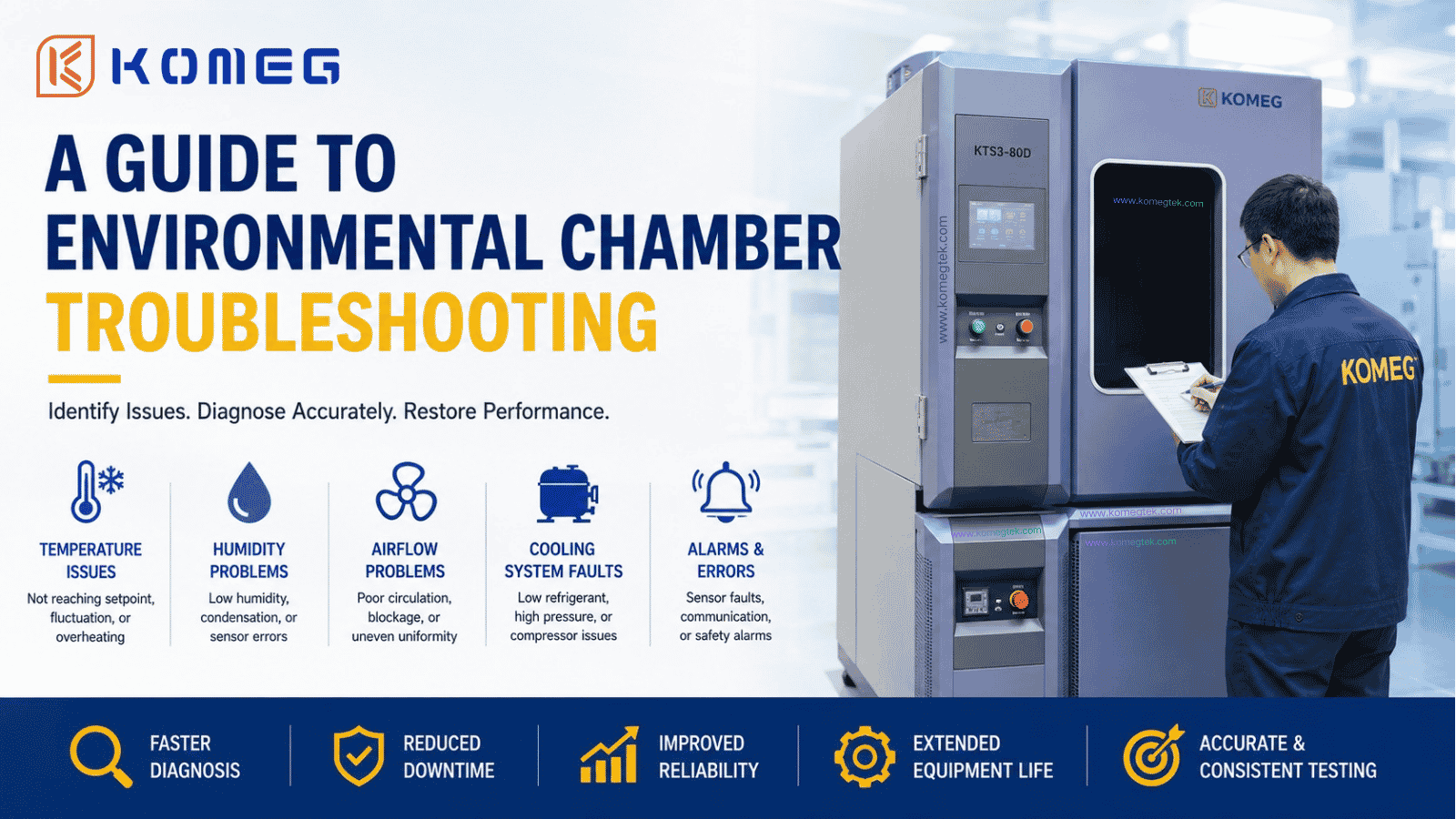
However, because environmental chambers operate under continuous thermal stress and demanding workloads, occasional operational issues are inevitable. When problems occur, fast and accurate troubleshooting becomes critical to minimize downtime, maintain testing accuracy, and protect valuable test samples.
This guide explains the most common environmental chamber problems, their causes, troubleshooting methods, and preventive maintenance strategies to help laboratories and manufacturers improve equipment reliability and operational efficiency.
Why Environmental Chamber Troubleshooting Matters
Environmental chambers often operate continuously for long periods under aggressive thermal conditions. Even minor system abnormalities may lead to:
- Inaccurate test results
- Product qualification delays
- Unexpected downtime
- Semiconductor test failures
- Calibration instability
- Reduced equipment lifespan
- Production interruption
A structured troubleshooting approach helps engineers quickly identify root causes and restore stable chamber performance. Common Environmental Chamber Problems
1. Chamber Not Reaching Target Temperature
One of the most common issues is failure to achieve the programmed temperature setpoint.
Possible Causes
- Refrigeration system inefficiency
- Heater malfunction
- Low refrigerant pressure
- Faulty temperature sensor
- Airflow blockage
- Compressor performance degradation
- Improper chamber loading
Troubleshooting Steps
Check Airflow Circulation
Inspect fans, air ducts, and ventilation pathways for dust buildup or obstruction.
Inspect Refrigeration Performance
Verify compressor operation, condenser cleanliness, and refrigerant pressure levels.
Test Heating Components
Check heater resistance values and inspect for damaged heating elements.
Verify Sensor Accuracy
Calibrate temperature sensors and confirm proper controller feedback.
Review Chamber Load
Overloaded chambers may prevent proper thermal stabilization.
2. Temperature Fluctuation or Instability
Temperature instability affects testing repeatability and compliance accuracy.
Common Symptoms
- Overshoot
- Oscillation
- Slow stabilization
- Inconsistent chamber readings
Possible Causes
- PID control tuning problems
- Sensor drift
- Fan instability
- Refrigeration cycling issues
- Poor airflow distribution
Troubleshooting Solutions
Recalibrate Sensors
Temperature sensor drift is a common source of instability.
Optimize PID Parameters
Incorrect PID settings may cause excessive overshoot or oscillation.
Inspect Air Circulation Fans
Unstable fan speed can create uneven temperature distribution.
Check Refrigeration Control
Expansion valve instability or compressor cycling may affect thermal stability.
3. Chamber Not Cooling Properly
Insufficient cooling performance often indicates refrigeration-related issues.
Possible Causes
- Dirty condenser
- Refrigerant leakage
- Compressor overheating
- Blocked evaporator
- High ambient temperature
- Cooling fan failure
Troubleshooting Steps
Clean the Condenser
Dust buildup significantly reduces cooling efficiency.
Inspect Refrigerant Pressure
Low pressure may indicate refrigerant leakage.
Verify Compressor Operation
Check for abnormal vibration, overheating, or unusual noise.
Improve Installation Ventilation
Poor room airflow increases refrigeration system stress.
4. Chamber Not Heating Correctly
Heating failures may prevent proper temperature cycling or thermal shock testing.
Possible Causes
- Burned heating elements
- SSR (Solid State Relay) failure
- Electrical connection issues
- Controller malfunction
- Safety limit activation
Troubleshooting Methods
Inspect Heater Circuits
Measure heater continuity and resistance values.
Check Electrical Relays
Faulty SSRs may interrupt heater operation.
Review Safety Protection Settings
Over-temperature protection may disable heating functions.
5. Humidity Control Problems
Humidity instability is common in temperature-humidity chambers.
Common Symptoms
- Low humidity generation
- Excessive condensation
- Slow humidity response
- Sensor inaccuracy
Possible Causes
- Empty water tank
- Contaminated humidifier
- Humidity sensor drift
- Water quality issues
- Steam generator malfunction
Troubleshooting Steps
Check Water Supply
Use distilled or deionized water only.
Clean Humidity Components
Scale buildup affects humidity performance.
Calibrate Humidity Sensors
Sensor drift can cause inaccurate RH readings.
Inspect Steam Generator
Verify proper heating and steam generation.
6. Excessive Frost or Ice Buildup
Frost accumulation affects airflow and refrigeration efficiency.
Possible Causes
- Door seal leakage
- High humidity infiltration
- Defrost system failure
- Frequent door opening
- Improper refrigeration operation
Troubleshooting Solutions
Inspect Door Gaskets
Damaged seals allow moisture intrusion.
Verify Defrost Function
Check heaters and control logic for proper defrost operation.
Reduce Door Opening Frequency
Frequent access increases moisture ingress.
7. Chamber Alarms and Safety Shutdowns
Modern environmental chambers include multiple protection systems.
Common Alarm Types
- Over-temperature alarm
- Compressor overload alarm
- Sensor fault alarm
- Water shortage alarm
- Phase protection alarm
Troubleshooting Process
Review Alarm History
Most controllers store fault logs for diagnosis.
Inspect Related Components
Identify which subsystem triggered the alarm.
Reset Protection Systems Carefully
Repeated alarm resets without root-cause correction may cause further damage.
8. Airflow and Uniformity Problems
Poor airflow affects temperature consistency and test reliability.
Symptoms
- Hot spots
- Cold spots
- Uneven temperature distribution
- Slow thermal response
Causes
- Fan wear
- Blocked ducts
- Overloaded chamber
- Improper sample placement
Solutions
Clean Airflow Channels
Dust accumulation restricts circulation.
Inspect Fan Motors
Worn fans reduce airflow efficiency.
Optimize Test Sample Arrangement
Avoid blocking air outlets or return vents.
9. Controller Communication Errors
Modern chambers often use Ethernet, USB, or remote monitoring systems.
Possible Causes
- Software conflicts
- Network instability
- Cable damage
- Firmware issues
- Communication port failure
Troubleshooting Methods
Verify Network Connections
Check Ethernet cables and IP settings.
Restart Communication Systems
Controller reboot may restore connectivity.
Update Firmware
Outdated firmware can create compatibility issues.
Root Cause Analysis in Environmental Chamber Troubleshooting
Successful troubleshooting requires identifying the true root cause rather than only treating symptoms.
A systematic troubleshooting process typically includes:
- Identifying the abnormal behavior
- Reviewing alarm history
- Checking recent maintenance records
- Isolating affected subsystems
- Testing sensors and electrical signals
- Verifying refrigeration performance
- Confirming airflow stability
Root cause analysis improves repair efficiency and reduces repeated failures.
Preventive Maintenance Reduces Troubleshooting Frequency
Most environmental chamber problems can be minimized through preventive maintenance.
Recommended Maintenance Practices
Daily
- Monitor alarms
- Check operating noise
- Inspect door sealing
Weekly
- Clean chamber interior
- Inspect airflow pathways
Monthly
- Clean condensers
- Verify refrigeration performance
- Check electrical connections
Quarterly
- Calibrate sensors
- Verify chamber uniformity
- Test safety systems
Annually
- Full refrigeration servicing
- Compressor inspection
- Comprehensive system validation
Preventive maintenance significantly extends chamber lifespan and improves testing reliability.
When to Contact Technical Support
Some problems require professional service support, especially involving:
- Refrigerant leakage
- Compressor replacement
- PLC/controller failure
- Electrical short circuits
- Refrigeration system charging
- Advanced calibration procedures
Attempting unauthorized repairs may increase damage or void warranties.
How Modern Environmental Chambers Simplify Troubleshooting
Advanced environmental chambers now include:
- Intelligent diagnostics
- Predictive maintenance systems
- Remote monitoring
- Self-check functions
- Smart alarm systems
- Real-time performance logging
These technologies help users identify problems earlier and reduce downtime.
Environmental chamber troubleshooting is essential for maintaining testing accuracy, minimizing downtime, and protecting long-term equipment reliability. Most chamber issues originate from airflow problems, refrigeration stress, electrical aging, sensor drift, or inadequate maintenance.
By implementing systematic troubleshooting methods and preventive maintenance programs, laboratories and manufacturers can:
- Improve testing consistency
- Reduce operational costs
- Extend equipment lifespan
- Minimize unexpected failures
- Maintain compliance accuracy
As testing requirements continue becoming more demanding across semiconductor, automotive, aerospace, battery, and AI industries, reliable environmental chamber operation has become increasingly important.
KOMEG environmental test chambers are engineered with advanced control systems, intelligent diagnostics, stable refrigeration technology, and precision airflow management to support reliable industrial testing and simplify long-term equipment maintenance.