

Vacuum drying ovens are widely used in laboratories, semiconductor manufacturing, pharmaceuticals, electronics, aerospace, battery research, chemical processing, and material testing industries. Compared with conventional drying equipment, vacuum drying ovens provide faster moisture removal, lower drying temperatures, reduced oxidation risk, and improved material stability.
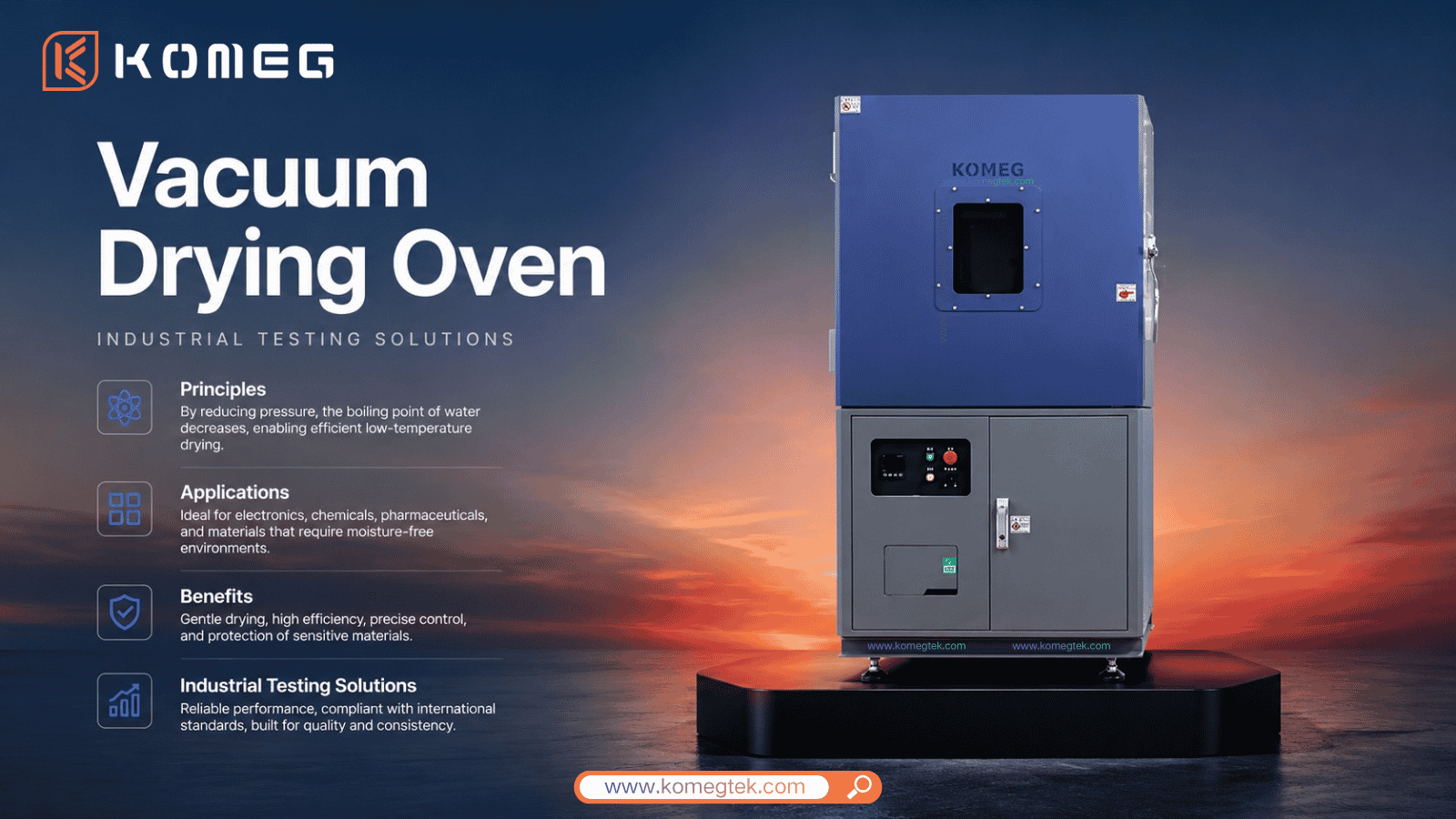
As modern industries increasingly require high-precision drying processes for sensitive materials and advanced manufacturing applications, vacuum drying technology has become an essential part of industrial thermal processing and reliability testing.
This article provides a comprehensive guide to vacuum drying ovens, including working principles, key applications, advantages, selection factors, maintenance requirements, and industrial testing solutions.
What Is a Vacuum Drying Oven?
A vacuum drying oven is a thermal processing chamber designed to remove moisture, solvents, or volatile substances from materials under reduced pressure conditions.
By lowering the atmospheric pressure inside the chamber, the boiling point of liquids decreases significantly. This allows moisture or solvents to evaporate at much lower temperatures than under normal atmospheric conditions.
Vacuum drying ovens are especially suitable for:
- Heat-sensitive materials
- Semiconductor components
- Pharmaceutical products
- Electronic assemblies
- Battery materials
- Chemical powders
- Optical components
- Aerospace materials
How Does a Vacuum Drying Oven Work?
The operating principle of a vacuum drying oven combines controlled heating with vacuum pressure reduction.
The basic process includes:
- Samples are placed inside the sealed chamber
- A vacuum pump removes air from the chamber
- Chamber pressure decreases
- The heating system raises the sample temperature
- Moisture or solvents evaporate at lower temperatures
- Vapor is removed through the vacuum system
Because evaporation occurs under reduced pressure, materials can be dried efficiently without exposure to excessive heat.
Why Vacuum Conditions Improve Drying Efficiency
Under standard atmospheric pressure, water boils at 100°C. However, under vacuum conditions, the boiling point drops significantly.
This provides several advantages:
- Faster evaporation
- Lower thermal stress
- Reduced oxidation
- Improved product quality
- Better protection for sensitive materials
Vacuum drying is therefore ideal for applications where traditional high-temperature drying could damage materials.
Main Components of a Vacuum Drying Oven
Vacuum Chamber
The chamber must maintain stable pressure conditions and provide excellent sealing performance.
Most industrial vacuum ovens use:
- Stainless steel interiors
- Corrosion-resistant structures
- Reinforced chamber designs
Heating System
Heating systems provide controlled thermal energy for drying.
Common heating methods include:
- Shelf heating
- Jacket heating
- Convection heating
- Radiant heating
Precision temperature control is critical for uniform drying.
Vacuum Pump
The vacuum pump removes air and maintains reduced pressure conditions.
Pump selection depends on:
- Required vacuum level
- Chamber size
- Process material
- Vapor load
Temperature Controller
Modern vacuum drying ovens use programmable PID controllers for precise temperature management and process automation.
Vacuum Measurement System
Pressure sensors monitor chamber vacuum levels to ensure process consistency.
Advantages of Vacuum Drying Ovens
Lower Drying Temperature
Vacuum conditions reduce boiling points, allowing drying at much lower temperatures.
This protects:
- Heat-sensitive materials
- Polymers
- Pharmaceuticals
- Electronics
- Semiconductor wafers
Faster Drying Speed
Lower pressure accelerates moisture evaporation and shortens drying cycles.
Reduced Oxidation Risk
Vacuum environments minimize oxygen exposure.
This is important for:
- Metal powders
- Electronic components
- Lithium battery materials
- Semiconductor devices
Improved Product Quality
Vacuum drying helps maintain:
- Material structure
- Chemical stability
- Surface quality
- Electrical properties
Better Uniformity
Modern vacuum ovens provide stable thermal distribution and consistent drying performance.
Vacuum Drying Oven Applications
Semiconductor Industry
Vacuum drying ovens are widely used in semiconductor manufacturing for:
- Wafer drying
- IC packaging
- Moisture removal
- PCB baking
- Optical component drying
Semiconductor processes require extremely clean and stable drying environments.
Lithium Battery Industry
Battery manufacturers use vacuum drying ovens for:
- Electrode drying
- Electrolyte moisture removal
- Battery material processing
- Vacuum baking
Moisture control is critical for lithium battery safety and performance.
Pharmaceutical Industry
Vacuum drying is ideal for:
- Heat-sensitive drugs
- Active pharmaceutical ingredients (API)
- Sterile materials
- Biological products
Aerospace Industry
Vacuum ovens are used for:
- Composite material drying
- Adhesive curing
- Aerospace electronics processing
Chemical Industry
Applications include:
- Powder drying
- Solvent removal
- Material stabilization
- Laboratory thermal processing
Vacuum Drying Oven vs Conventional Drying Oven
Conventional Drying Oven
Traditional ovens operate under atmospheric pressure and typically require higher temperatures.
Suitable for:
- General industrial drying
- Non-sensitive materials
- Basic thermal processing
Vacuum Drying Oven
Vacuum ovens provide:
- Lower drying temperature
- Faster evaporation
- Better oxidation protection
- Improved drying precision
Ideal for high-value and sensitive materials.
Important Parameters When Selecting a Vacuum Drying Oven
Temperature Range
Select based on process requirements and material sensitivity.
Vacuum Level
Different applications require different vacuum capabilities.
Chamber Size
Consider sample dimensions and production capacity.
Temperature Uniformity
Uniform heating improves drying consistency.
Control System
Programmable controllers improve automation and process repeatability.
Safety Features
Industrial vacuum ovens should include:
- Over-temperature protection
- Pressure protection
- Vacuum safety systems
- Alarm functions
Common Problems in Vacuum Drying Ovens
Vacuum Leakage
Possible causes include:
- Damaged door seals
- Loose fittings
- Pipeline leakage
Slow Drying Performance
Possible causes:
- Insufficient vacuum level
- Poor heating efficiency
- Overloaded chamber
Temperature Instability
Possible causes:
- Sensor drift
- Controller malfunction
- Heating system failure
Excessive Pump Noise
Often caused by:
- Pump wear
- Insufficient lubrication
- Contamination
Vacuum Drying Oven Maintenance Tips
Proper maintenance significantly improves equipment lifespan and process reliability.Regular Cleaning
Keep the chamber clean to avoid contamination.
Inspect Door Seals
Damaged seals reduce vacuum performance.
Maintain the Vacuum Pump
Replace oil and inspect pump condition regularly.
Calibrate Sensors
Periodic calibration ensures accurate temperature and pressure control.
Check Electrical Systems
Inspect wiring and control systems for stability.
Trends in Modern Vacuum Drying Technology
Modern vacuum drying ovens increasingly feature:
- Smart touch-screen controllers
- Remote monitoring
- Data logging systems
- Automated vacuum control
- Energy-efficient heating
- Programmable thermal profiles
- Industry 4.0 integration
Advanced systems provide improved efficiency and process traceability.
Why Precision Matters in Industrial Vacuum Drying
In industries such as semiconductors, batteries, pharmaceuticals, and aerospace, even small process variations may affect product quality and reliability.
High-performance vacuum drying ovens must provide:
- Stable temperature control
- Accurate vacuum regulation
- Excellent chamber sealing
- Uniform heat distribution
- Reliable process repeatability
Precision drying directly affects production yield and product consistency.
Vacuum drying ovens are essential thermal processing systems for industries requiring precise, low-temperature, and contamination-sensitive drying applications. Compared with conventional drying methods, vacuum drying offers faster evaporation, reduced oxidation, improved product quality, and better protection for heat-sensitive materials.
As semiconductor manufacturing, lithium battery production, pharmaceutical processing, and advanced materials industries continue growing rapidly, demand for high-performance vacuum drying solutions will continue increasing.
KOMEG vacuum drying ovens provide precision temperature control, stable vacuum performance, industrial-grade reliability, and advanced programmable systems designed for demanding laboratory and industrial thermal processing applications.