

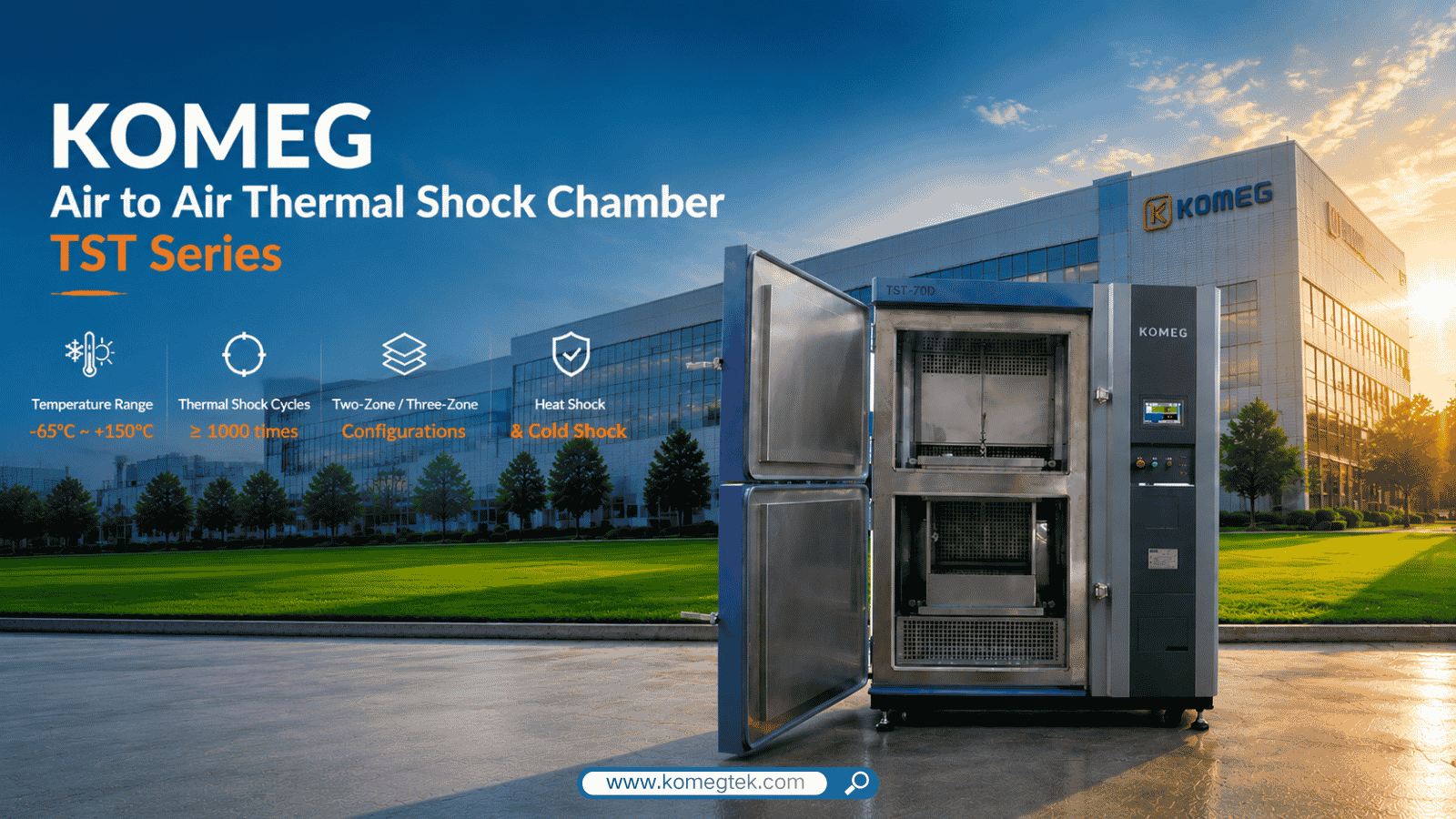
Modern electronic products and industrial components are becoming increasingly complex, while their operating environments are becoming more challenging. During transportation, storage, and actual operation, products may experience sudden temperature changes that can cause material stress, mechanical damage, or functional failure.
To verify product reliability under extreme temperature transitions, manufacturers and laboratories use Air-to-Air Thermal Shock Chambers to perform accelerated thermal stress testing.
An air-to-air thermal shock chamber can rapidly move test samples between high-temperature and low-temperature zones, creating sudden temperature changes that simulate harsh real-world conditions. This testing method helps identify hidden weaknesses in components and improves product durability before mass production.
This article explains what an air-to-air thermal shock chamber is, how it works, its applications, testing standards, and how to choose the right thermal shock testing solution.
What Is an Air-to-Air Thermal Shock Chamber?
An Air-to-Air Thermal Shock Chamber is a specialized environmental testing system designed to expose products to rapid temperature changes between hot and cold environments.
Unlike conventional temperature cycling chambers, which gradually change temperature inside a single test space, thermal shock chambers use separate temperature zones to create an immediate transition between extreme conditions.
During testing, the product is moved between:
- A high-temperature zone
- A low-temperature zone
This rapid transfer creates thermal stress on materials, components, and assemblies, allowing engineers to evaluate product reliability and detect potential failures.
Air-to-air thermal shock chambers are widely used for testing:
- Electronic components
- Automotive parts
- Semiconductor devices
- Battery systems
- Aerospace equipment
- Industrial products
The primary goal is to ensure products can withstand sudden environmental changes without performance degradation.
How Does an Air-to-Air Thermal Shock Chamber Work?
The working principle of an air-to-air thermal shock chamber is based on rapid temperature transfer through controlled airflow.
Two-Zone Structure
Most air-to-air thermal shock chambers use a two-zone design, including:
High Temperature Zone
The hot chamber maintains a preset high temperature, commonly reaching:
+150°C
or higher depending on the system configuration.
Low Temperature Zone
The cold chamber provides low-temperature conditions, with typical ranges including:
-40°C
-55°C
-65°C
The test sample basket moves between these two zones according to programmed cycles.
Thermal Shock Process
A typical thermal shock test includes:
- The sample is placed inside the test basket.
- The product is exposed to a high-temperature environment for a defined period.
- The basket is quickly transferred into the low-temperature zone.
- The product experiences sudden cooling.
- The cycle repeats according to the test requirements.
This rapid temperature transition creates mechanical and thermal stress, helping reveal defects such as:
- Solder joint cracks
- Material expansion issues
- Component failures
- Seal damage
- Electrical performance instability
Air-to-Air Thermal Shock Chamber vs Temperature Cycling Chamber
Although both systems perform temperature testing, their testing purposes are different.
Temperature Cycling Chamber
A temperature cycling chamber changes temperature gradually within one chamber.
Typical applications:
- Long-term durability testing
- Environmental aging
- Temperature endurance evaluation
The temperature transition rate is usually slower.
Air-to-Air Thermal Shock Chamber
A thermal shock chamber creates rapid temperature changes by moving products between separate hot and cold zones.
Typical applications:
- Detecting manufacturing defects
- Accelerated reliability testing
- Evaluating thermal stress resistance
The temperature change happens much faster, creating stronger thermal stress on the product.
Main Features of Air-to-Air Thermal Shock Chambers
Rapid Temperature Transition
The biggest advantage of an air-to-air thermal shock chamber is its ability to create fast temperature changes.
Common thermal shock ranges include:
- -40°C to +150°C
- -55°C to +150°C
- -65°C to +150°C
This allows manufacturers to simulate severe environmental changes in a short period.
Two-Zone and Three-Zone Designs
Air-to-air thermal shock chambers are available in different configurations.
Two-Zone Thermal Shock Chamber
The product moves between:
- Hot zone
- Cold zone
Advantages:
- Simple structure
- High testing efficiency
- Cost-effective solution
Three-Zone Thermal Shock Chamber
The system includes:
- Hot zone
- Cold zone
- Test zone
Advantages:
- Reduced mechanical movement
- Improved testing stability
- Suitable for continuous production testing
Manufacturers can select the appropriate structure according to product requirements and testing standards.
Intelligent Control System
Modern thermal shock chambers use advanced controllers to improve testing accuracy and convenience.
Typical functions include:
- Programmable test cycles
- Temperature monitoring
- Data recording
- Alarm management
- Remote communication
For example, KOMEG thermal shock chambers feature color touchscreen control systems that integrate testing parameters and operational management into one interface.
Safety Protection System
Reliable protection is essential for long-term operation.
Common safety functions include:
- Compressor protection
- Over-temperature protection
- Heater protection
- Power overload protection
- Sensor fault alarms
- Door safety protection
These systems help protect both the equipment and test samples.
Applications of Air-to-Air Thermal Shock Chambers
Automotive Electronics
Modern vehicles contain increasing numbers of electronic components, including:
- ECU modules
- Sensors
- Displays
- Connectors
- Power control systems
Thermal shock testing helps verify that these components maintain stable performance under changing environmental conditions.
Semiconductor Industry
Semiconductor devices require strict reliability validation.
Thermal shock testing helps identify:
- Package defects
- Internal connection failures
- Material stress problems
It is commonly used during semiconductor qualification and reliability testing.
Battery Testing
Lithium batteries may experience temperature variations during:
- Transportation
- Charging and discharging
- Outdoor operation
Thermal shock testing helps evaluate:
- Battery structure reliability
- Protection system performance
- Material stability
Aerospace and Defense
Aerospace equipment often operates in extreme temperature environments.
Thermal shock chambers help verify that critical components maintain reliability under rapid environmental changes.
Consumer Electronics
Products such as:
- Smartphones
- Wearable devices
- Computers
- Smart devices
require thermal shock testing to improve durability and reduce early failures.
Common Testing Standards
Air-to-air thermal shock chambers are commonly used for testing according to international standards, including:
IEC 60068-2-14
Environmental testing standard for temperature change tests.
It evaluates whether products can withstand rapid temperature variations.
MIL-STD-810H
A military environmental testing standard used for evaluating equipment reliability under harsh conditions.
JESD22-A106
A temperature cycling test standard commonly used in semiconductor reliability testing.
AEC-Q100
Automotive electronic component qualification standard.
It defines reliability requirements for integrated circuits used in vehicles.
How to Choose an Air-to-Air Thermal Shock Chamber?
Selecting the right thermal shock chamber requires considering several factors.
Temperature Range
Confirm whether the chamber can achieve the required high and low temperatures.
Typical requirements:
- -40°C to +150°C
- -55°C to +150°C
- -65°C to +150°C
Test Sample Size
Consider:
- Product dimensions
- Number of samples
- Required fixtures
A suitable chamber size ensures proper airflow and testing accuracy.
Two-Zone or Three-Zone Structure
Choose based on:
- Testing frequency
- Production requirements
- Space limitations
- Automation needs
Cooling Method
Thermal shock chambers can use different cooling configurations:
- Air cooled
- Water cooled
The selection depends on installation conditions and laboratory requirements.
Customization Requirements
Different industries may require additional functions, such as:
- Cable ports
- Product shelves
- Special fixtures
- Communication interfaces
- Customized test baskets
A manufacturer with customization capability can provide a better long-term solution.
Why Choose KOMEG Air-to-Air Thermal Shock Chambers?
KOMEG provides advanced thermal shock testing solutions designed for reliable and efficient environmental testing.
KOMEG Air-to-Air Thermal Shock Chambers feature:
- Rapid thermal shock capability
- Temperature ranges up to -65°C to +150°C
- Intelligent touchscreen operation
- Stable heating and cooling performance
- Energy-efficient control technology
- Comprehensive safety protection
- Flexible customization options
With applications across automotive, semiconductor, battery, aerospace, and electronics industries, KOMEG helps manufacturers accelerate reliability testing and improve product quality.
An Air-to-Air Thermal Shock Chamber is an essential testing system for evaluating product reliability under rapid temperature changes.
By transferring samples between hot and cold environments, it creates thermal stress conditions that reveal hidden defects and potential failure risks.
For industries requiring high reliability, such as automotive electronics, semiconductors, batteries, and aerospace, thermal shock testing plays a critical role in product development and quality assurance.
Choosing the right thermal shock chamber with a suitable temperature range, configuration, control system, and customization options can significantly improve testing efficiency and product reliability.
KOMEG continues to provide professional environmental testing solutions to help global manufacturers develop safer, stronger, and more reliable products.