

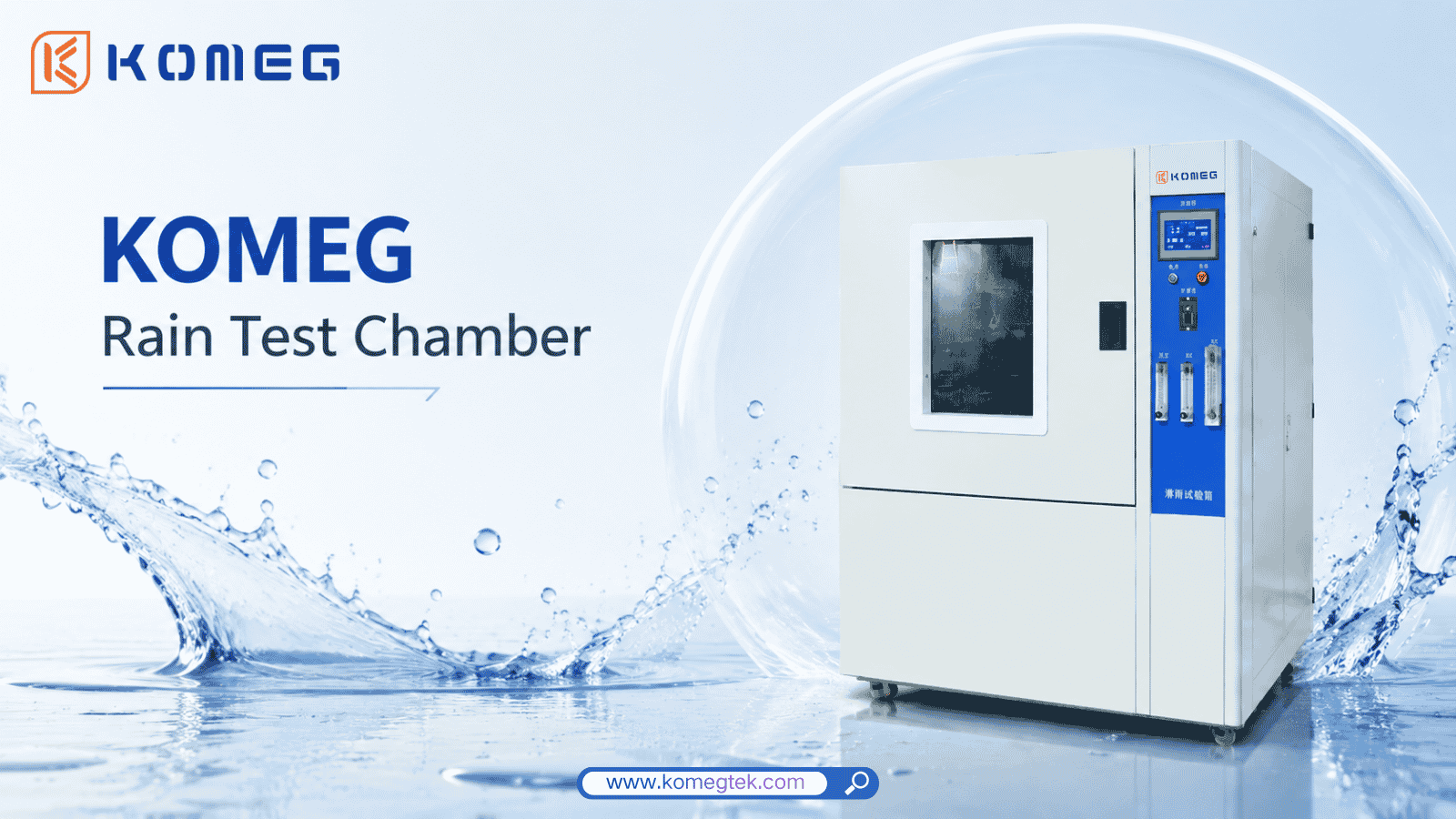
Water exposure is one of the most common environmental challenges faced by products used outdoors or in harsh operating conditions. Rain, splashing water, water spray, and high-pressure water flow can affect product performance, shorten service life, or even cause complete failure if the product enclosure does not provide sufficient protection.
For industries such as automotive, electronics, lighting, electrical equipment, and industrial manufacturing, waterproof performance is a critical part of product reliability verification. A product that performs well in a laboratory environment may still fail when exposed to real-world weather conditions without proper water resistance testing.
A Rain Test Chamber provides a controlled environment to simulate different rainfall and water exposure conditions. By accurately controlling parameters such as water flow rate, spray angle, water pressure, and testing duration, manufacturers can evaluate whether their products meet required waterproof protection levels.
Rain testing is especially important for products requiring Ingress Protection (IP) ratings, where manufacturers need to verify resistance against water penetration according to international standards such as IEC 60529.
This article explains what a rain test chamber is, how it works, different types of rain testing methods, applicable standards, major applications, and key considerations when selecting a suitable rain testing solution.
What Is a Rain Test Chamber?
A Rain Test Chamber is an environmental testing system designed to simulate artificial rainfall and water exposure conditions to evaluate the waterproof performance of products, components, and enclosures.
The main purpose of a rain test chamber is to determine whether water can enter a product enclosure under specified testing conditions and whether internal components remain functional after exposure.
Unlike ordinary water spraying equipment, a professional rain test chamber provides precise control over testing parameters, including:
- Water flow rate
- Spray pressure
- Spray direction
- Nozzle arrangement
- Test duration
- Sample movement
- Water circulation
This allows manufacturers to reproduce standardized testing environments rather than relying on inconsistent manual water spraying methods.
A typical rain test chamber consists of:
- Water storage tank
- Water circulation pump
- Filtration system
- Spray nozzles
- Rotating platform or sample fixture
- Control system
- Safety protection devices
Depending on the testing requirements, rain test chambers can simulate different water exposure conditions, from light dripping water to strong water jets.
Why Is Rain Testing Important?
Water resistance is not only about preventing visible water leakage. Even a small amount of moisture entering a product can create long-term reliability problems.
Preventing Electrical Failures
For electronic products, water ingress can cause serious problems, including:
- Short circuits
- Electrical leakage
- Signal interruption
- Component corrosion
- Permanent circuit damage
Rain testing helps manufacturers verify whether sealing structures, protective covers, and enclosure designs can effectively protect internal components.
Evaluating Product Durability
Products installed outdoors may experience repeated exposure to rain, humidity, and temperature changes.
Over time, water exposure may cause:
- Seal aging
- Material degradation
- Corrosion
- Reduced insulation performance
Rain testing allows engineers to evaluate whether products maintain their protection capability throughout their expected service life.
Meeting International Standards
Many industries require products to achieve specific waterproof protection levels before entering the market.
Examples include:
- Automotive lighting systems
- Outdoor electrical equipment
- Communication devices
- Industrial control systems
- Consumer electronics
Rain test chambers provide repeatable and measurable testing conditions to support certification and quality control.
How Does a Rain Test Chamber Work?
A rain test chamber creates controlled water exposure through a combination of water circulation, spraying systems, and precise control technology.
Water Circulation System
The water circulation system is responsible for supplying and recycling water during testing.
The main components include:
Water Tank
Stores testing water and maintains a stable water supply.
Pump System
Provides sufficient pressure and flow to deliver water through spray nozzles.
Filtration System
Removes impurities from water to prevent nozzle blockage and maintain consistent spray performance.
A reliable circulation system ensures stable testing conditions throughout long-duration tests.
Spray Nozzle System
The spray system determines how water contacts the test sample.
Different testing requirements use different nozzle configurations.
Common designs include:
Drip Water System
Produces vertically falling water drops to simulate dripping conditions.
Used mainly for IPX1 and IPX2 testing.
Oscillating Spray Tube
A moving spray tube creates water exposure from multiple directions.
Commonly used for IPX3 and IPX4 rain spray tests.
Water Jet Nozzle System
Produces stronger water jets with controlled pressure and flow.
Used for IPX5 and IPX6 testing.
The accuracy of nozzle design directly affects test reliability because uneven spraying may result in inaccurate evaluation.
Sample Rotation and Movement System
Many rain test chambers include rotating platforms or moving fixtures.
The purpose is to ensure:
- Complete water exposure
- Consistent testing conditions
- Reduced influence from sample positioning
For products with complex structures, rotation helps simulate real-world exposure from multiple directions.
Intelligent Control System
Modern rain test chambers are equipped with programmable controllers that allow operators to set and monitor testing parameters.
Typical functions include:
- Test time control
- Water flow adjustment
- Spray cycle programming
- Rotation speed control
- Alarm monitoring
- Safety management
A precise control system improves repeatability and reduces operator errors.
Types of Rain Test Chambers
Different products require different levels of water protection testing. Rain test chambers are commonly classified according to testing methods and IP protection requirements.
IPX1 and IPX2 Drip Test Chamber
Drip testing evaluates protection against vertically falling water drops.
IPX1 Test
The product is exposed to vertically falling water drops.
Typical applications:
- Indoor electrical equipment
- Basic enclosure protection testing
IPX2 Test
The product is tested under dripping water conditions while tilted at different angles.
This evaluates whether products maintain protection when installed in slightly inclined positions.
Common applications include:
- Electrical devices
- Control equipment
- Small electronic products
IPX3 and IPX4 Rain Spray Test Chamber
IPX3 and IPX4 tests simulate rain and water splashing from different directions.
IPX3 Testing
Evaluates protection against water spray at specific angles.
Commonly used for:
- Outdoor electrical equipment
- Lighting products
- Electronic components
IPX4 Testing
Tests protection against water splashing from all directions.
Applications include:
- Automotive components
- Outdoor devices
- Consumer electronics
IPX4 testing is one of the most common rain tests because many outdoor products must withstand water exposure from multiple directions.
IPX5 and IPX6 Water Jet Testing Chamber
These tests evaluate protection against stronger water impact.
IPX5 Testing
Uses a water jet with controlled pressure to test resistance against water spray.
Applications:
- Vehicle components
- Industrial equipment
- Outdoor machinery
IPX6 Testing
Uses stronger water jets to simulate more severe water exposure.
Common applications:
- Heavy-duty equipment
- Outdoor electrical systems
- Industrial products
Rain Test Chamber and IEC 60529 IP Testing
The most widely referenced standard for waterproof testing is:
IEC 60529: Degrees of Protection Provided by Enclosures (IP Code)
IEC 60529 defines how electrical enclosures are classified according to their protection against:
- Solid objects
- Water ingress
The second digit of an IP rating represents water protection.
Examples:
IPX1
Protection against vertical dripping water.
IPX3
Protection against sprayed water.
IPX4
Protection against splashing water from all directions.
IPX5
Protection against water jets.
IPX6
Protection against powerful water jets.
Rain test chambers help manufacturers verify whether their products achieve the required IP protection level.
Applications of Rain Test Chambers
Automotive Industry
Automotive products are constantly exposed to changing weather conditions, including rain, washing, and road spray.
Rain testing is commonly used for:
- Headlights
- Taillights
- Cameras
- Sensors
- Charging interfaces
- Electronic modules
Testing helps ensure automotive components maintain reliable performance throughout vehicle operation.
Electronics Industry
Many electronic products require waterproof protection.
Applications include:
- Mobile devices
- Outdoor communication equipment
- Smart devices
- Control panels
- Electronic enclosures
Rain testing helps verify enclosure sealing and internal protection.
Lighting Industry
Outdoor lighting products must operate reliably under long-term weather exposure.
Rain testing evaluates:
- Housing protection
- Seal performance
- Electrical safety
- Water resistance
Industrial Equipment
Industrial equipment installed outdoors requires strong environmental protection.
Rain testing helps verify:
- Enclosure design
- Waterproof performance
- Long-term durability
How to Choose the Right Rain Test Chamber?
Selecting a suitable rain test chamber requires consideration of testing requirements, product characteristics, and applicable standards.
Define the Required Testing Standard
The first step is identifying the required protection level.
For example:
- IPX3/IPX4 for rain spray testing
- IPX5/IPX6 for water jet testing
Different standards require different chamber structures and spray systems.
Consider Product Size and Weight
The chamber working area should accommodate:
- Product dimensions
- Test fixtures
- Rotation requirements
- Operator access
Oversized products may require customized solutions.
Evaluate Water Control Accuracy
Reliable testing depends on precise water control.
Important factors include:
- Stable water pressure
- Accurate flow rate
- Uniform spray distribution
- Reliable filtration
Consider Automation Features
Advanced rain test chambers may include:
- Automatic test programs
- Data recording
- Remote monitoring
- Automatic rotation systems
Automation improves testing efficiency and repeatability.
Maintenance and Operation Requirements
A well-designed rain test chamber should provide:
- Easy cleaning
- Simple water replacement
- Reliable components
- Safety protection systems
Low maintenance requirements help reduce operating costs.
A Rain Test Chamber is an important environmental testing system used to evaluate product waterproof performance under controlled rainfall and water exposure conditions.
By accurately simulating different rain environments, it helps manufacturers identify potential water ingress risks, improve product designs, and verify compliance with international protection standards.
From automotive components and outdoor electronics to industrial equipment and lighting products, rain testing plays a critical role in ensuring reliability and durability.
When selecting a rain test chamber, manufacturers should carefully evaluate testing standards, water control accuracy, product size, automation requirements, and future testing needs.
A properly designed rain testing solution provides reliable data, improves product quality, and helps ensure products perform safely in real-world environments.