

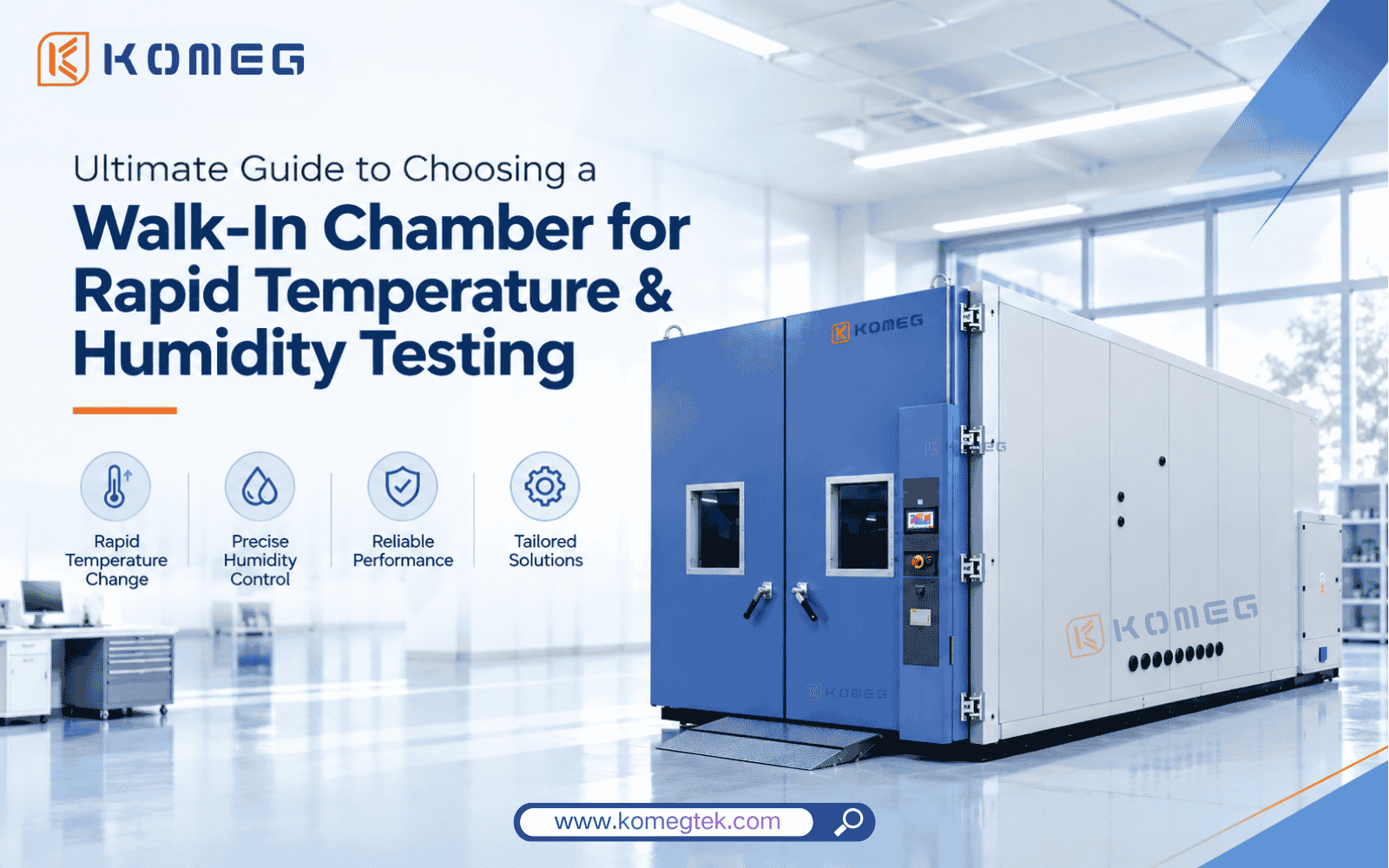
When a product is too large for a conventional environmental chamber, but still needs to undergo aggressive temperature and humidity cycling, a walk-in chamber becomes a practical solution. However, choosing the right system is not simply a matter of selecting a larger chamber.
For rapid-rate temperature and humidity testing, chamber size, ramp rate, heat load, airflow design, refrigeration capacity, humidity performance, and test requirements are closely connected. A system that performs well at an empty-chamber ramp rate may deliver very different results once a large battery pack, automotive assembly, electronic cabinet, or other high-mass test specimen is installed.
The right walk-in chamber should therefore be selected as a complete testing system rather than as an oversized temperature chamber.
This guide explains the main engineering factors that should be considered when choosing a walk-in chamber for rapid temperature and humidity testing.
1. Start With the Actual Test Requirement, Not the Chamber Size
One of the most common mistakes in walk-in chamber selection is starting with the question: How large should the chamber be?
Chamber dimensions are important, but they should be determined after the testing requirements have been defined.
Before selecting a system, engineers should establish the following parameters:
- Temperature range
- Humidity range
- Required temperature change rate
- Test specimen dimensions and weight
- Product heat dissipation
- Number of samples tested simultaneously
- Required temperature and humidity uniformity
- Test duration and cycle profile
- Relevant test standards
- Whether the sample will operate during testing
These factors determine the actual thermal load placed on the environmental chamber.
For example, a chamber may be designed for a temperature range of -40°C to +150°C with a nominal ramp rate of 15°C/min. However, if several large battery modules or heat-generating electronic systems are placed inside, the effective temperature transition rate may decrease significantly.
This is why the relationship between chamber performance and product load should always be evaluated before finalizing a system.
For applications involving aggressive temperature cycling, a Rapid Temperature Change Test Chamber may also be considered as the basis for the walk-in system design.
2. Understand the Difference Between Empty-Chamber and Loaded Ramp Rate
The advertised temperature change rate of an environmental chamber does not always represent the rate that will be achieved during an actual test.
Manufacturers may specify ramp rates under different conditions, including:
- Empty chamber
- Specified test load
- Linear temperature change
- Average temperature change across a defined range
- Full-range or partial-range testing
These conditions matter.
An empty walk-in chamber can change temperature faster because the refrigeration and heating systems only need to control the chamber structure and internal air volume. Once a large test object is introduced, the system must also overcome the thermal mass of that product.
A large metal assembly, battery pack, or electronic cabinet can absorb a significant amount of thermal energy during heating and release it during cooling. As a result, the product temperature may lag behind the chamber air temperature.
For this reason, engineers should clarify whether the required ramp rate refers to:
Air temperature inside the chamber or the actual temperature change of the test specimen.
For reliability testing, the second parameter is often more important.
A well-designed walk-in system should therefore be sized according to the total thermal mass and heat generation of the product rather than relying solely on an empty-chamber performance specification.
3. Chamber Volume Directly Affects Rapid Temperature Performance
Walk-in chambers can range from relatively compact rooms to large environmental testing facilities capable of accommodating vehicles, battery packs, aerospace components, and industrial equipment.
As chamber volume increases, more air must be conditioned during each temperature transition. At the same time, larger chambers require more complex airflow management to maintain temperature uniformity.
Simply increasing the capacity of a standard refrigeration system is usually not enough.
A properly designed large walk-in chamber must balance several factors, including refrigeration capacity, heater capacity, air circulation volume and insulation performance.
The chamber should also provide sufficient clearance around the test specimen. If a large product is positioned too close to an air outlet or return-air path, airflow may become restricted, and temperature distribution may become uneven.
As a general engineering principle, the test space should be designed around the product’s actual dimensions while maintaining enough air circulation space for stable environmental control.
For larger applications, KOMEG also provides Walk-In Environmental Chambers designed around specific product dimensions and test requirements.
4. Airflow Design Is Critical for Temperature Uniformity
Rapid temperature changes depend heavily on airflow.
A refrigeration system may have sufficient cooling capacity, but poor airflow distribution can still lead to slow product temperature response and significant temperature differences within the chamber.
In a walk-in chamber, air must circulate effectively around the entire test specimen. This becomes more challenging when the sample occupies a large percentage of the chamber volume.
Poor airflow can create several problems:
- Localized hot or cold zones
- Uneven temperature distribution
- Slow recovery after door opening
- Large differences between chamber air and product temperature
- Inconsistent test results between different sample locations
For rapid-rate testing, airflow volume and airflow path design should be evaluated together.
High airflow velocity can improve heat transfer between the chamber air and the product surface. However, excessive airflow may create other issues, particularly when testing lightweight components or products that are sensitive to direct airflow.
The best design is not simply the system with the highest fan speed. Instead, it should provide controlled and evenly distributed airflow throughout the usable test area.
This is particularly important when testing large battery systems, electronic cabinets, or automotive assemblies with complex geometries.
5. Humidity Control Becomes More Difficult During Rapid Temperature Changes
Adding humidity control to a rapid temperature change chamber significantly increases the complexity of the system.
During a temperature transition, the saturation point of air changes continuously. When the temperature drops rapidly, moisture may condense on the test sample or inside the chamber. When temperature rises, the system must adjust humidity while maintaining the required thermal profile.
This requires close coordination between the refrigeration system, heating system, and humidification system.
For example, a test may require a transition from:
+85°C / 85% RH → +25°C → -40°C
Each stage presents different humidity-control challenges.
At high temperature and humidity, the chamber must provide stable moisture generation. During cooling, excess moisture must be removed efficiently to prevent uncontrolled condensation or frost formation. At low temperatures, conventional humidity control may no longer be possible depending on the dew point and operating conditions.
Therefore, when selecting a walk-in chamber for combined temperature and humidity testing, it is important to define the entire test profile rather than specifying only a temperature range and humidity range.
The required combination of temperature, humidity, and transition speed should be evaluated as a complete operating envelope.
For applications requiring customized temperature and humidity conditions, a Custom Temperature and Humidity Test Chamber can be engineered around the specific test profile.
6. Consider the Heat Load Generated by the Test Product
Some products are passive during testing, while others remain powered and operational.
A battery pack may be charging or discharging. An electronic control cabinet may be running at full power. A communication system may continuously generate heat.
This internal heat load directly affects chamber performance.
If a product generates several kilowatts of heat, the refrigeration system must remove that additional energy while still maintaining the programmed temperature profile.
Without sufficient cooling capacity, several issues may occur:
- The chamber may fail to reach the required low temperature.
- Cooling rates may decrease significantly.
- Temperature stability may become difficult to maintain.
- Refrigeration compressors may operate continuously at high load.
For this reason, the thermal output of the test specimen should be included in the system design calculations.
A walk-in chamber designed for an inactive 2,000 kg product may require a very different refrigeration system from one designed for the same product operating continuously and generating several kilowatts of heat.
7. Linear and Non-Linear Temperature Profiles Should Be Specified Clearly
Rapid temperature testing can be performed using different control strategies.
A linear temperature profile attempts to maintain a relatively constant rate of temperature change throughout the programmed transition. This is useful when a test standard requires a defined ramp rate.
A non-linear profile allows the chamber to heat or cool at its maximum available capacity. The rate may vary depending on temperature, refrigeration performance and product load.
The difference is important.
For example, a chamber may cool very quickly between +80°C and +20°C but more slowly as it approaches -40°C. If the test requires a controlled 10°C/min linear rate, the control system must actively regulate the refrigeration and heating systems to maintain that profile.
Before selecting a chamber, engineers should therefore determine whether the test requires:
- Maximum achievable ramp rate
- Average ramp rate
- Controlled linear ramp rate
- Product temperature ramp rate
These requirements can significantly affect system design and overall cost.
8. Refrigeration System Design Determines Long-Term Performance
Rapid-rate walk-in chambers place a high demand on the refrigeration system.
Unlike a standard environmental chamber operating under relatively stable conditions, a rapid temperature change system repeatedly switches between high cooling demand and heating demand. The refrigeration system must recover quickly while maintaining stable control.
Depending on the required temperature range, the system may use:
- Single-stage refrigeration
- Cascade refrigeration
- Multi-compressor systems
- Mechanical cooling combined with other technologies
- Water-cooled or air-cooled condensers
For ultra-low-temperature applications, more advanced refrigeration technologies may be required.
KOMEG’s environmental testing systems can be configured according to the required temperature range, cooling rate and test load. For applications involving extremely low temperatures, KOMEG also develops Ultra-Low Temperature Test Chambers for demanding research and reliability testing conditions.
The refrigeration system should not be selected based only on the minimum temperature requirement. Engineers should also consider how quickly the chamber must reach that temperature and how much heat must be removed during the process.
9. Insulation and Chamber Construction Matter More Than Many Buyers Expect
A large walk-in chamber has a much greater surface area than a conventional test chamber.
Heat entering through the chamber walls increases the cooling load and can affect energy consumption and temperature stability.
High-quality insulation is therefore essential.
The chamber structure should also be designed to withstand repeated expansion and contraction caused by temperature cycling. Over time, poorly designed panels, door seals, and joints may develop air leakage.
This can lead to:
- Increased energy consumption
- Frost formation
- Temperature instability
- Moisture leakage
- Reduced cooling performance
Door design is particularly important because walk-in chambers are frequently accessed by operators.
A large chamber door should provide reliable sealing while remaining easy and safe to operate.
For battery and energy storage applications, additional safety features may also be required depending on the test object.
10. Safety Requirements Depend on What You Are Testing
Not every walk-in chamber requires the same safety configuration.
Testing an inactive metal assembly is very different from testing a high-energy lithium battery system.
Depending on the application, additional safety systems may include:
- Over-temperature protection
- Independent temperature limiters
- Smoke detection
- Gas detection
- Emergency pressure relief
- Explosion-proof components
- Fire suppression systems
- Emergency stop systems
- Remote monitoring
- Data logging and alarm notifications
Battery testing may require a particularly detailed risk assessment because thermal runaway, gas release, and fire hazards must be considered.
For this reason, KOMEG provides specialized environmental testing systems for battery applications, including Battery Temperature and Humidity Test Chambers.
The safety system should be designed according to the actual energy level and failure risks of the test specimen rather than treated as a standard optional feature.
11. Data Acquisition and Control Are Part of the Testing System
A walk-in chamber may be physically large, but the quality of the test ultimately depends on measurement and control.
Modern environmental testing systems may include:
- Programmable touchscreen controllers
- Multi-channel temperature monitoring
- Product temperature sensors
- Humidity sensors
- Remote monitoring
- Ethernet communication
- Data logging
- USB data export
- Alarm history
- Integration with external data acquisition systems
For rapid temperature testing, monitoring the chamber air temperature alone may not provide enough information.
Product temperature sensors can help engineers understand whether the test specimen is actually following the required temperature profile.
This distinction becomes particularly important for high-mass products.
A chamber may reach -40°C according to its internal sensor while the product itself remains at +5°C. Without product-level monitoring, the actual environmental stress experienced by the test object may be very different from the programmed profile.
12. Customization Is Often Necessary for Walk-In Rapid Testing
Standard environmental chambers are useful for common test conditions, but large walk-in systems are often application-specific.
Customization may involve:
- Chamber dimensions
- Door configuration
- Internal shelving or fixtures
- Reinforced floors
- Cable ports
- Product power supply connections
- Cooling capacity
- Humidity system design
- Observation windows
- Safety systems
- Data acquisition interfaces
- Special airflow patterns
For example, an automotive battery pack may require a reinforced floor and multiple cable ports for charging and monitoring. An electronic cabinet may require high airflow around specific areas. A large aerospace component may require customized fixtures to maintain its position during testing.
This is why the best walk-in chamber is often not selected from a fixed catalog specification. It is engineered around the actual product and testing process.
How to Choose the Right Walk-In Chamber
Before requesting a quotation, prepare a complete description of the application.
The most useful information to provide includes:
Test specimen: dimensions, weight, material, and thermal mass.
Temperature range: minimum and maximum operating temperatures.
Humidity requirements: including the required temperature and humidity combinations.
Ramp rate: specify whether the requirement applies to chamber air or product temperature.
Heat load: estimate how much heat the product generates during testing.
Test profile: provide the complete temperature and humidity cycle whenever possible.
Relevant standards: such as IEC 60068, MIL-STD-810, or application-specific requirements.
Safety requirements: particularly for batteries, energy storage systems, or other high-energy products.
Providing this information early allows the chamber manufacturer to evaluate the application correctly and recommend a system based on actual engineering requirements.
Final Thoughts
Choosing a walk-in chamber for rapid temperature and humidity testing is not simply about selecting the largest chamber with the fastest advertised ramp rate.
The most important question is whether the system can deliver the required environmental stress with your actual test product inside.
Temperature range, humidity capability, ramp rate, product thermal mass, internal heat load, airflow design, and refrigeration capacity all interact. A well-designed system considers these factors as part of one integrated engineering solution.
For laboratories and manufacturers testing large batteries, automotive components, electronics, aerospace equipment, or industrial systems, a customized walk-in chamber can provide the space and environmental performance required to perform realistic reliability testing.
KOMEG designs and manufactures environmental testing systems ranging from standard chambers to large-scale customized solutions. If you are planning a walk-in chamber for rapid temperature or humidity testing, providing your product dimensions, test profile, required ramp rate and heat load is the best starting point for determining the appropriate system configuration.