

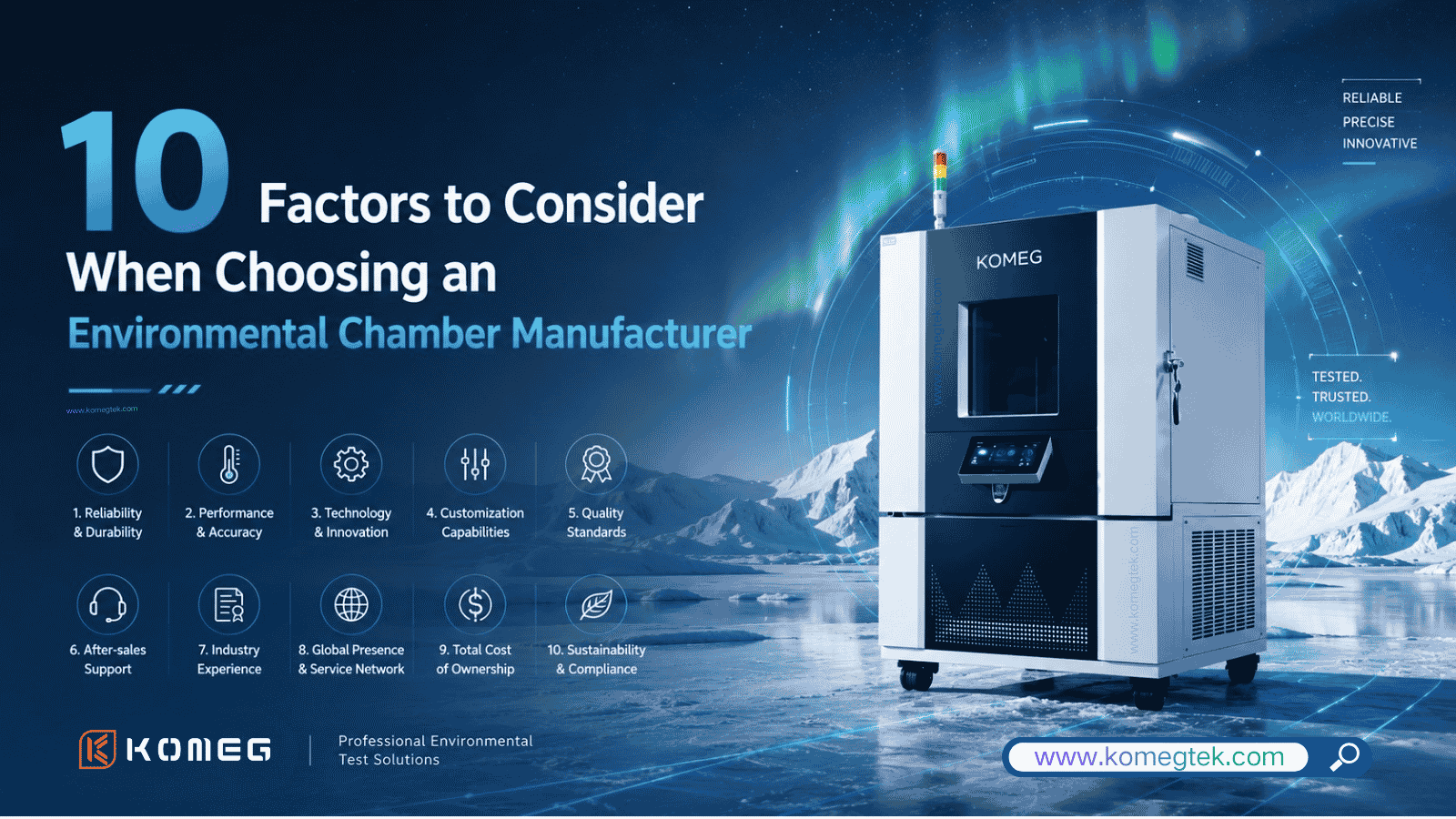
Environmental test chambers play a critical role in product reliability testing across industries such as electronics, automotive, aerospace, batteries, semiconductors, telecommunications, and renewable energy. Whether you need a temperature-humidity chamber, thermal shock chamber, walk-in environmental chamber, HAST chamber, or altitude test chamber, choosing the right manufacturer is just as important as selecting the right equipment. A high-quality environmental chamber is a long-term investment that can serve your laboratory or production facility for more than a decade. The wrong choice can lead to inaccurate test results, unexpected downtime, costly repairs, and compliance issues. This guide outlines the 10 most important factors buyers should evaluate before selecting an environmental chamber manufacturer.
1. Industry Experience and Technical Expertise
The first factor to evaluate is the manufacturer’s experience in environmental simulation technology. Environmental testing equipment involves complex integration of refrigeration systems, heating systems, humidity control systems, airflow management, insulation technology, and intelligent control systems. Manufacturers with decades of experience generally possess stronger engineering capabilities and more mature designs.
When evaluating suppliers, consider:
- Years in business
- Engineering team size
- Number of installed systems
- Industry specialization
- Global project experience
A manufacturer with extensive experience is more likely to understand your testing requirements and provide practical solutions.
2. Product Portfolio and Testing Capabilities
A reliable manufacturer should offer a comprehensive range of environmental testing equipment rather than a single product category.
Look for manufacturers that provide:
Temperature Test Chambers
Used for high-temperature and low-temperature testing.
Temperature and Humidity Chambers
Used for climatic and environmental simulation testing.
Thermal Shock Chambers
Used to evaluate resistance to sudden temperature changes.
HAST Chambers
Used for accelerated reliability testing of semiconductor and electronic components.
Walk-In Environmental Chambers
Used for testing large products, battery systems, automotive components, and complete assemblies.
Altitude Test Chambers
Used for aerospace and aviation applications.
A broad product range usually indicates strong technical capabilities and manufacturing resources.
3. Compliance with International Standards
Environmental testing equipment must support internationally recognized test standards.
Key standards include:
Manufacturers should demonstrate a clear understanding of these standards and provide equipment designed to meet their requirements.
4. Temperature and Humidity Performance
Performance specifications directly affect test accuracy and repeatability.
Important parameters include:
Temperature Range
Common ranges include:
- -40°C to +150°C
- -70°C to +180°C
Humidity Range
Typical range:
- 20% RH to 98% RH
Advanced chambers may provide:
- 10% RH to 98% RH
Temperature Uniformity
Uniformity determines temperature consistency throughout the workspace.
Typical values:
- ±0.5°C to ±2.0°C
Temperature Fluctuation
Typical values:
- ±0.3°C to ±0.5°C
Better performance results in more reliable and repeatable testing.
5. Customization Capabilities
Standard equipment does not always meet specialized testing requirements.
Many industries require custom solutions, including:
- Large battery pack testing
- Energy storage system testing
- Semiconductor reliability testing
- Military testing
- Aerospace component testing
Evaluate whether the manufacturer can provide:
- Custom chamber dimensions
- Extended temperature ranges
- Special cable ports
- Observation windows
- Automated loading systems
- Integrated data acquisition systems
Strong customization capabilities indicate advanced engineering expertise.
6. Manufacturing Quality and Materials
The durability of an environmental chamber depends heavily on construction quality.
Important considerations include:
Internal Chamber Material
High-quality chambers commonly use:
- SUS304 stainless steel
This material offers excellent corrosion resistance and long-term durability.
Insulation Structure
High-density insulation improves temperature stability and energy efficiency.
Refrigeration Components
Look for internationally recognized compressor brands and refrigeration systems designed for continuous operation.
Electrical Components
High-quality relays, contactors, sensors, and controllers significantly improve reliability.
7. Control System and Intelligent Features
Modern laboratories increasingly require automation and remote monitoring.
Key features may include:
- Color touch-screen controller
- Programmable test profiles
- Ethernet communication
- USB data export
- Remote monitoring
- Alarm notification systems
- Cloud-based data management
Advanced control systems improve operational efficiency and reduce manual intervention.
8. Service and Technical Support
Even the best equipment requires maintenance and support.
Before selecting a supplier, evaluate:
Installation Services
Can the manufacturer provide on-site installation assistance?
Training Programs
Are operators trained properly?
Spare Parts Availability
Can replacement parts be delivered quickly?
Technical Support
Is remote troubleshooting available?
Calibration Services
Can the manufacturer support long-term calibration requirements?
Reliable after-sales support minimizes downtime and protects your investment.
9. Certifications and Quality Management
Quality certifications demonstrate a manufacturer’s commitment to consistent production standards.
Important certifications include:
- ISO 9001
- ISO 14001
- CE Certification
- Third-party performance verification
These certifications provide confidence in product quality and manufacturing processes.
10. Customer References and Global Project Experience
One of the best indicators of reliability is proven project success.
Ask for references from industries similar to your own.
Examples include:
- Semiconductor manufacturers
- Automotive suppliers
- Battery manufacturers
- Aerospace companies
- Research laboratories
- Telecommunications companies
A manufacturer with successful projects across multiple industries is more likely to understand complex testing challenges.
Why Many Global Companies Choose KOMEG
Founded in 1990, KOMEG has more than three decades of experience in environmental reliability testing equipment manufacturing.
KOMEG provides a complete range of environmental testing solutions, including:
- Temperature and Humidity Chambers
- Rapid Temperature Change Chambers
- Thermal Shock Chambers
- Walk-In Environmental Chambers
- HAST Chambers
- Battery Test Chambers
- Altitude Test Chambers
- Salt Spray Chambers
With a manufacturing facility covering more than 20,000 square meters, over 160 employees, and products exported to more than 70 countries and regions, KOMEG supports customers across electronics, automotive, aerospace, semiconductor, telecommunications, energy storage, and scientific research industries.
KOMEG is committed to helping customers improve product quality, accelerate reliability validation, and meet international testing standards.
Choosing an environmental chamber manufacturer involves much more than comparing prices and specifications. Buyers should carefully evaluate technical expertise, manufacturing quality, testing performance, customization capabilities, certifications, and long-term service support.
By considering these 10 factors, organizations can select a reliable environmental chamber manufacturer that supports their testing requirements today and their growth plans in the future.