

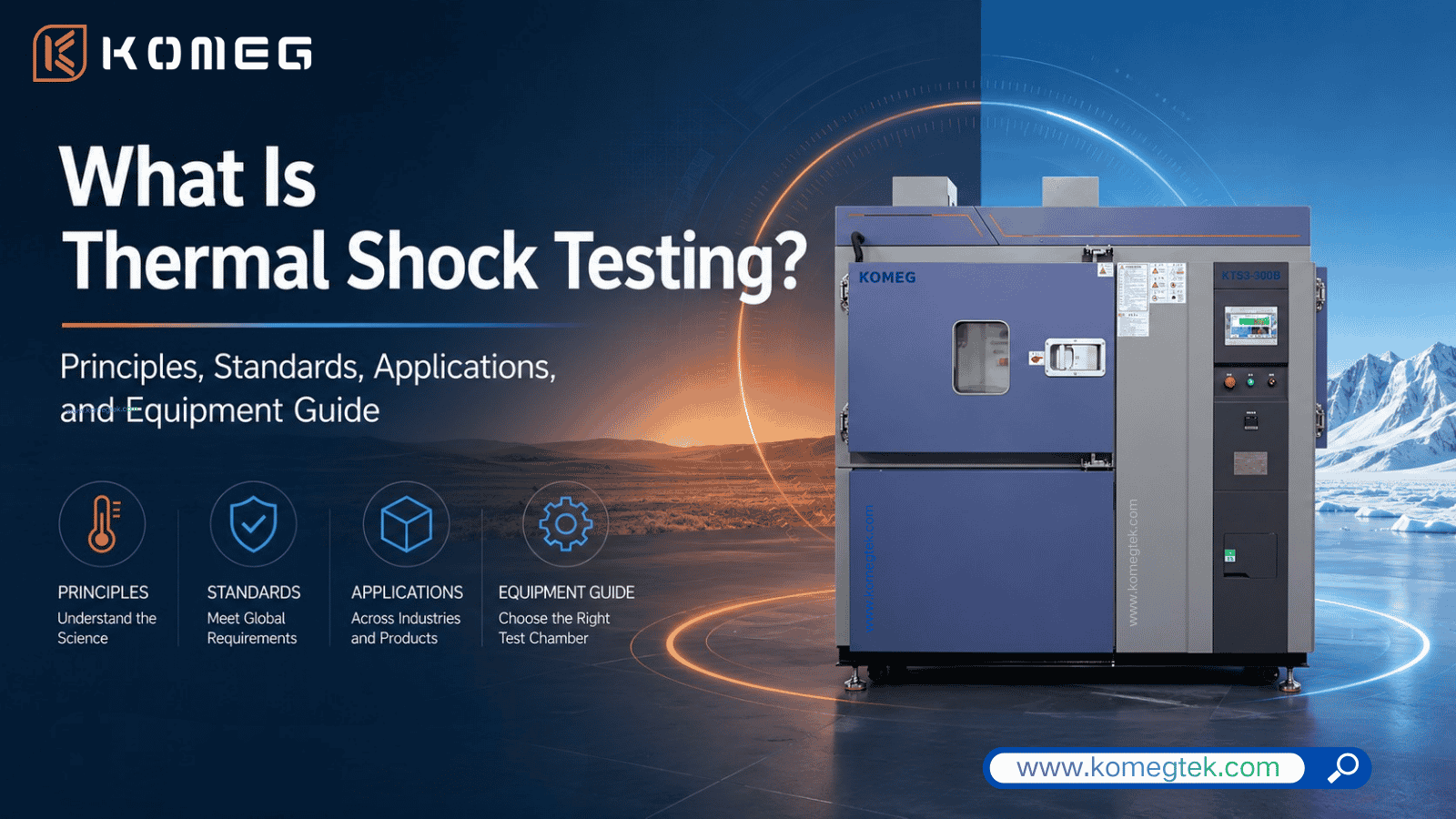
Modern products are expected to operate reliably in some of the harshest environments imaginable. Automotive electronics must survive freezing winter mornings and scorching engine compartments. Aerospace components experience rapid temperature transitions during takeoff, flight, and landing. Semiconductor devices generate significant heat during operation and may face sudden cooling during manufacturing or field use.
These extreme temperature changes can create mechanical stress within materials, leading to cracking, delamination, solder joint fatigue, seal failure, and electrical malfunction. To evaluate a product’s ability to withstand these conditions, manufacturers rely on thermal shock testing. Thermal shock testing is one of the most widely used environmental reliability tests across industries such as electronics, semiconductors, aerospace, automotive, defense, telecommunications, batteries, and industrial manufacturing. It helps identify potential weaknesses before products reach the market, reducing warranty costs and improving long-term reliability. This guide explains the principles, standards, applications, and equipment used in thermal shock testing.
What Is Thermal Shock Testing?
Thermal shock testing is an environmental reliability test that evaluates a product’s ability to withstand rapid and extreme temperature changes.
During testing, specimens are repeatedly exposed to alternating high-temperature and low-temperature environments within a short transfer period. The sudden expansion and contraction of different materials generate thermal stress that may reveal latent defects.
Unlike traditional temperature cycling tests, which gradually transition between temperatures, thermal shock testing subjects products to abrupt temperature changes that simulate the most severe operating conditions.
Typical thermal shock test conditions include:
| Test Level | Low Temperature | High Temperature |
|---|---|---|
| Standard | -40°C | +125°C |
| Automotive | -55°C | +150°C |
| Military | -65°C | +150°C |
| Semiconductor | -65°C | +175°C |
The objective is to accelerate failure mechanisms that may occur during years of field operation.
How Does Thermal Shock Testing Work?
Thermal shock testing is based on the principle that different materials expand and contract at different rates when exposed to temperature changes.
When temperatures change rapidly:
- Metals expand and contract
- Plastics respond differently
- Ceramics experience thermal strain
- Adhesives weaken under stress
- Solder joints undergo fatigue
These differences create mechanical stresses at material interfaces.
Common thermal shock chambers expose products to:
Hot Zone
Typically maintained between:
+60°C to +200°C
Cold Zone
Typically maintained between:
-40°C to -80°C
Transfer Time
Products are transferred between zones in:
≤10 seconds
Recovery Time
The chamber restores target temperatures within:
≤5 minutes
Repeated cycling accelerates damage accumulation and reveals potential failure points.
Thermal Shock Testing vs Thermal Cycling
Many engineers confuse thermal shock testing with thermal cycling testing. While both evaluate temperature-related reliability, they serve different purposes.
| Parameter | Thermal Shock Testing | Thermal Cycling Testing |
|---|---|---|
| Temperature Transition | Very Rapid | Gradual |
| Transfer Time | Seconds | Minutes or Hours |
| Stress Severity | Very High | Moderate |
| Main Objective | Structural Reliability | Lifetime Evaluation |
| Typical Duration | Hours to Days | Days to Weeks |
| Failure Detection | Early Weaknesses | Long-Term Fatigue |
Thermal shock testing is ideal for identifying manufacturing defects and material compatibility issues. Thermal cycling is better suited for evaluating product life expectancy.
Many qualification programs use both tests together.
Common Failure Mechanisms Revealed by Thermal Shock Testing
Thermal shock testing can expose numerous reliability issues that may remain hidden under normal operating conditions.
Solder Joint Fatigue
Repeated expansion and contraction can cause micro-cracks within solder joints, especially in:
- BGA packages
- Surface-mounted components
- Power modules
Cracked Semiconductor Packages
Plastic encapsulation materials may crack due to thermal mismatch between:
- Silicon die
- Mold compound
- Lead frame
Delamination
Thermal stress may separate bonded layers within:
- PCBs
- Semiconductor packages
- Laminated materials
Seal and Gasket Failure
Products requiring environmental sealing may develop leaks after repeated temperature transitions.
Optical Misalignment
Thermal shock can affect:
- Fiber optic modules
- Co-Packaged Optics (CPO)
- Laser assemblies
- Camera systems
Material Deformation
Warping and dimensional instability may occur in:
- Plastic housings
- Composite structures
- Mechanical assemblies
Major Thermal Shock Testing Standards
Various international standards define thermal shock testing requirements.
IEC 60068-2-14
One of the most commonly used thermal shock standards.
Applicable to:
- Electronics
- Electrical equipment
- Consumer products
Key focus:
Environmental testing and temperature change resistance.
MIL-STD-810H
Widely used for military equipment.
Evaluates:
- Extreme environmental durability
- Field deployment readiness
- Defense applications
JESD22-A106
Developed by JEDEC for semiconductor qualification.
Used to assess:
- Semiconductor package reliability
- Solder integrity
- Electronic component durability
AEC-Q100
Automotive electronic qualification standard.
Requires thermal shock testing for:
- Integrated circuits
- Automotive semiconductors
- Vehicle electronics
IPC Standards
Frequently used for PCB and electronic assembly qualification.
Focuses on:
- Solder joint reliability
- Board-level durability
Industries That Use Thermal Shock Testing
Semiconductor Industry
Thermal shock testing is critical for:
- IC packages
- Power devices
- Memory chips
- Sensors
- Silicon photonics
Semiconductor manufacturers often combine thermal shock testing with HAST testing and temperature cycling tests.
Automotive Electronics
Modern vehicles contain hundreds of electronic modules.
Applications include:
- Engine control units
- Battery management systems
- ADAS systems
- Inverters
- Power electronics
Thermal shock testing verifies reliability across varying climate conditions.
Aerospace and Defense
Aircraft and defense equipment encounter severe environmental changes.
Testing helps validate:
- Avionics
- Navigation systems
- Radar systems
- Communication equipment
Telecommunications
5G infrastructure and optical communication equipment require long-term environmental reliability.
Typical products include:
- Optical transceivers
- Fiber optic modules
- Base station electronics
Battery and Energy Storage
Battery systems generate heat during charging and discharging.
Thermal shock testing helps assess:
- Battery pack durability
- Thermal management systems
- Energy storage reliability
Types of Thermal Shock Chambers
Two-Zone Thermal Shock Chambers
Most widely used configuration.
Features:
- Separate hot zone
- Separate cold zone
- Moving basket transfer system
Advantages:
- Fast transition
- High efficiency
- Lower energy consumption
Three-Zone Thermal Shock Chambers
Includes:
- Hot chamber
- Cold chamber
- Test chamber
Advantages:
- No product movement
- Better for fragile products
- Higher temperature stability
Air-to-Air Thermal Shock Chambers
Use conditioned air for temperature transitions.
Suitable for:
- Electronics
- Semiconductors
- Consumer products
Liquid-to-Liquid Thermal Shock Chambers
Use heated and cooled liquids.
Provide:
- Faster heat transfer
- More severe thermal stress
Commonly used in specialized applications.
How to Select a Thermal Shock Chamber
When choosing a thermal shock chamber, engineers should consider:
Temperature Range
Typical options:
- -40°C to +150°C
- -55°C to +150°C
- -65°C to +150°C
Test Volume
Select chamber size based on:
- Product dimensions
- Sample quantity
- Future testing requirements
Transfer Time
Faster transfer times create more severe thermal shock conditions.
Recovery Time
Short recovery times improve testing efficiency.
Temperature Uniformity
Uniform temperature distribution ensures repeatable results.
Compliance Requirements
Ensure compatibility with standards such as:
- IEC 60068
- MIL-STD-810
- JESD22
- AEC-Q100
Why Choose KOMEG Thermal Shock Chambers?
For more than 36 years, KOMEG has specialized in environmental reliability testing equipment for global manufacturers and laboratories.
KOMEG thermal shock chambers are designed to meet demanding reliability testing requirements across semiconductor, automotive, aerospace, battery, and electronics industries.
Key advantages include:
- Temperature ranges from -65°C to +150°C
- Fast transfer times ≤10 seconds
- Recovery times ≤5 minutes
- Intelligent touchscreen controller
- Remote monitoring capability
- SUS304 stainless steel interior
- Comprehensive safety protection systems
- Standard and customized solutions available
KOMEG offers both two-zone and three-zone thermal shock chambers to support a wide range of testing applications.
Frequently Asked Questions
What is the purpose of thermal shock testing?
Thermal shock testing evaluates a product’s ability to withstand rapid temperature changes and identifies potential reliability issues before deployment.
What is the difference between thermal shock and thermal cycling?
Thermal shock involves sudden temperature transitions, while thermal cycling changes temperature gradually over time.
Which industries use thermal shock testing?
Semiconductor, automotive, aerospace, telecommunications, battery, defense, and industrial manufacturing industries commonly use thermal shock testing.
What temperature range is commonly used?
The most common range is -40°C to +150°C, although more severe testing may use -65°C to +150°C or higher.
Thermal shock testing is a critical reliability assessment method used to simulate sudden temperature transitions that products may encounter throughout their service life. By exposing products to rapid changes between extreme hot and cold environments, manufacturers can identify hidden defects, validate material compatibility, and improve overall product reliability.
As industries such as semiconductors, electric vehicles, energy storage, aerospace, and telecommunications continue to demand higher reliability standards, thermal shock testing will remain an essential part of product qualification programs. Choosing the right thermal shock chamber and testing strategy can significantly reduce field failures, shorten development cycles, and enhance product quality.
For organizations seeking accurate, repeatable, and standards-compliant thermal shock testing solutions, KOMEG provides advanced thermal shock chambers engineered to meet the evolving needs of modern reliability testing.