

As advanced technologies are increasingly deployed in commercial aviation, satellite systems, electric vehicles, utility-scale energy storage systems, and next-generation telecommunications infrastructure, manufacturers face a critical reliability bottleneck: ensuring flawless operation under reduced atmospheric pressure.
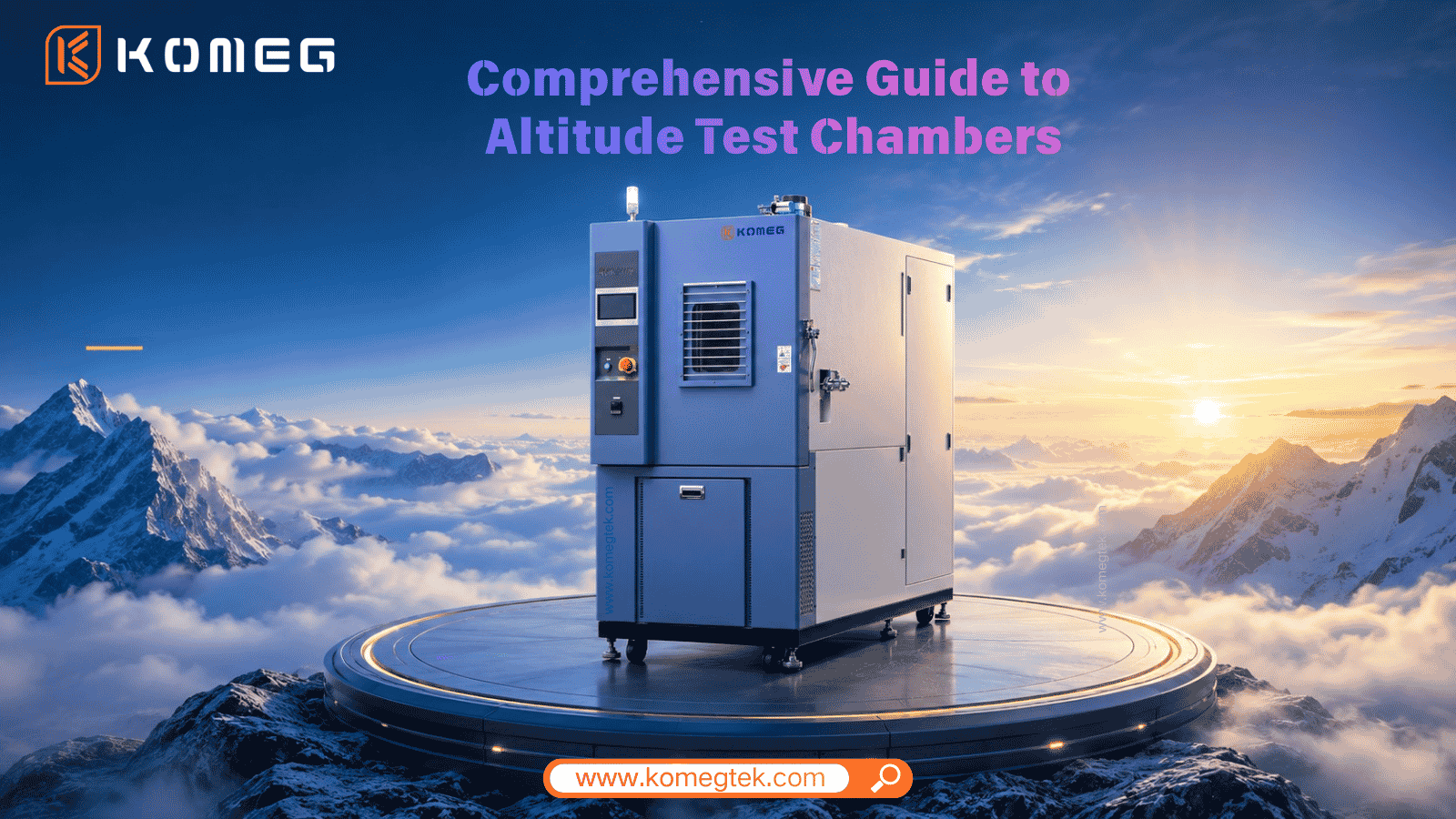
At higher elevations, the dramatic drop in air density and atmospheric pressure triggers a cascade of physical, thermal, and electrical changes. To preempt catastrophic field failures, global OEMs utilize Altitude Test Chambers, also known as Low-Pressure Simulation Chambers, to stress-test products within a highly controlled, repeatable laboratory environment.
1. What Is an Altitude Test Chamber?
An Altitude Test Chamber is a highly specialized environmental simulation enclosure equipped with a high-capacity vacuum system. By precisely evacuating air from a sealed test space, it recreates the low-pressure conditions encountered from mountain elevations up to commercial cruising altitudes and near-space environments.
Unlike standard temperature-humidity cabinets, modern altitude chambers integrate three distinct environmental stressors into a single test profile:
Barometric Pressure Reduction: Simulating deep vacuum or specific flight profiles.
Dynamic Temperature Margins: Replicating extreme thermal gradients at altitude.
Controlled Relative Humidity: Simulating moisture behavior during rapid ascent and descent transitions.
2. The Science of High-Altitude Risks: Why Testing Is Critical
Products engineered at sea level (approximately 101.3 kPa) often behave unpredictably when atmospheric pressure drops. Below are the primary failure modes simulated within an altitude chamber:
- Thermal Management Degradation: Rarefied air drastically reduces convective cooling efficiency. Without adequate air density to dissipate heat, power electronics and electric vehicle batteries experience rapid thermal build-up, leading to premature component aging or thermal runaway.
- Dielectric Breakdown and Arcing: Lower air pressure decreases the insulating property, or dielectric strength, of air. This amplifies the risk of corona discharge, high-voltage electrical arcing, and insulation breakdown in avionics and power modules.
- Seal Compromise and Outgassing: The internal-external pressure differential exerts massive mechanical stress on hermetic seals, liquid cooling loops, and enclosures. This causes structural deformation, outgassing, fluid leaks, and subsequent moisture ingress.
- Lithium-Ion Battery Expansion: Under vacuum, pouch cells and battery modules experience internal pressure imbalances, resulting in cell swelling, safety vent premature activation, or electrolyte leakage.
As an engineering reference for atmospheric decay: pressure drops from 101.3 kPa at sea level to approximately 70.0 kPa at 3,000 meters, 35.0 kPa at 8,000 meters, and plunges to 11.6 kPa at 15,000 meters, which represents the critical threshold for international transit simulation.
3. How Does an Advanced Altitude Test Chamber Work?
A premium altitude simulation system relies on the seamless synchronization of four core engineering subsystems:
High-Vacuum Evacuation System
Driven by heavy-duty, multi-stage vacuum pumps, the system rapidly evacuates air to achieve precise pressure setpoints. KOMEG systems are engineered to simulate deep vacuums down to 0.5 kPa, accommodating testing requirements for high-altitude aerospace profiles and near-space simulations.
Dynamic Thermal System
Because altitude testing frequently requires simultaneous thermal cycling, the chamber utilizes advanced cascade refrigeration and targeted heating arrays. Standard configurations support ranges from -20°C to +150°C and -40°C to +150°C, with ultra-low expansions reaching -70°C to +150°C. Optional high-temperature modifications allow testing up to +180°C.
Precision Humidity System
To simulate low-altitude humidity combined with low-pressure transitions, specialized climate configurations are available. The system covers a standard range from 20% RH to 98% RH, with extended low-humidity options customizable down to 10% RH or 5% RH for ultra-dry aerospace sensor validation.
Smart Ecosystem and Connectivity
Modern test protocols demand rigorous data traceability. Advanced chambers feature an intuitive architecture built for laboratory automation, incorporating high-definition color touch-screen programmable controllers alongside network integration via Ethernet, RS485, and USB data export for remote monitoring.
4. Key International Testing Standards Met
Compliance is mandatory for international market access. Altitude test chambers are engineered to fulfill the world’s most stringent test methods:
MIL-STD-810H Method 500.6: The definitive standard for defense and military hardware, dictating profiles for Storage at Altitude, Operational Altitude, Rapid Decompression, and Explosive Decompression.
UN 38.3 Section 38.3.4.1: A strict safety mandate for global lithium battery logistics, requiring cells and modules to withstand a simulated altitude of 15,000 meters at a low pressure of 11.6 kPa for a minimum of six hours.
RTCA DO-160G Section 4.0: The environmental blueprint for airborne equipment, focusing heavily on commercial avionics, flight controls, and in-cabin electronics.
IEC 60068-2-13: The international environmental standard for low-pressure air testing across consumer, industrial, and automotive electronics.
The hardware fully supports a broad spectrum of additional global and regional standards, including GJB150.2A, GJB150.6A, GB/T 2423, JIS W 0812, JIS W 7114, ASTM D6653, ISO 2873, UL 1642, UL 2580, and UN ECE R100.
5. Strategic Applications Across Industries
Aerospace and Avionics: Validating critical flight controls, radar systems, communication transceivers, and structural sensors under flight-level pressure changes.
Lithium-Ion Batteries and Energy Storage Systems: Conducting safety validation, structural swell analysis, and transit certification for cells, modules, and complete high-voltage battery packs.
Electric Vehicles: Ensuring that high-voltage Battery Management Systems, power inverters, and on-board charging systems do not suffer from dielectric breakdown when driving through mountainous passes.
Semiconductors and Power Modules: Evaluating high-power IGBT modules, automotive-grade integrated circuits, and smart sensors for thermal dissipation efficiency under reduced air density.
Telecommunications: Testing high-altitude base stations, remote microwave links, and satellite ground terminal hardware against combined climate and altitude stresses.
6. Engineering Checklist: Choosing the Right Altitude Chamber
When specifying an altitude simulation system for your laboratory, consider the following parameters to secure maximum return on investment:
- Minimum Target Pressure: Ensure the vacuum pump configuration can reliably reach your lowest required pressure. Systems reaching 0.5 kPa offer excellent future-proofing for advanced aerospace profiles.
- Temperature Change Rates: For Environmental Stress Screening, verify the temperature ramp rate under loaded conditions, rather than relying solely on empty chamber baselines.
- Internal Volume and Geometry: Select a standard footprint from internal capacities of 125L, 216L, 504L, or 1000L, or opt for engineered walk-in and drive-in altitude rooms for large-scale battery racks or automotive assemblies.
- Active Heat Load Dissipation: If testing live electronics or active battery packs, the refrigeration capacity must counteract the heat generated by the device under test.
- Integrated Safety Systems: For battery testing, ensure the chamber features essential safety hardware, including over-temperature protection, vacuum relief valves, explosion-proof vents, gas detection, and emergency stop matrices.
Why Global Manufacturers Trust KOMEG
Established in 1990, KOMEG brings over three decades of environmental simulation expertise to global research and development and quality assurance laboratories. Our altitude test chambers offer an elite blend of premium technical specifications, uncompromised structural reliability, and exceptional cost-performance value.
Ultra-deep vacuum simulation down to 0.5 kPa.
Extensive thermal flexibility ranging from -70°C to +150°C.
Turnkey safety packages specifically engineered for hazardous lithium battery testing.
Full compliance with major international testing standards including MIL, IEC, UN, and RTCA.
Global technical support architecture ensuring reliable installation, calibration, and maintenance.
As global engineering boundaries push higher into the atmosphere and further into high-voltage applications, altitude simulation is a core pillar of risk mitigation. Partnering with the right chamber manufacturer ensures your products deliver on safety, compliance, and long-term field reliability.
Contact KOMEG’s application engineers today to configure the ideal altitude simulation system for your industry’s exact specifications.