

Corrosion is one of the most common causes of product failure across industries. From automotive fasteners and electronic connectors to renewable energy systems and marine components, exposure to moisture, salt, and harsh environmental conditions can significantly reduce product lifespan and reliability.
To evaluate corrosion resistance efficiently and consistently, manufacturers around the world rely on standardized salt spray testing methods. Among these standards, ISO 9227 is one of the most widely recognized and adopted international standards for artificial corrosion testing.
This guide explains what ISO 9227 is, how salt spray testing works, the different test methods defined by the standard, common applications, and how to select the right salt spray chamber for compliance testing.
What Is ISO 9227?
ISO 9227 is an international standard published by the International Organization for Standardization (ISO) that specifies methods for conducting three types of salt spray tests:
Neutral salt spray (NSS)
Acetic acid salt spray (AASS)
Copper-accelerated acetic acid salt spray (CASS)
The purpose of ISO 9227 is to create a controlled and repeatable corrosive environment that allows manufacturers to evaluate the corrosion resistance of:
Metallic materials
Protective coatings
Electroplated surfaces
Painted components
Conversion coatings
Fasteners and hardware
Electronic enclosures
Rather than waiting months or years for natural corrosion to occur outdoors, engineers can accelerate the corrosion process inside a salt spray chamber and obtain comparative performance data within days or weeks.
Today, ISO 9227 is widely used in quality control, product development, supplier qualification, and certification testing.
Why Is Salt Spray Corrosion Testing Important?
Corrosion costs industries billions of dollars every year in maintenance, repairs, warranty claims, and equipment replacement. Even a small amount of corrosion can lead to:
Structural weakness
Electrical failure
Water ingress
Poor product appearance
Reduced service life
Safety risks
As products become increasingly exposed to challenging environments—such as coastal regions, industrial pollution, and high-humidity climates—corrosion resistance has become a critical design requirement.
Salt spray testing helps manufacturers:
Compare different coating systems
Evaluate material durability
Verify supplier quality
Improve product reliability
Reduce warranty costs
Meet customer specifications
For industries such as automotive, aerospace, electronics, energy storage, and marine engineering, corrosion testing is often a mandatory part of product qualification.
Types of Salt Spray Tests Defined in ISO 9227
ISO 9227 defines three primary corrosion testing methods, each with increasing aggressiveness.
Neutral Salt Spray (NSS) Test
The NSS test is the most commonly used method. It uses a 5% sodium chloride solution atomized into a fine mist inside the test chamber.
Typical test conditions:
Chamber temperature: 35°C ± 2°C
Salt concentration: 50 ± 5 g/L
pH value: 6.5 – 7.2
Common applications:
Zinc plating and galvanized coatings
Fasteners and industrial hardware
Powder-coated products
Because of its simplicity and broad applicability, NSS testing has become the default corrosion evaluation method for many industries.
Acetic Acid Salt Spray (AASS) Test
The AASS test is more aggressive than NSS testing. Acetic acid is added to the salt solution to lower the pH and accelerate corrosion.
Typical applications:
Decorative coatings
Nickel-chromium plating
Automotive trim components
Consumer products
The more acidic environment helps reveal coating defects faster than standard NSS testing.
Copper-Accelerated Acetic Acid Salt Spray (CASS) Test
The CASS test is the most severe corrosion test described in ISO 9227. In addition to acetic acid, copper chloride is added to the solution to further accelerate corrosion reactions.
Typical applications:
Automotive decorative coatings
High-performance electroplating systems
Premium corrosion-resistant finishes
Due to its high severity, CASS test durations are typically much shorter than NSS tests.
How Does ISO 9227 Salt Spray Testing Work?
A salt spray chamber creates a controlled corrosive environment by continuously atomizing a salt solution into fine droplets.
Inside the chamber:
Salt solution is prepared according to ISO 9227 requirements.
Compressed air atomizes the solution into a fog.
The chamber maintains a stable temperature.
Test specimens are positioned at specified angles (typically 15° to 30° from vertical).
Corrosion develops on the sample surface over the defined exposure period.
After exposure, engineers inspect the specimens for:
Rust formation
Blistering
Coating delamination
Pitting corrosion
Surface discoloration
Protective coating failure
The results are then compared against customer specifications or acceptance criteria.
ISO 9227 Test Conditions
Accurate and stable test conditions are essential for reliable, repeatable results.
Salt Solution
The standard specifies a sodium chloride solution prepared with high-purity water (deionized or distilled). Contaminants such as copper, chloride, or organic matter can significantly affect corrosion behavior and invalidate test results.
Chamber Temperature
For NSS and AASS testing, the standard chamber temperature is 35°C ± 2°C. Maintaining stable temperature conditions is critical to achieving repeatable results.
Fog Collection Rate
The fog collection rate, measured using one or more collection funnels, is typically 1.0 – 2.0 mL per hour per 80 cm². This ensures a consistent corrosion environment throughout the chamber.
pH Requirements
The pH value must remain within specified limits and be checked regularly:
NSS: pH 6.5 – 7.2
AASS: pH 3.1 – 3.3
CASS: pH 3.1 – 3.3
Regular monitoring is necessary to ensure ongoing compliance.
Air Supply
Compressed air used for atomization must be:
Clean and dry
Oil-free
Properly filtered
Contaminated air can alter test results and damage the chamber’s internal components.
Common ISO 9227 Test Durations
Test duration depends on product specifications, coating type, and industry requirements. Common exposure periods include:
24 hours
48 hours
96 hours
240 hours
500 hours
720 hours
1000 hours
For highly corrosion-resistant coatings (e.g., automotive topcoats or marine-grade finishes), exposure periods may exceed 2000 hours.
However, it is important to understand that salt spray hours do not directly correspond to years of outdoor service life. Salt spray testing is primarily used for comparative evaluation (e.g., Coating A vs. Coating B) rather than precise lifetime prediction.
ISO 9227 vs. ASTM B117
One of the most frequently asked questions is the difference between ISO 9227 and ASTM B117.
Both standards are used for salt spray corrosion testing and share many similarities. However, there are key differences:
| Aspect | ISO 9227 | ASTM B117 |
|---|---|---|
| Geographic Recognition | Internationally recognized | Widely used in North America |
| Test Methods Included | NSS, AASS, and CASS | Primarily NSS (neutral salt spray) |
| Specimen Angle | Typically 15° – 30° | Typically 15° – 30° (similar) |
| Common Applications | Global automotive, electronics, and marine | North American automotive, defense, and coatings |
Many multinational manufacturers require compliance with both standards, depending on customer and market requirements.
Industries That Use ISO 9227 Testing
Automotive Industry
Corrosion resistance directly impacts vehicle safety, durability, and warranty costs. Applications include fasteners, body panels, connectors, brake components, and decorative trims.
Electronics Industry
Electronic products often contain metal contacts and housings vulnerable to corrosion. ISO 9227 testing is used for connectors, switches, communication equipment, and outdoor electronics.
Renewable Energy
Solar and energy storage systems operate outdoors for decades. Manufacturers use salt spray testing to evaluate battery enclosures, mounting structures, electrical cabinets, and solar racking systems.
Aerospace Industry
Aircraft components are frequently exposed to harsh environmental conditions, especially in naval aviation. Salt spray testing helps verify long-term corrosion resistance and safety performance.
Marine Applications
Marine environments are among the most corrosive operating conditions. ISO 9227 testing is commonly used for offshore equipment, ship hardware, coastal infrastructure, and marine electronics.
Equipment Required for ISO 9227 Testing
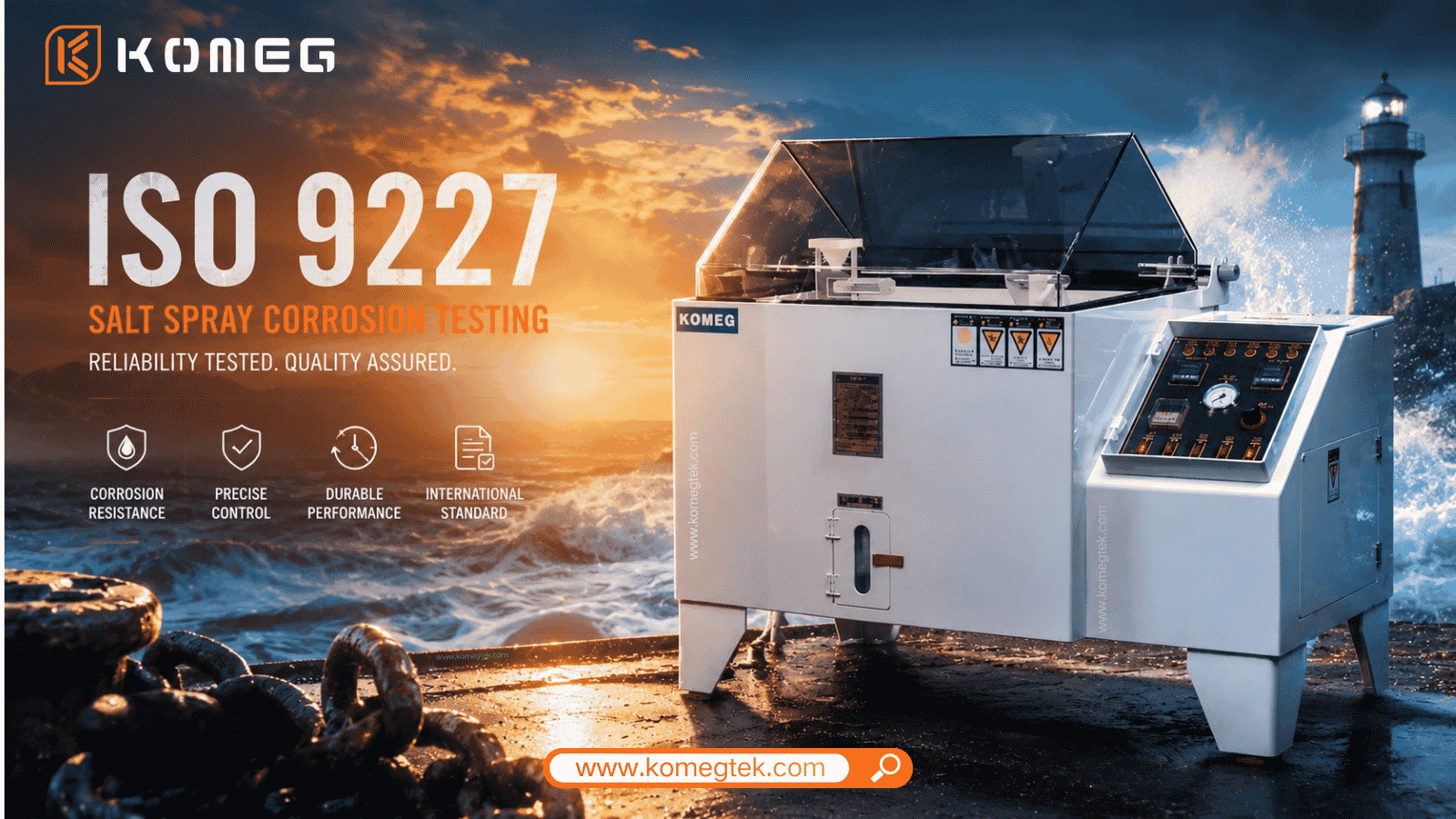
The core equipment required is a Salt Spray Test Chamber. A high-quality chamber should provide:
Precise temperature control
Uniform salt fog distribution
Automatic water replenishment
Corrosion-resistant chamber construction (typically PVC or PP)
Programmable controller with data logging
- Long-term stability and reliability
Modern salt spray chambers also feature remote monitoring, automated test management, and real-time alarm functions.
Common Mistakes in Salt Spray Testing
Even when using certified equipment, testing errors can lead to unreliable or non-compliant results. Common mistakes include:
Incorrect Salt Concentration
Improper solution preparation can dramatically affect corrosion rates and invalidate comparisons.
Improper Sample Placement
Specimens should be positioned according to ISO 9227 requirements to avoid shielding or dripping effects. Overcrowding the chamber is a frequent error.
Poor Chamber Maintenance
Nozzle contamination, salt residue buildup, and drain blockages can affect spray uniformity and temperature stability.
Inaccurate pH Control
Failure to monitor pH regularly—especially in AASS and CASS tests—can result in non-compliant test conditions.
Lack of Calibration
Temperature sensors, collection funnels, pH meters, and monitoring instruments should be calibrated periodically to maintain accuracy.
How to Choose an ISO 9227 Salt Spray Chamber
When selecting a chamber for ISO 9227 compliance testing, consider the following factors:
Chamber Size
Choose an internal volume suitable for both current and future testing requirements. Consider the largest sample you will ever need to test.
Material Construction
High-quality corrosion-resistant materials (e.g., PVC or PP) ensure long service life and prevent chamber degradation during long-term testing.
Spray Uniformity
Uniform fog distribution across the entire working area is essential for consistent results. Check that the chamber meets ISO 9227 collection uniformity requirements.
Control Accuracy
Stable temperature and spray control improve repeatability and reduce test-to-test variation. Look for PID controllers with good thermal response.
Compliance Verification
The chamber should be fully compliant with ISO 9227 and preferably come with a factory calibration certificate. Some chambers also support ASTM B117 standards.
Service and Support
Reliable technical support, spare parts availability, and calibration services are critical for long-term operation and minimizing downtime.
ISO 9227 is one of the world’s most important standards for evaluating corrosion resistance through accelerated salt spray testing. By providing a controlled and repeatable corrosive environment, the standard enables manufacturers to assess coatings, materials, and finished products efficiently—before they enter the market.
Whether testing automotive components, electronic devices, renewable energy systems, aerospace parts, or marine equipment, ISO 9227 helps manufacturers:
Improve product reliability
Reduce failure risks
Shorten development cycles
Ensure long-term performance
As corrosion resistance becomes an increasingly critical requirement across industries, understanding and correctly implementing ISO 9227 testing procedures remains essential for quality assurance, regulatory compliance, and successful product development.