

With the rapid growth of electric vehicles (EVs), renewable energy storage, and high-performance consumer electronics, battery safety and reliability have become critical concerns across industries. As energy density increases, so does the risk associated with environmental stress.
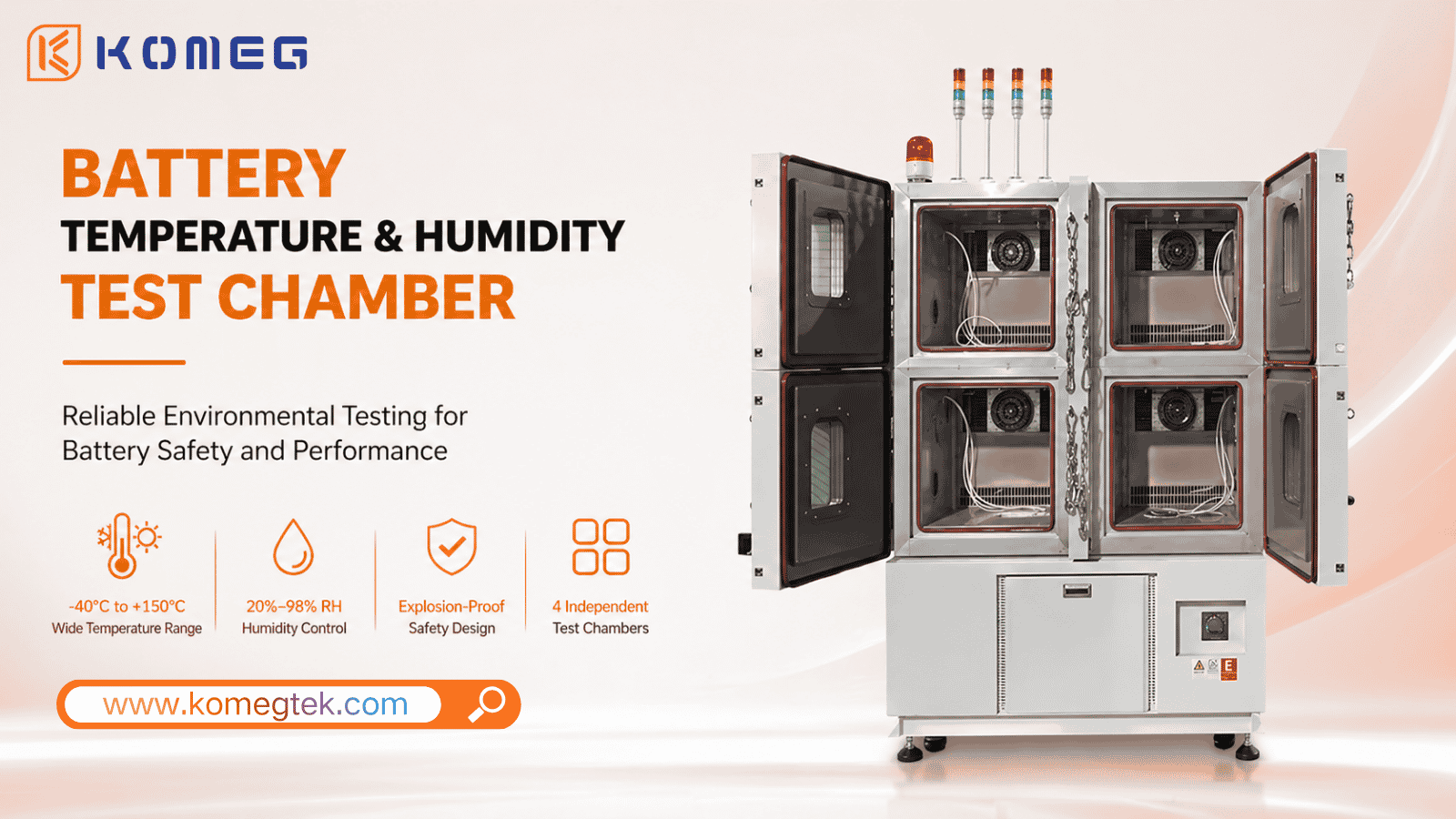
A Battery Temperature and Humidity Test Chamber is a specialized environmental testing system designed to simulate extreme climatic conditions—combining temperature, humidity, and safety-controlled environments—to evaluate the performance, durability, and safety of batteries under real-world and accelerated conditions.
1. What is a Battery Temperature and Humidity Test Chamber?
A battery temperature and humidity test chamber is an advanced environmental simulation system used primarily in the new energy industry, supporting testing for:
- 3C batteries (consumer electronics)
- Power batteries (EV applications)
- Energy storage systems (ESS)
It enables engineers to perform temperature storage tests, thermal cycling tests, and humidity reliability tests, often integrated with charge/discharge systems for real-time performance evaluation.
Unlike standard environmental chambers, battery test chambers are specifically engineered with enhanced safety and explosion-proof design, addressing the inherent risks of lithium-ion batteries.
2. Why Battery Environmental Testing is Critical
Battery systems are highly sensitive to environmental factors. Variations in temperature and humidity can directly impact:
- Electrochemical reaction rates
- Internal resistance and capacity stability
- Structural integrity of battery materials
- Seal reliability and moisture ingress
Under extreme conditions, batteries may experience:
- Thermal runaway
- Swelling or leakage
- Internal short circuits
- Accelerated aging and degradation
A temperature and humidity test chamber allows manufacturers to identify these risks early, significantly reducing failure rates in real-world applications.
3. Core Testing Capabilities
Wide Temperature Range Testing
Modern battery chambers support extreme temperature ranges, typically from:
- -40°C to +150°C, enabling both low-temperature and high-temperature testing. For more details about the KOMEG Battery Temperature and Humidity Test Chamber EH-125L, please click this link.
This allows evaluation of:
- Cold-start performance
- High-temperature stability
- Thermal cycling durability
Humidity Simulation
Humidity control typically ranges from:
- 20% to 98% RH, covering a wide spectrum of environmental conditions
This enables testing of:
- Moisture penetration
- Corrosion of terminals and connectors
- Insulation degradation
Combined Temperature & Humidity Testing
The combination of heat and humidity creates an accelerated stress environment that reproduces real-world failure mechanisms such as:
- Electrolyte breakdown
- Seal failure
- Corrosion of conductive pathways
This is especially critical for automotive and outdoor battery applications, where exposure to harsh climates is unavoidable.
4. Advanced Structural Design and Engineering Features
Independent Multi-Chamber Design
The KOMEG EH-125L battery test chamber features:
- Four independent test chambers, each with its own control and refrigeration system
This design allows:
- Simultaneous multi-condition testing
- Improved testing efficiency
- Reduced cross-interference between test environments
Explosion-Proof Safety System
Battery testing requires strict safety measures. The chamber integrates:
- Explosion-proof pressure relief ports
- Explosion-proof windows and safety chains
- Flame-retardant insulation materials
- Reinforced chamber structure
These features ensure safe operation even under extreme testing conditions.
High-Precision Control System
- 7-inch color touchscreen intelligent controller
- Independently developed control system
- Precise regulation of temperature and humidity
This ensures:
- Stable test conditions
- High repeatability
- Accurate data acquisition
Robust Material and Build Quality
- High-quality insulation materials (flame-retardant grade)
- Durable internal structure designed for long-term operation
- Mobile casters for flexible installation
The overall design emphasizes reliability, durability, and long service life.
5. Performance Specifications (Typical Configuration)
A typical battery temperature and humidity test chamber offers:
- Temperature range: -40°C to +150°C
- Temperature fluctuation: ±0.5°C
- Temperature uniformity: ≤2°C
- Humidity range: 20% to 98% RH
- Humidity fluctuation: ±2% RH
- Chamber volume: around 125L (EH-125L model)
These parameters ensure the chamber can simulate a wide variety of environmental conditions with high precision.
6. Compliance with International Standards
Battery test chambers are designed to meet multiple global standards, including:
- IEC 60068 environmental testing standards
- UN 38.3 for lithium battery transportation safety
- UL 1642 and UL 2580 for battery safety
- Automotive and military testing standards (MIL-STD series)
Compliance ensures that test results are globally recognized and suitable for certification processes.
7. Application Scenarios Across Industries
Electric Vehicles (EV)
- Battery pack durability testing
- High/low temperature performance validation
- Safety verification under extreme climates
Energy Storage Systems (ESS)
- Long-term environmental reliability
- Stability under fluctuating conditions
- Grid-level performance validation
Consumer Electronics
- Smartphones, laptops, and wearable devices
- Resistance to humidity and thermal stress
- Lifecycle performance testing
Industrial & Aerospace Applications
- Harsh environment testing
- Long-duration operational validation
- High-reliability system qualification
8. Key Advantages for Manufacturers
Implementing a battery temperature and humidity test chamber provides:
- Accelerated product development cycles
- Early detection of design and manufacturing defects
- Reduced risk of field failures and recalls
- Improved product quality and reliability
- Enhanced compliance with global standards
For manufacturers, this translates into lower risk, faster time-to-market, and stronger brand credibility.
9. Future Trends in Battery Testing Technology
As battery technologies evolve, environmental testing is also advancing:
- Increasing demand for explosion-proof and safety-integrated chambers
- Growth of multi-zone and modular testing systems
- Integration with data monitoring and remote control systems
- Expansion toward multi-stress testing (temperature, humidity, vibration, altitude)
Battery testing chambers are becoming more intelligent, safer, and more adaptable to complex testing requirements.
The Battery Temperature and Humidity Test Chamber is a critical tool in modern battery development and quality assurance. By accurately simulating extreme environmental conditions enables engineers to evaluate battery performance, identify potential risks, and ensure long-term reliability.
With advanced features such as independent chamber control, explosion-proof design, and high-precision environmental simulation, solutions from KOMEG provide a comprehensive platform for battery testing in demanding industries.
As electrification continues to reshape global industries, investing in high-performance environmental testing systems is no longer optional—it is essential for ensuring safety, compliance, and long-term product success.