

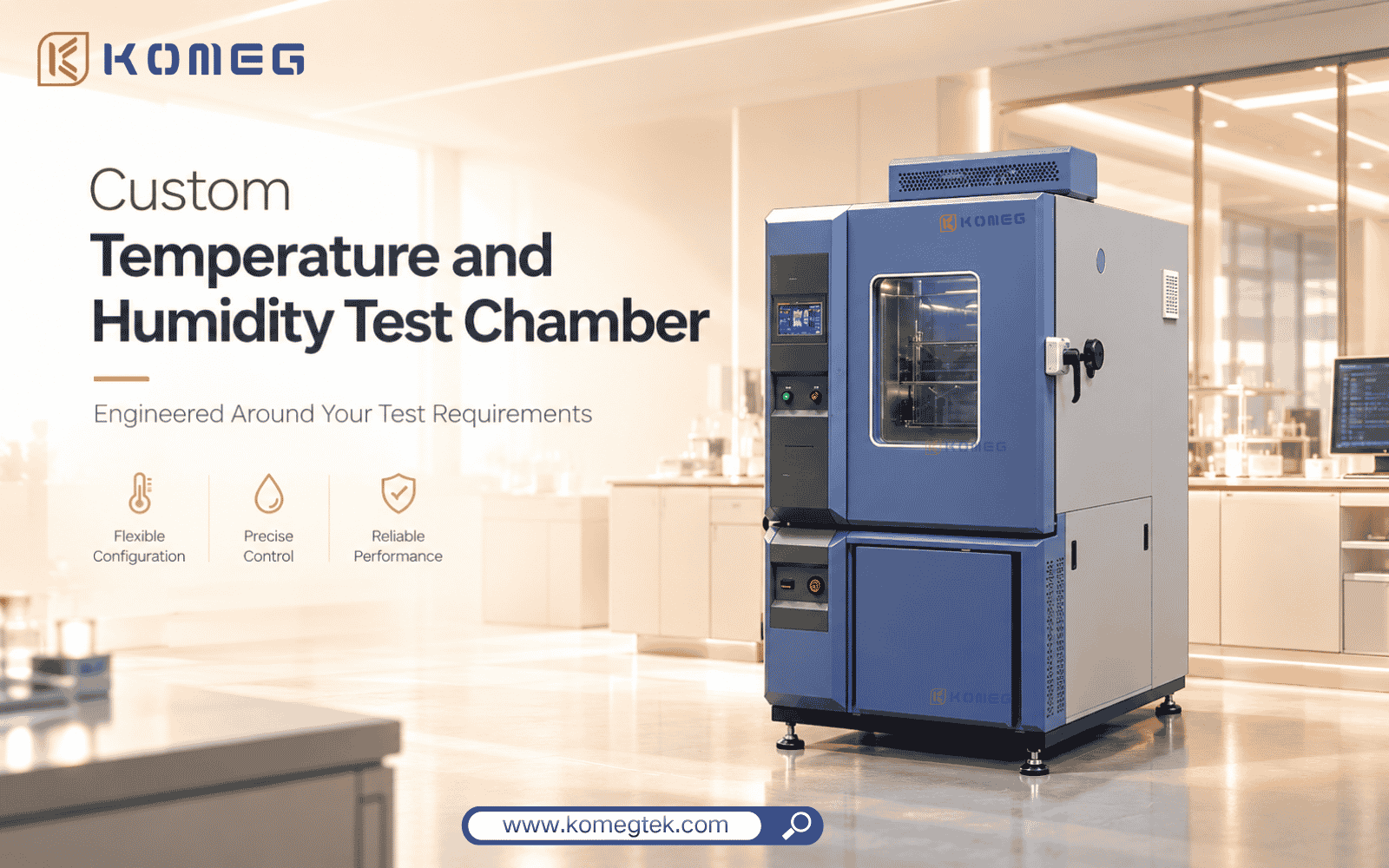
A custom temperature and humidity test chamber is the right solution when a standard chamber cannot adequately accommodate the product, test profile, loading configuration, environmental conditions, or safety requirements.
The important point is that customization is not simply about making a chamber larger or changing its temperature range. A properly designed system must consider the DUT, thermal load, humidity requirements, airflow, test fixtures, ramp rate, electrical connections, safety functions, installation environment, and sometimes even the laboratory workflow.
For routine testing, a standard temperature and humidity test chamber may be sufficient. When the test becomes more specialized, however, designing the chamber around the actual application can provide much better control and repeatability.
What Is a Custom Temperature and Humidity Test Chamber?
A custom temperature and humidity test chamber is an environmental testing system engineered around requirements that cannot be fully satisfied by a standard configuration.
A standard chamber normally provides predefined working volumes, temperature ranges, humidity ranges, control systems, shelves, cable ports, and refrigeration configurations. Custom equipment can modify these elements according to the product and test procedure.
Depending on the application, customization may involve:
- Chamber dimensions and working volume
- Temperature and humidity ranges
- Heating and cooling capacity
- Temperature and humidity ramp rates
- Airflow direction and distribution
- Sample fixtures and loading systems
- Cable and electrical feedthroughs
- Automatic water filling and drainage
- Data acquisition and communication interfaces
- Safety monitoring and protection systems
- Explosion-proof or pressure-relief functions
- Single-door, double-door, or special access designs
- Walk-in or large-volume structures
- Integration with automated testing equipment
KOMEG’s custom climatic test chamber solutions cover both modifications to standard chambers and completely customized environmental testing systems.
When Do You Need a Customized Temperature Humidity Chamber?
Not every application requires a custom chamber. In fact, using a standard model is usually more economical when its specifications already match the test requirements.
Customization becomes more practical when one or more of the following conditions apply.
1. The Product Does Not Fit a Standard Chamber
Product dimensions are often the first reason for customization. Large assemblies, battery packs, automotive components, medical devices, solar modules, and production fixtures may require considerably more working space than a conventional reach-in chamber provides.
The usable chamber volume should also account for airflow. Simply fitting the product inside the chamber does not mean the test will perform correctly. Large samples can obstruct circulation and create temperature or humidity gradients.
For larger products or production-level testing, a walk-in environmental chamber may be more appropriate than continuously enlarging a standard cabinet.
2. The Required Temperature or Humidity Range Is Non-Standard
Standard temperature and humidity chambers cover a wide range of common applications, but some tests require conditions outside a conventional configuration.
The requirement may involve an unusually low temperature, high temperature, high humidity, extended humidity operation, or a particular combination of temperature and relative humidity.
For example, KOMEG’s standard temperature and humidity chambers offer different configurations covering temperature ranges down to -70°C and humidity ranges up to 98% RH, while non-standard requirements can be customized according to the application.
The key is not simply achieving an extreme setpoint. The refrigeration, heating, humidification, dehumidification, insulation, and control systems must work together to maintain stable conditions at the required load.
3. The Test Profile Requires a Specific Ramp Rate
Temperature change rate is another common reason for customization.
A chamber designed for long-duration temperature exposure does not necessarily have the same heating and cooling capability as a chamber designed for rapid thermal cycling. The required ramp rate depends on the product, test standard, thermal mass, loading condition, and test objective.
More importantly, the chamber air temperature ramp rate is not necessarily the same as the DUT temperature change rate.
A large metal assembly may respond much more slowly than the surrounding air because of its thermal mass. Fixture design, airflow, product orientation, and internal heat generation can also influence the actual thermal response.
Therefore, specifying only “10°C/min” or “15°C/min” is often not enough. The complete test profile and loading condition should be considered when designing the system.
4. The Product Requires Special Fixtures or Loading
Some products cannot simply be placed on standard chamber shelves.
A customized chamber may need:
- Dedicated product fixtures
- Trolleys or mobile loading systems
- Multi-level sample racks
- Heavy-load supports
- Rotating fixtures
- Electrical test fixtures
- Automated loading systems
- Special cable routing
- Production-line interfaces
The fixture itself can affect airflow and thermal uniformity. For this reason, it should be considered during chamber design rather than added after the chamber has already been manufactured.
5. The Test Requires Special Safety Protection
Safety requirements can significantly change the design of a temperature and humidity test chamber.
This is particularly important for batteries, energy storage products, chemical products, and other specimens that may release heat, gas, smoke, or pressure during testing.
Depending on the application, a customized system may incorporate:
- Explosion-proof observation windows
- Pressure-relief systems
- Gas detection
- Smoke detection
- Fire detection and suppression
- Emergency shutdown
- Door interlocks
- Over-temperature protection
- Independent safety controllers
- Exhaust or ventilation systems
For battery testing, the environmental chamber should not be treated as a conventional climate chamber with a few additional safety devices. The potential failure mode of the DUT needs to be considered from the beginning of the design.
KOMEG, for example, also develops customized battery and environmental testing systems for applications requiring additional safety protection.
What Parameters Should Be Customized?
A good custom chamber begins with a clear technical specification. The following parameters are particularly important.
Chamber Size and Internal Layout
Start with the actual dimensions of the DUT rather than selecting a chamber based only on nominal volume.
Consider product dimensions, quantity, fixtures, cable routing, operator access, airflow space, and future testing requirements. For large or irregular products, the internal layout may be more important than simply increasing the chamber volume.
Temperature Range and Stability
Define the minimum and maximum temperatures based on the actual test profile. Then consider temperature fluctuation, uniformity, deviation, recovery time, and the expected thermal load.
A chamber that reaches the required temperature without load may perform differently when heavily loaded.
Humidity Range and Control
Humidity requirements should be specified together with temperature because the achievable RH range depends on temperature.
The chamber may require humidification, dehumidification, condensation control, and drainage systems. At low temperatures, humidity control also becomes more complicated because condensation and frosting can affect both the test and the equipment.
Airflow and Uniformity
Airflow is easy to overlook during customization, but it directly influences temperature and humidity uniformity.
The chamber should provide sufficient circulation around the DUT without creating excessive obstruction or localized hot and cold zones. This becomes increasingly important when testing large or densely packed products.
Heating and Cooling Capacity
The refrigeration and heating system must be selected according to the chamber volume and, more importantly, the actual thermal load.
A large DUT with significant heat capacity can require substantially more cooling capacity than an empty chamber. Electrical products that generate heat during operation can create another thermal load that needs to be included in the design.
Customization Is More Than Making the Chamber Bigger
This is one of the most important points when purchasing a custom environmental chamber.
Increasing chamber size changes more than the physical dimensions. It can affect refrigeration capacity, air circulation, heating power, humidity control, insulation thickness, structural strength, power consumption, recovery time, and overall system stability.
For example, a 5 m³ chamber is not simply a 500 L chamber scaled up by ten times. The engineering requirements change with volume, surface area, thermal load, airflow path, and product configuration.
The same principle applies to humidity. Increasing the working volume also increases the amount of air that must be conditioned, while the DUT and fixtures may absorb or release moisture during the test.
This is why a reliable custom solution should be designed as an integrated system rather than assembled by simply adding options to a standard machine.
Standard Chamber or Custom Chamber: Which One Should You Choose?
The decision can be relatively straightforward.
Choose a standard chamber when:
- The DUT fits comfortably inside the working space.
- The temperature and humidity ranges are standard.
- The required ramp rate is within the standard specification.
- Standard shelves and cable ports are sufficient.
- No special safety system is required.
- The chamber can be installed normally in the laboratory.
Consider a custom chamber when:
- The DUT is unusually large or heavy.
- Multiple products must be tested simultaneously.
- Special fixtures or loading systems are required.
- Temperature or humidity conditions fall outside standard configurations.
- A specific ramp profile is required.
- Automated testing or external equipment must be integrated.
- Special electrical interfaces are needed.
- Battery or hazardous-product testing requires additional protection.
- The chamber must fit a particular laboratory or production-line layout.
In other words, customization should solve a real testing problem rather than simply add features.
How KOMEG Approaches Custom Temperature and Humidity Chamber Projects
KOMEG provides both standard and customized environmental test chambers, allowing customers to start from an existing platform when possible or develop a more specialized system when necessary.
The engineering process typically begins with the test requirements rather than the equipment model. Important information includes the DUT dimensions and weight, quantity, operating condition, heat generation, test temperature, humidity range, ramp profile, test duration, fixtures, electrical connections, applicable standards, and required safety functions.
This approach helps determine whether a standard chamber can meet the requirement or whether a customized design is justified.
KOMEG’s portfolio includes reach-in temperature and humidity chambers as well as large and specialized systems. Its customized projects have included medical-device chambers, large-volume systems, special access configurations, and environmental chambers designed around specific customer workflows. For example, a customized 5,000 L temperature and humidity chamber has been developed for vascular interventional medical device testing.
KOMEG has also completed customized environmental chamber projects involving temperature and humidity chambers, explosion-proof test systems, and large walk-in chambers.
This range is important because custom chamber engineering is rarely about one isolated parameter. The final system needs to balance environmental performance, product loading, safety, control, installation, and long-term operation.
What Information Should You Provide for a Custom Chamber Quote?
The more accurate the initial technical information, the easier it is for an environmental chamber manufacturer to propose a suitable solution.
A useful specification should include:
Product information: product name, dimensions, weight, quantity, materials, and whether the product is energized during testing.
Test conditions: minimum and maximum temperature, humidity range, temperature/humidity cycle, ramp rate, exposure time, and recovery requirements.
Loading information: fixture dimensions, shelf requirements, trolley requirements, product arrangement, and available airflow space.
Electrical requirements: voltage, current, power consumption, cable quantity, connector type, and required external monitoring or communication.
Safety requirements: battery chemistry, possible heat generation, gas release, fire risk, pressure risk, and required detection or protection functions.
Installation conditions: available floor space, door dimensions, transportation route, power supply, water supply, drainage, ventilation, and ambient temperature.
This information gives the manufacturer enough engineering context to determine whether an existing configuration can be modified or whether a completely new chamber structure is more appropriate.
Frequently Asked Questions
What is a custom temperature and humidity test chamber?
It is an environmental chamber designed or modified to meet application-specific temperature, humidity, size, loading, control, safety, or integration requirements that cannot be fully satisfied by a standard chamber.
Can a standard temperature and humidity chamber be customized?
Yes. Depending on the design, manufacturers can modify chamber dimensions, fixtures, cable ports, control functions, access doors, communication interfaces, humidity systems, safety protection, and other components. KOMEG states that its temperature and humidity chambers support non-standard and special customization.
Is a custom chamber always better than a standard chamber?
No. If a standard chamber already meets the required test conditions, customization may add unnecessary cost and complexity. Customization is most valuable when there is a clear engineering requirement that standard equipment cannot satisfy efficiently.
Can a custom chamber be used for battery testing?
Yes, but battery testing may require safety features beyond ordinary temperature and humidity control. Depending on the battery and test procedure, additional protection such as pressure relief, gas detection, fire detection, emergency shutdown, and explosion-resistant construction may be required.
How large can a custom temperature and humidity chamber be?
There is no universal maximum size. The practical limit depends on the test load, installation site, refrigeration system, structural design, power supply, and required environmental performance. Large applications may use walk-in or specially engineered chambers rather than conventional reach-in cabinets.
The best custom temperature and humidity test chamber is not necessarily the chamber with the widest temperature range, largest volume, or highest heating and cooling rate. It is the system that reproduces the required environmental conditions consistently while accommodating the actual DUT, loading method, test profile, safety requirements, and laboratory environment.
For straightforward testing, a standard chamber is often the most efficient choice. When product dimensions, thermal load, humidity requirements, test profiles, automation, or safety conditions become more complicated, a customized environmental chamber can provide a much better fit.
The most effective approach is therefore to define the test first and design the chamber around it.
KOMEG provides standard and customized temperature and humidity test chambers for electronics, automotive, semiconductor, medical, battery, aerospace, renewable energy, and other reliability-testing applications. Its engineering team can develop solutions ranging from modified standard chambers to large and application-specific environmental testing systems.