

In the fast-paced world of product development, the ability to replicate real-world environmental conditions is the gatekeeper of quality. Whether you are validating a new electronic sensor or certifying a full-scale automotive powertrain, your choice of test equipment defines the accuracy and efficiency of your R&D lifecycle.
When selecting an environmental test chamber, the most critical fork in the road is deciding between a benchtop environmental chamber and a walk-in environmental test chamber. While both systems excel at simulating temperature and humidity, they serve fundamentally different stages of product development.
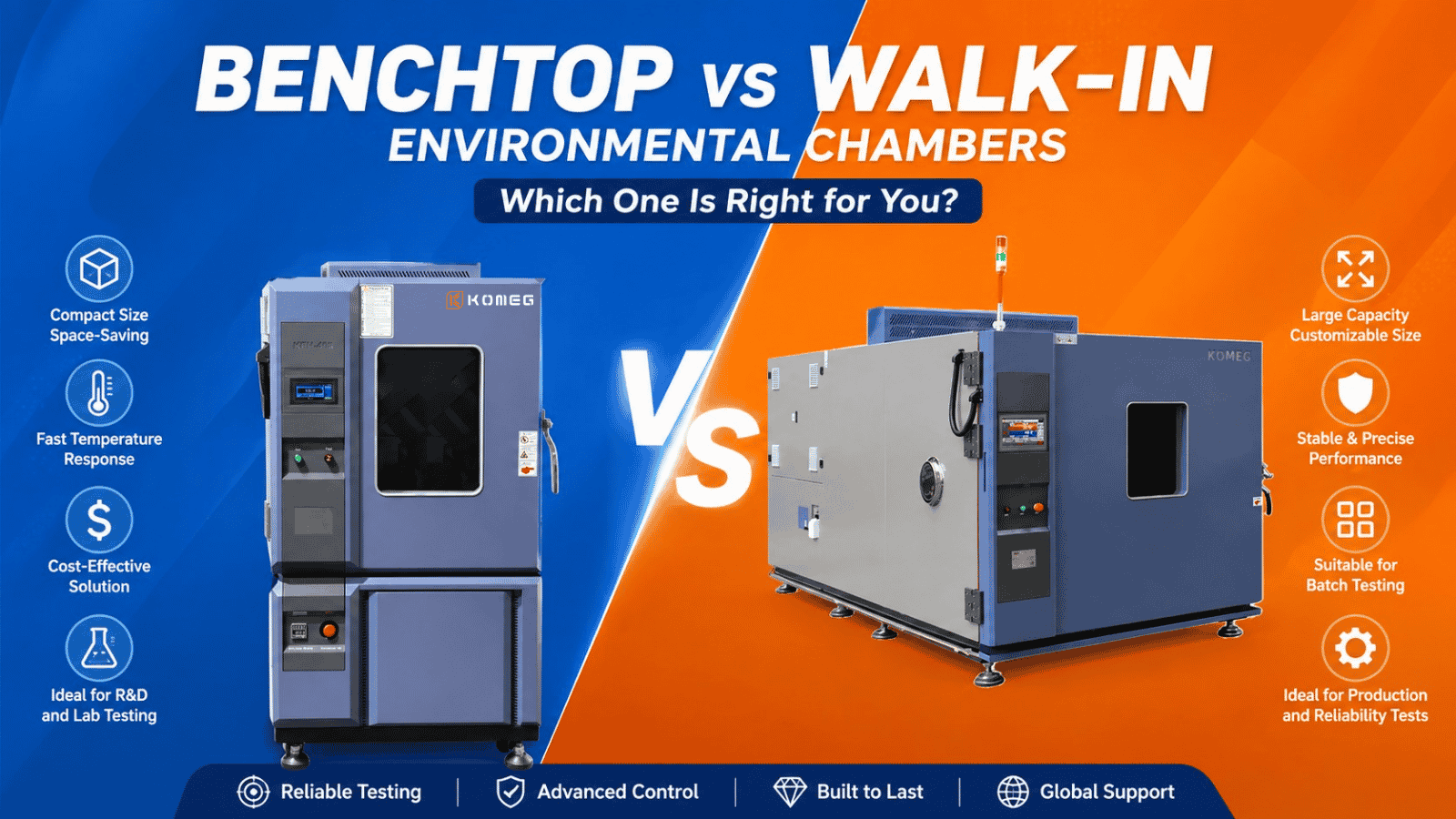
This guide breaks down the core differences, helping you navigate the decision between laboratory-scale precision and industrial-scale validation.
1. The Benchtop Chamber: Precision at the R&D Level
A benchtop environmental chamber is the “workhorse” of the modern laboratory. Compact and agile, these systems are designed to fit seamlessly onto standard workbenches.
Best for:
Component-Level Testing: Ideal for small electronics, PCB testing, and material samples.
Early-Stage R&D: Perfect for engineers needing to perform iterative testing during the prototyping phase.
Space-Constrained Labs: When footprint is at a premium, the benchtop model delivers high performance without requiring a dedicated room.
Why choose this? You get faster temperature response times and a lower initial investment, allowing your team to move quickly through design iterations.
2. The Walk-In Chamber: The Industrial Powerhouse
A walk-in environmental test chamber is not just a piece of equipment; it is an environmental simulation room. These systems are engineered for products that are too large, too complex, or too numerous to fit into a standard chamber.
Best for:
Full-Scale Assemblies: Ideal for testing finished products, large machinery, or entire system assemblies.
Batch Testing: Perfect for high-volume reliability testing, allowing you to test dozens or hundreds of units simultaneously.
Industrial Validation: A requirement for the automotive, aerospace, and renewable energy sectors where safety and system-level compliance are mandatory.
Why choose this? It offers high load capacity and stable control over large thermal masses, ensuring that your production-ready product can withstand the harsh realities of its operating environment.
3. Quick Comparison: Key Differences
| Feature | Benchtop Chamber | Walk-In Chamber |
| Primary Use | R&D, Lab Research, Components | Production, System-level, Batch |
| Capacity | Limited (Small samples) | High (Full products/Large volumes) |
| Installation | Plug-and-play (Lab-ready) | Requires dedicated facility planning |
| Thermal Response | Fast, agile response | Stable control for a large mass |
| Investment | Cost-effective entry point | Higher, long-term infrastructure |
4. How to Determine Your Needs
Choosing the wrong chamber leads to costly inefficiencies—either by under-testing your products or over-investing in capacity you don’t use. Before you purchase, ask yourself these four questions:
What is the “Thermal Mass” of your product? Small sensors reach equilibrium quickly (Benchtop). A full vehicle chassis or a rack of battery modules contains massive thermal inertia that requires the specialized airflow and cooling power of a Walk-in chamber.
What stage is your product in? If you are in the design phase, flexibility and speed are key (Benchtop). If you are in the validation/production phase, volume and compliance are paramount (Walk-in).
What are the compliance requirements? Does your industry require standard testing, or do you need to meet rigorous batch-testing documentation?
Do you plan to expand? Many facilities start with benchtop units for R&D and eventually scale up to walk-in chambers as products move from prototype to production.
5. The KOMEG Advantage
Selecting an environmental chamber is a long-term investment. At KOMEG, we leverage over 30 years of engineering expertise to bridge the gap between complex testing standards and your specific operational needs.
Why industry leaders trust KOMEG:
Custom Engineering: Whether you need a standardized benchtop unit or a bespoke walk-in cleanroom-grade testing environment, we tailor our systems to your testing protocols.
Global Support: Our equipment is backed by global installation and maintenance services, ensuring your uptime remains consistent.
Reliability-First Design: We design for compliance with international standards (IEC, MIL-STD), giving you the data integrity required for global markets.
Get the Right Solution for Your Project
The difference between a successful product launch and a recall often comes down to the quality of your testing data. Whether you are just beginning your R&D journey or scaling up to industrial-level reliability testing, our engineers are here to help.
Need a custom recommendation?
Our team can evaluate your product size, temperature specifications, and budget to provide a tailored quote within 24 hours.