

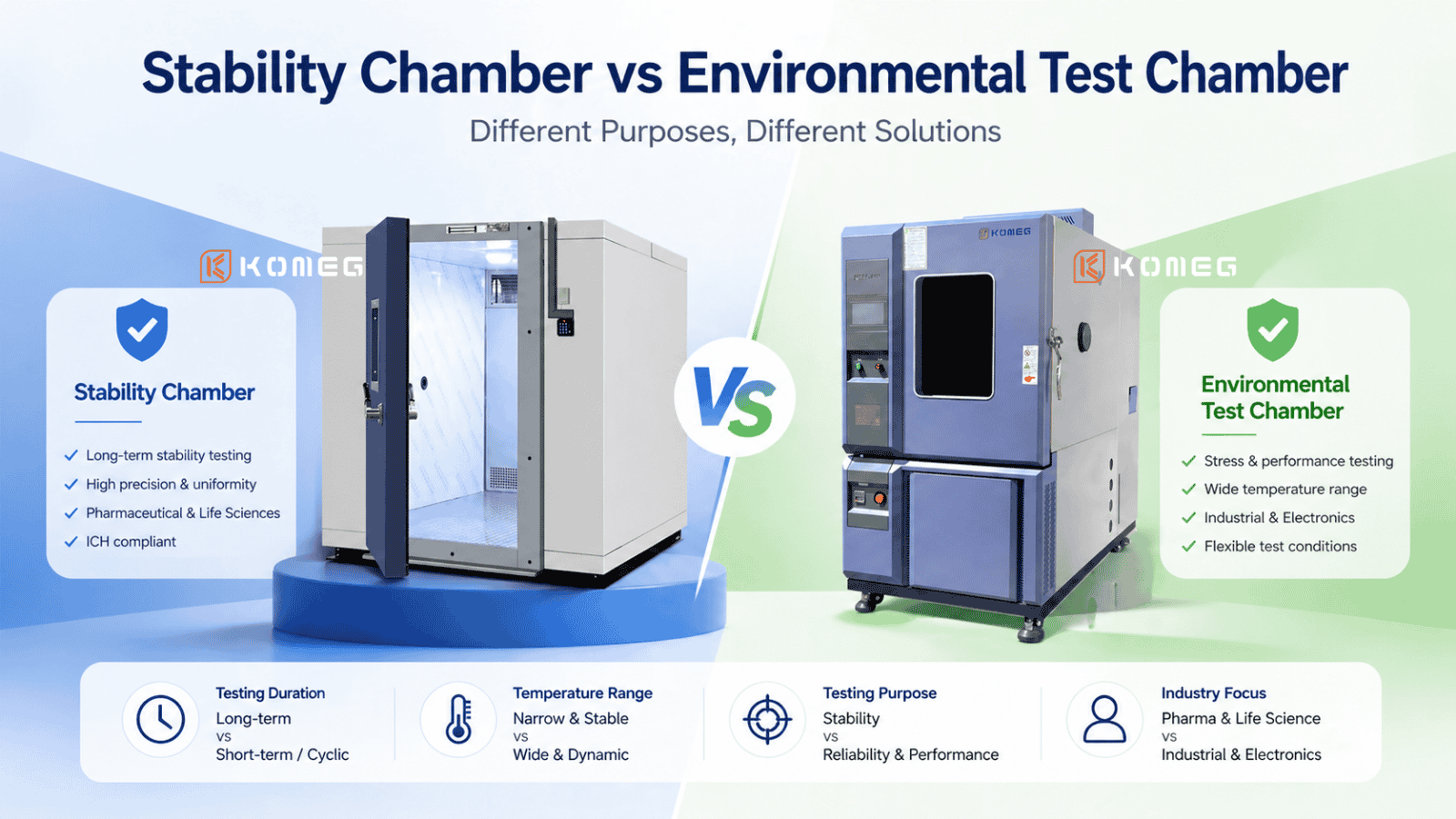
When selecting temperature and humidity testing equipment, many buyers encounter two commonly used systems: stability chambers and environmental test chambers.
At first glance, they may appear similar because both control temperature and humidity. However, in practice, they are designed for completely different testing objectives, industries, and regulatory requirements.
Understanding their differences is essential for choosing the right solution, avoiding unnecessary costs, and ensuring accurate testing results.
This guide provides a detailed comparison of stability chambers and environmental test chambers, including their working principles, applications, standards, performance differences, and selection criteria.
1. What Is a Stability Chamber?
A stability chamber is a specialized testing system designed to maintain precise and stable environmental conditions over extended periods, typically for months or even years.
It is primarily used in regulated industries where product quality and safety must comply with strict international standards.
1.1 Main Purpose of Stability Chambers
The primary purpose of a stability chamber is to evaluate how products change over time under controlled environmental conditions.
These tests are critical for:
Determining product shelf life
Verifying storage conditions
Ensuring regulatory compliance
Supporting product approval and certification
1.2 Typical Applications
Stability chambers are widely used in:
Pharmaceutical Industry
Drug stability testing>>Product recommendation: KOMEG Drug Stability Test Chamber
API (Active Pharmaceutical Ingredient) validation
Vaccine storage studies
Biotechnology & Life Sciences
Biological sample preservation
Reagent stability testing
Food & Cosmetics
Shelf-life evaluation
Packaging compatibility testing
1.3 Key Features of Stability Chambers
Stability chambers are designed with a strong focus on precision and consistency:
Extremely stable temperature and humidity control
High uniformity throughout the chamber
Long-term continuous operation
Data logging for regulatory audits
Alarm systems for deviations
1.4 Standards and Compliance
Stability chambers must comply with strict regulatory guidelines, including:
ICH Q1A (Stability Testing of New Drug Substances and Products)
ICH Q1B (Photostability Testing)
FDA and GMP requirements
This makes them essential for industries where compliance is mandatory
2. What Are Environmental Test Chambers?
Environmental test chambers are designed to simulate a wide range of environmental conditions to evaluate product performance, durability, and reliability.
Unlike stability chambers, they are not limited to fixed conditions—they can create dynamic and extreme environments.
2.1 Main Purpose of Environmental Test Chambers
These chambers are used to:
Simulate real-world environmental conditions
Accelerate product aging
Identify design weaknesses
Validate product reliability
2.2 Typical Applications
Environmental test chambers are widely used in industrial sectors:
Electronics Industry
PCB and component testing
Consumer electronics reliability
Automotive Industry
ECU testing
Component durability
Battery and EV system validation
Aerospace & Defense
Avionics testing
Extreme environment simulation
Energy & Battery Sector
Lithium battery testing
Energy storage system validation
2.3 Key Features of Environmental Test Chambers
Environmental chambers emphasize flexibility and performance:
Wide temperature range (e.g., -70°C to +150°C or higher)
Rapid temperature change (thermal cycling)
Programmable test profiles
Multi-condition simulation (temperature + humidity + cycling)
High load capacity for industrial testing
2.4 Common Standards
Environmental test chambers are typically designed to meet:
IEC 60068 (Environmental testing standards)
MIL-STD-810 (Military testing standards)
ASTM standards
These standards focus on product reliability under stress conditions
3. Core Differences Between Stability and Environmental Test Chambers
3.1 Testing Objective
Stability chamber → Long-term consistency and product shelf-life
Environmental test chamber → Performance testing and stress simulation
One focuses on time-based stability, the other on condition-based stress
3.2 Environmental Conditions
Stability chamber → Fixed, narrow conditions (e.g., 25°C / 60% RH)
Environmental test chamber → Wide and variable conditions
Environmental chambers offer significantly more flexibility
3.3 Testing Duration
Stability chamber → Months to years
Environmental chamber → Minutes, hours, or cycles
3.4 Precision vs Flexibility
Stability chamber → Extremely high precision and uniformity
Environmental chamber → Greater flexibility and dynamic control
3.5 Industry Focus
Stability chamber → Pharma, biotech, regulated industries
Environmental chamber → Industrial, automotive, electronics
3.6 Cost Structure
Stability chamber → Moderate cost, focused on precision
Environmental chamber → Wider price range depending on performance
4. Can One Chamber Replace the Other?
This is a common question.
The answer is: No, they are not interchangeable
Stability chambers cannot perform rapid cycling or extreme stress tests
Environmental chambers cannot maintain the ultra-stable long-term conditions required for compliance
Choosing the wrong system can lead to:
Invalid test results
Compliance issues
Increased operational cost
5. How to Choose the Right Chamber
Before selecting equipment, you should clearly define:
5.1 Your Industry
Pharma → Stability chamber
Industrial → Environmental chamber
5.2 Testing Objective
Long-term storage → Stability
Stress testing → Environmental
5.3 Required Conditions
Fixed conditions → Stability
Variable/extreme conditions → Environmental
5.4 Compliance Requirements
Regulatory (ICH, GMP) → Stability
Performance standards (IEC, MIL) → Environmental
5.5 Future Testing Needs
If your testing scope may expand, consider:
Modular systems
Custom environmental chambers
Scalable solutions
6. Why Choose KOMEG Environmental Test Chambers
KOMEG has over 30 years of experience in designing and manufacturing environmental testing equipment for global industries.
We provide:
Temperature and humidity test chambers
Thermal shock chambers
Walk-in environmental test chambers
Customized testing solutions
Our advantages:
Advanced temperature control technology
Reliable performance under demanding conditions
Global installation and support
Engineering customization capability
We help customers build efficient, reliable, and scalable testing systems
7. Get Expert Guidance for Your Testing Application
Still unsure whether you need a stability chamber or an environmental test chamber?
Contact KOMEG engineers for a free consultation and customized solution within 24 hours.
We will help you:
Define testing requirements
Select the right chamber type
Optimize cost and performance
Ensure compliance with relevant standards
Although stability chambers and environmental test chambers both control temperature and humidity, they serve fundamentally different purposes:
Stability chambers ensure long-term consistency and regulatory compliance
Environmental test chambers provide dynamic testing and product reliability validation
Choosing the correct chamber is essential for achieving accurate results, maintaining compliance, and optimizing your investment.