

Modern products are expected to perform reliably in increasingly demanding environments. From electric vehicles traveling on rough roads to aircraft exposed to turbulence and electronic devices subjected to constant transportation stress, vibration is one of the most common causes of product failure. To ensure long-term reliability, manufacturers use vibration testing to simulate real-world mechanical stresses before products reach the market.
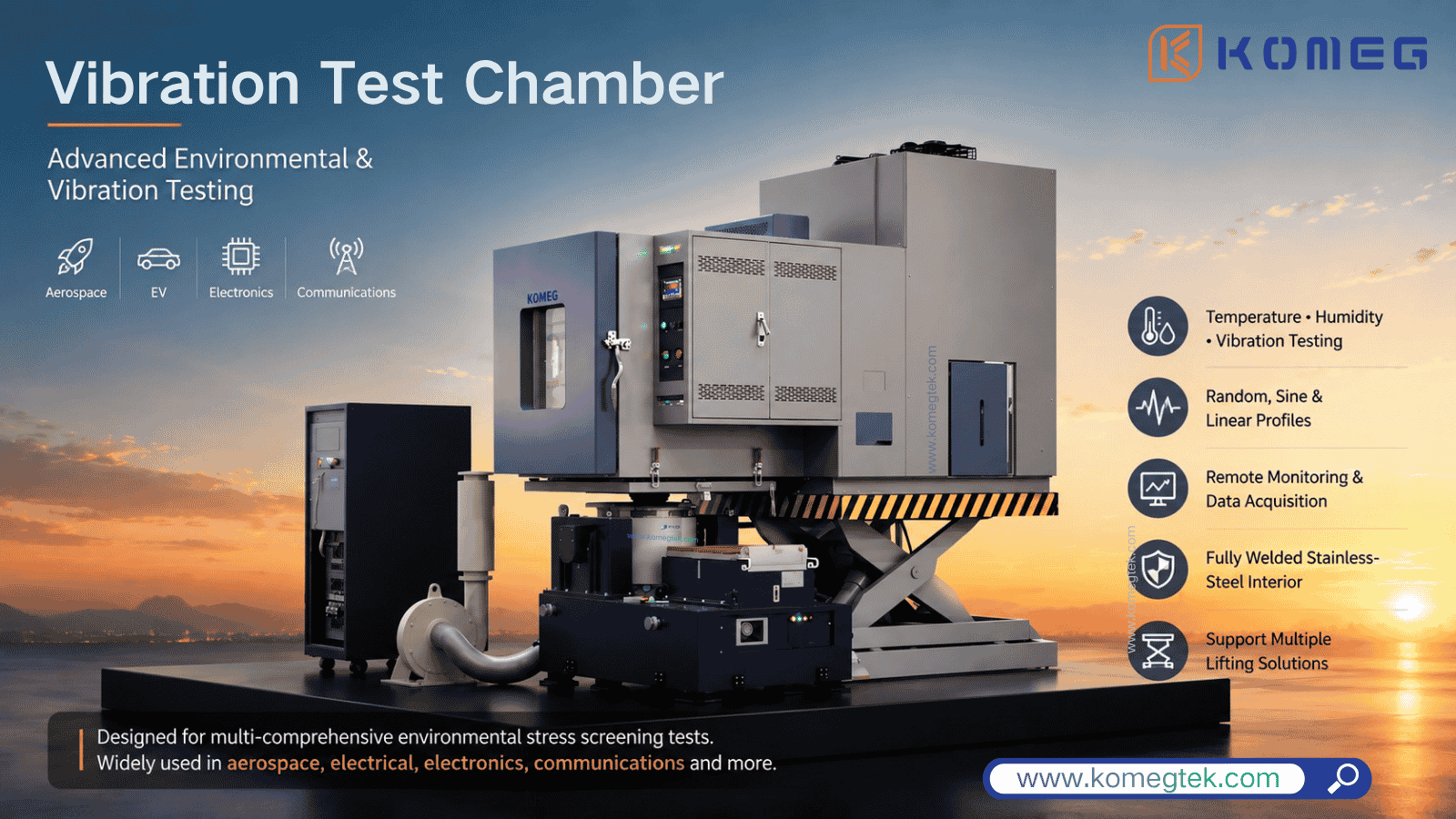
A vibration test chamber allows engineers to evaluate how products respond to vibration alone or in combination with environmental conditions such as temperature and humidity. This guide explains what a vibration test chamber is, how it works, relevant testing standards, key applications, and what factors should be considered when selecting the right testing solution.
What Is a Vibration Test Chamber?
A vibration test chamber is a specialized environmental testing system designed to expose products to controlled vibration conditions that replicate transportation, operational, and field environments.
In many industries, vibration testing is performed simultaneously with temperature and humidity testing to evaluate how multiple stresses interact and affect product performance. These integrated systems are often called:
- Temperature, Humidity, Vibration Chambers
- Combined Environmental Test Chambers
- AGREE Chambers (Aeronautical Ground Equipment Reliability Environment Chambers)
By combining climatic and mechanical stress testing into a single platform, engineers can more accurately reproduce real-world operating conditions.
Why Is Vibration Testing Important?
Mechanical vibration can cause a wide range of failures, including:
- Cracked solder joints
- Connector loosening
- Wire fatigue
- Structural fractures
- Component displacement
- PCB damage
- Seal degradation
- Fastener loosening
Products may pass functional tests in laboratory conditions but fail prematurely when exposed to transportation vibrations, vehicle operation, industrial machinery, or aerospace environments.
Vibration testing helps manufacturers identify these weaknesses early in the product development cycle, reducing warranty costs and improving reliability.
How Does a Vibration Test Chamber Work?
A typical vibration test system consists of two major components:
Environmental Chamber
The chamber controls environmental conditions such as:
- High temperature
- Low temperature
- Temperature cycling
- Humidity exposure
Electrodynamic Shaker System
The shaker generates controlled vibration profiles including:
- Sine vibration
- Random vibration
- Shock testing
- Mixed-mode vibration
The chamber is mounted around or integrated with the vibration system, allowing the test specimen to experience multiple stresses simultaneously.
For example, an automotive control unit may be tested under:
- Temperature: -40°C to +125°C
- Humidity: 95% RH
- Random vibration: 10 Hz–2,000 Hz
This combination closely simulates actual operating conditions.
Types of Vibration Test Chambers
Standalone Vibration Systems
These systems perform vibration testing only and are commonly used for transportation simulation and structural durability evaluations.
Advantages:
- Lower initial investment
- Simpler operation
- Suitable for basic vibration testing
Limitations:
- Cannot evaluate environmental effects
- Less representative of real-world conditions
Combined Environmental Test Chambers
Combined chambers integrate temperature, humidity, and vibration testing into a single system.
Advantages:
- More realistic testing
- Reduced testing time
- Better failure acceleration
- Improved reliability prediction
These systems are increasingly used in automotive, aerospace, battery, and electronics industries.
AGREE Chambers
AGREE chambers represent the most advanced form of combined environmental testing.
They are specifically designed to work with electrodynamic shakers while maintaining precise environmental control.
AGREE chambers are widely used for qualification testing, reliability testing, and military standards compliance.
Common Vibration Testing Standards
Various industries use standardized testing procedures to ensure consistency and reliability.
IEC 60068 Series
The IEC 60068 family is one of the most widely used environmental testing standards.
Common vibration-related sections include:
- IEC 60068-2-6 (Sine Vibration)
- IEC 60068-2-64 (Random Vibration)
- IEC 60068-2-27 (Shock Testing)
These standards are commonly applied to electronic products and industrial equipment.
MIL-STD-810H
Widely used in military and defense applications.
Includes testing methods for:
- Transportation vibration
- Operational vibration
- Mechanical shock
- Combined environmental testing
RTCA DO-160
The primary environmental testing standard for airborne equipment.
Used extensively in:
- Commercial aviation
- Aerospace electronics
- Avionics systems
ISO 16750
Specifically developed for automotive electrical and electronic equipment.
Covers vibration requirements encountered during vehicle operation.
Applications of Vibration Test Chambers
Automotive Industry
Automotive components are constantly exposed to road-induced vibration.
Common test objects include:
- ECUs
- Sensors
- Connectors
- Battery systems
- Power electronics
Testing helps verify durability throughout the vehicle lifecycle.
Electric Vehicle Batteries
Battery systems must withstand:
- Road vibration
- Charging cycles
- Temperature fluctuations
Combined temperature and vibration testing helps identify structural weaknesses and electrical failures.
Aerospace Industry
Aircraft components experience:
- Turbulence
- Takeoff and landing shock
- High-altitude temperature variations
Vibration chambers help validate mission-critical reliability.
Semiconductor Industry
Semiconductor devices often undergo transportation and operational vibration.
Testing verifies:
- Package integrity
- Wire bond reliability
- Solder joint durability
Defense and Military Equipment
Military systems operate in some of the harshest environments imaginable.
Combined vibration and environmental testing helps ensure operational readiness and mission success.
Key Specifications to Consider
Selecting the right vibration test chamber requires evaluating several critical parameters.
Temperature Range
A wider temperature range allows more comprehensive testing.
Typical ranges include:
- -40°C to +150°C
- -70°C to +180°C
Humidity Range
For combined testing applications, humidity capability is equally important.
Typical range:
- 10% RH to 98% RH
Vibration Force
The shaker system must provide sufficient force to move the test specimen.
Common ratings include:
- 20 kN
- 35 kN
- 50 kN
- 70 kN and above
Frequency Range
The frequency range determines what vibration environments can be simulated.
Typical range:
- 5 Hz to 2,000 Hz
Advanced systems may exceed 3,000 Hz.
Chamber Size
The chamber must accommodate:
- Product dimensions
- Test fixtures
- Cable routing
- Airflow requirements
Larger products such as battery packs or aerospace assemblies often require custom solutions.
Control System
Modern controllers should support:
- Programmable test profiles
- Data logging
- Ethernet communication
- Remote monitoring
- Industry 4.0 integration
Why Choose KOMEG AGREE Chambers?
Founded in 1990, KOMEG is a professional manufacturer of environmental reliability testing equipment with more than three decades of experience serving global customers.
KOMEG AGREE Chambers are designed to provide accurate, repeatable, and efficient combined environmental testing for demanding industries.
Key advantages include:
Wide Environmental Range
- Temperature range up to -70°C to +180°C
- Humidity control from 10% RH to 98% RH
Compatible with Leading Shaker Systems
KOMEG chambers can be integrated with various electrodynamic vibration systems to support customized testing requirements.
High Testing Accuracy
Advanced airflow design ensures:
- Excellent temperature uniformity
- Stable humidity control
- Consistent test conditions
Custom Engineering Solutions
Available options include:
- Custom chamber sizes
- Cable ports
- Observation windows
- Automated control systems
- Specialized fixtures
Global Industry Experience
KOMEG equipment is widely used in:
- Automotive electronics
- New energy batteries
- Aerospace
- Telecommunications
- Semiconductor manufacturing
- Defense applications
Future Trends in Vibration Testing
As products become more complex, reliability testing is evolving toward:
- Combined environmental testing
- Accelerated life testing
- Digital monitoring and data analytics
- Smart test chambers
- EV battery validation
- Aerospace reliability simulation
Manufacturers increasingly prefer integrated AGREE chambers because they provide more realistic testing conditions and faster reliability assessments.
Vibration testing is a critical part of product reliability validation across automotive, aerospace, electronics, battery, and defense industries. By simulating real-world mechanical stresses, vibration test chambers help identify weaknesses before products reach customers.
When selecting a vibration test chamber, engineers should carefully evaluate temperature capability, humidity control, vibration performance, chamber size, compliance standards, and long-term service support.
For organizations seeking comprehensive environmental reliability testing, KOMEG AGREE Chambers provide a powerful solution that combines temperature, humidity, and vibration testing into a single integrated platform, helping manufacturers accelerate product development while improving reliability and quality.