

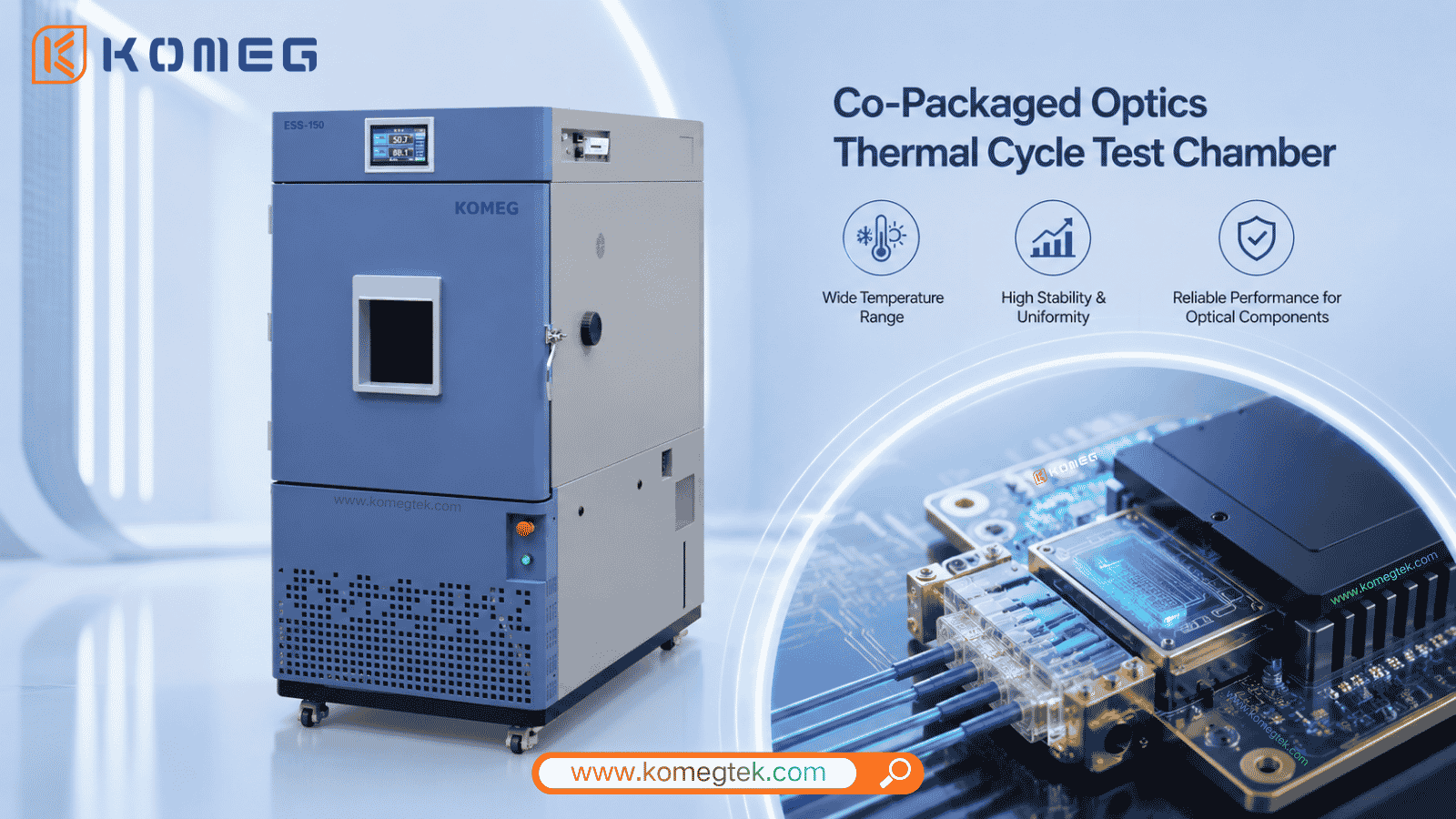
As artificial intelligence, cloud computing, hyperscale data centers, and high-performance networking continue advancing at an unprecedented pace, the demand for faster and more energy-efficient data transmission technologies is rapidly increasing. Traditional electrical interconnect architectures are approaching their physical performance limitations, especially in ultra-high-bandwidth computing environments.
To overcome these challenges, the semiconductor and optical communication industries are increasingly adopting Co-Packaged Optics (CPO) technology.
Co-Packaged Optics integrates optical communication engines directly alongside high-performance ASICs within the same package or substrate. This architecture dramatically shortens electrical signal paths, improves bandwidth density, lowers power consumption, and enhances signal integrity.
However, integrating lasers, silicon photonics, fiber arrays, advanced substrates, and high-power chips into a compact heterogeneous package creates major thermal and mechanical reliability challenges.
Even microscopic thermal expansion differences between materials can lead to:
- Optical misalignment
- Fiber coupling loss
- Substrate warpage
- Solder fatigue
- Delamination
- Thermal interface degradation
- Signal instability
To validate long-term product reliability, manufacturers rely heavily on thermal cycle testing.
A Co-Packaged Optics thermal cycle test chamber is a highly specialized environmental testing system designed to simulate repeated temperature stress conditions that CPO assemblies experience during real-world operation.
This article explains in detail:
- What a CPO thermal cycle test chamber is
- Why thermal cycling matters in silicon photonics reliability
- How these chambers work
- Key testing parameters
- Chamber design requirements
- Common failure mechanisms
- Industry applications
- Future trends in photonic reliability testing
Understanding Co-Packaged Optics (CPO)
Co-Packaged Optics is an advanced packaging technology that combines optical and electronic components within a tightly integrated assembly.
Unlike traditional pluggable optical transceivers, CPO places optical engines directly adjacent to switching ASICs or processors.
A typical CPO system may include:
- Silicon photonic integrated circuits (PICs)
- High-performance switching ASICs
- Laser arrays
- Optical modulators
- Fiber array units (FAUs)
- High-density substrates
- Thermal interface materials (TIMs)
This architecture provides several important advantages:
- Reduced electrical signal loss
- Lower power consumption
- Higher bandwidth scalability
- Improved data transmission speed
- Reduced latency
- Better energy efficiency
CPO technology is increasingly used in:
- AI servers
- Hyperscale data centers
- High-performance computing systems
- Cloud infrastructure
- 800G and 1.6T optical communication platforms
As data rates continue increasing, CPO is becoming one of the most important next-generation optical interconnect technologies.
Why Reliability Testing Is Critical for CPO Systems
Although CPO offers major performance advantages, its complex heterogeneous structure introduces serious reliability concerns.
CPO assemblies contain multiple materials with different coefficients of thermal expansion (CTE).
When temperature changes occur, each material expands and contracts differently.
Over time, repeated thermal stress can gradually damage the package structure.
This is particularly critical because CPO modules operate in environments with:
- Continuous workload fluctuations
- High thermal density
- Rapid heat generation
- Long operational cycles
- Constant data transmission activity
Without proper reliability validation, thermal stress may eventually cause:
- Optical coupling instability
- Fiber alignment shifts
- Package cracking
- Solder joint fatigue
- Delamination
- Thermal resistance increases
- Performance degradation
Since even nanoscale alignment changes can affect optical signal transmission, thermal reliability testing becomes essential.
What Is a Co-Packaged Optics Thermal Cycle Test Chamber?
A Co-Packaged Optics thermal cycle test chamber is a programmable environmental testing system designed to repeatedly expose CPO assemblies to controlled high and low temperature cycles.
The purpose of the chamber is to accelerate thermal stress and evaluate the long-term reliability of photonic and semiconductor packages.
These chambers simulate years of operational temperature variation within a shortened testing period.
During testing, the chamber repeatedly changes temperature between predefined high and low limits while controlling:
- Ramp rates
- Dwell times
- Temperature uniformity
- Airflow stability
- Thermal recovery performance
The system helps engineers analyze how repeated thermal expansion and contraction affect package integrity and optical performance.
Why Thermal Cycling Matters in CPO Reliability Testing
Thermal cycling is one of the most important reliability tests for advanced semiconductor packaging.
For CPO systems, thermal cycling helps evaluate:
- Optical alignment stability
- Mechanical durability
- Interconnect reliability
- Material compatibility
- Thermal interface performance
Repeated temperature changes generate cyclic stress throughout the package structure.
Over time, this stress may weaken interfaces and cause fatigue-related failures.
Thermal cycling allows manufacturers to identify potential reliability issues before mass production.
Common Failure Mechanisms Detected During Thermal Cycling
Optical Fiber Misalignment
One of the most critical issues in CPO systems is optical alignment accuracy.
Thermal expansion mismatch may gradually shift the position of:
- Fiber arrays
- Photonic dies
- Optical connectors
Even a microscopic displacement can increase optical insertion loss and reduce communication efficiency.
Substrate Warpage
Large advanced packaging substrates may deform under repeated thermal stress.
Substrate warpage can affect:
- Optical coupling precision
- Mechanical stability
- Solder joint integrity
This issue becomes increasingly severe as package sizes continue increasing.
Delamination
Thermal cycling may weaken adhesive interfaces between different materials.
Delamination can occur between:
- Die attach layers
- Underfill materials
- Substrates
- Thermal interface layers
Once delamination begins, thermal performance and mechanical reliability may rapidly deteriorate.
Solder Joint Fatigue
Repeated expansion and contraction gradually damage solder connections.
Solder fatigue is especially critical in:
- ASIC interconnects
- Optical engine interfaces
- Power delivery structures
Cracked solder joints may eventually lead to electrical or optical failure.
Thermal Interface Material (TIM) Degradation
Thermal interface materials help transfer heat away from high-power chips.
Repeated thermal cycling may cause:
- TIM pump-out
- Dry-out
- Mechanical cracking
- Increased thermal resistance
This can reduce cooling efficiency and accelerate overheating.
Typical Thermal Cycling Conditions for CPO Testing
Thermal cycling conditions vary depending on product requirements and reliability standards.
Common temperature ranges include:
- -40°C to +125°C
- -55°C to +125°C
- -65°C to +150°C
These extreme temperature transitions accelerate material stress and help simulate long-term operational aging.
Ramp Rate Requirements
Ramp rate refers to how quickly the chamber changes temperature.
Typical ramp rates for CPO testing include:
- 5°C/min
- 10°C/min
- 15°C/min
Faster ramp rates create more aggressive thermal stress conditions.
However, excessive overshoot or unstable temperature control may damage sensitive photonic components.
This is why advanced thermal cycling chambers require highly accurate temperature control systems.
Importance of Precise Temperature Uniformity
Temperature uniformity is one of the most important chamber performance indicators in photonic reliability testing.
Poor temperature distribution may create localized thermal gradients.
This can result in:
- Uneven material expansion
- Differential stress concentration
- Optical alignment instability
- Inconsistent test results
CPO thermal cycle chambers, therefore require:
- Optimized airflow systems
- CFD-based airflow engineering
- Stable thermal distribution
- Precise PID control systems
Maintaining excellent temperature uniformity is critical for accurate reliability evaluation.
Airflow Design in CPO Thermal Cycle Chambers
Airflow design directly affects chamber thermal stability.
Poor airflow may create:
- Hot spots
- Cold zones
- Non-uniform stress exposure
Advanced chambers use carefully engineered air circulation systems to ensure consistent environmental conditions throughout the workspace.
Proper airflow design is especially important during:
- High-density semiconductor testing
- Wafer-level reliability testing
- Multi-DUT optical module testing
Refrigeration Systems in Thermal Cycle Chambers
Low-temperature testing requires advanced refrigeration systems capable of maintaining stable thermal performance.
Most high-performance CPO thermal cycle chambers use cascade refrigeration systems.
These systems provide:
- Ultra-low-temperature capability
- Fast pull-down performance
- Stable temperature recovery
- Accurate ramp rate control
Refrigeration stability directly affects test repeatability and long-term chamber reliability.
Optical Feedthrough and Real-Time Monitoring
Unlike conventional semiconductor testing, CPO reliability validation often requires real-time optical monitoring during thermal cycling.
Modern CPO test chambers may include:
- Optical feedthrough ports
- Fiber optic bulkheads
- BER tester interfaces
- High-speed signal access ports
These features allow engineers to monitor:
- Optical insertion loss
- Signal integrity
- Communication stability
- Bit-error-rate (BER)
while the DUT remains under continuous thermal stress.
This capability is critical for evaluating active optical performance under real operating conditions.
Thermal Shock vs Thermal Cycling in CPO Testing
Although thermal cycling is commonly used for CPO reliability validation, some applications also require thermal shock testing.
Thermal shock chambers use separate hot and cold zones to achieve extremely rapid temperature transitions.
Compared with standard thermal cycling, thermal shock testing generates more aggressive mechanical stress.
Thermal shock testing helps accelerate:
- Material fatigue
- Package cracking
- Optical alignment stress
- Solder degradation
Dual-zone and triple-zone air-to-air thermal shock chambers are commonly used in advanced photonic reliability testing programs.
Industry Standards Related to CPO Thermal Reliability Testing
CPO testing programs often reference semiconductor reliability standards such as:
- JEDEC thermal cycling standards
- Optical module qualification specifications
- Semiconductor packaging reliability protocols
Testing may include pre-conditioning procedures that simulate:
- Reflow exposure
- Moisture sensitivity
- Long-term environmental stress
After testing, engineers evaluate:
- Optical loss
- Mechanical deformation
- Delamination
- Signal stability
- Electrical performance
Applications of Co-Packaged Optics Thermal Cycle Test Chambers
These chambers are widely used throughout the advanced semiconductor and photonics industries.
Major applications include:
AI Data Center Infrastructure
AI servers generate extremely high thermal loads and require highly reliable optical communication systems.
Silicon Photonics Development
Silicon photonic integrated circuits require strict thermal reliability validation.
High-Speed Optical Interconnect Testing
800G and 1.6T communication systems depend heavily on thermal stability.
Optical Module Qualification
Manufacturers use thermal cycling to validate optical transceiver durability.
Semiconductor Packaging Reliability
Advanced heterogeneous integration requires extensive thermal stress evaluation.
Future Trends in CPO Reliability Testing
As AI infrastructure and optical communication technologies continue evolving, reliability testing requirements are becoming more demanding.
Future trends include:
- Higher thermal density packages
- Faster optical interconnects
- Larger heterogeneous packages
- Increased power consumption
- More complex silicon photonics architectures
As a result, next-generation thermal cycle chambers will require:
- Faster ramp rates
- Higher temperature precision
- Improved airflow engineering
- Enhanced optical monitoring integration
- AI-assisted predictive diagnostics
Environmental testing systems will remain essential for validating future photonic packaging technologies.
A Co-Packaged Optics thermal cycle test chamber is a critical environmental testing solution for validating the reliability of advanced photonic and semiconductor packaging technologies.
By simulating repeated thermal stress conditions, these chambers help manufacturers identify potential failure mechanisms before products enter real-world deployment.
From optical alignment stability and substrate warpage to solder fatigue and thermal interface degradation, thermal cycling plays a vital role in ensuring long-term reliability in AI data centers, hyperscale networking systems, and silicon photonics platforms.
Modern CPO thermal cycle chambers must provide:
- Precise temperature control
- Excellent temperature uniformity
- Stable ramp rate performance
- Advanced airflow engineering
- Reliable refrigeration systems
- Real-time optical monitoring capability
With the rapid advancement of optical communication technology, thermal reliability testing is more critical than ever. KOMEG Rapid Temperature Change Chambers(ESS) delivers superior ramp rates and precise control—making it the go-to solution for CPO and high-density optical module validation. It simulates thermal shock, exposes early defects, enhances stability, accelerates CPO production, and ensures reliable high-speed optical interconnects.