

In the industrial manufacturing landscape of 2026, as high-performance electronics, energy storage, and complex sensor technologies advance rapidly, product reliability verification has evolved far beyond simple “heat and cold testing.” Faced with global climate challenges, the proliferation of extreme operating conditions, and increasingly stringent industry compliance, environmental test chambers have become the central nervous system of industrial R&D and quality assurance.
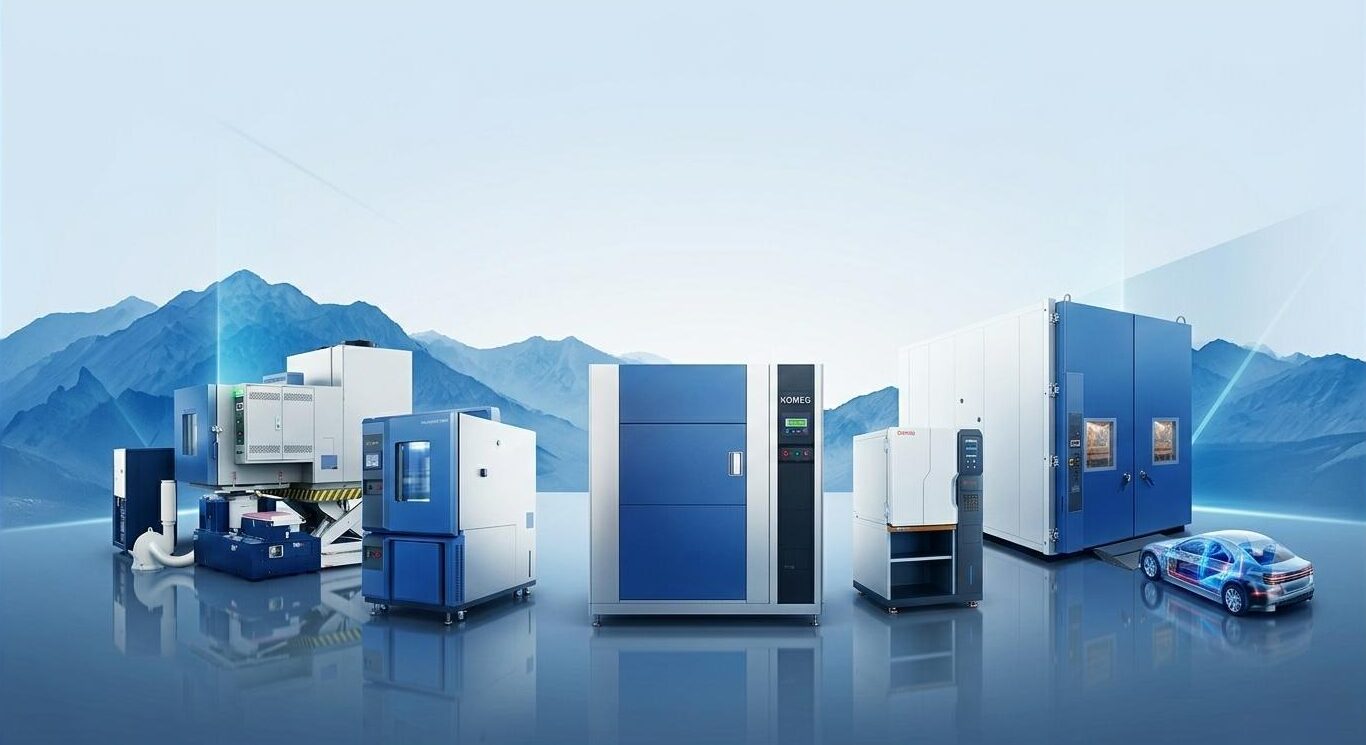
Whether in aerospace, new energy vehicles, or cutting-edge semiconductor fields, performing “stress tests” on products under simulated extreme environments has become the key to a company’s technological competitiveness. Below are the top 10 core application areas for environmental test chambers in 2026:
1. Electric Vehicle (EV) Battery Safety and Performance Validation
As the most critical testing requirement today, the simulation of extreme environments for lithium-ion batteries has entered an era of precision. Test chambers must now comply with global battery safety standards like NFPA 850. They are essential for simulating thermal runaway through ultra-rapid temperature changes and validating the structural integrity and stability of power batteries under extreme cold or heat during charge/discharge cycles.
2. Semiconductor and Wide-Bandgap Material Testing
The miniaturization and high-performance demands of chip manufacturing present extreme challenges for thermal management. For wide-bandgap materials such as Silicon Carbide (SiC) and Gallium Nitride (GaN), environmental test chambers are widely used to verify the reliability of power electronics, ensuring they maintain precise electrical performance under long-term high-temperature and high-power operational loads.
3. Accelerated Life Testing (ALT) and Reliability Growth
In 2026, with product development cycles severely compressed, leveraging accelerated life testing to quickly identify design bottlenecks is the “secret weapon” for shortening time-to-market. By subjecting products to combined extremes of temperature, humidity, and pressure, test chambers can convert years of outdoor aging into laboratory cycles of just a few weeks, ensuring durability throughout the product’s entire life cycle.
4. Environmental Stress Screening (ESS) for Electronic Components
For sectors demanding “zero-failure” performance—such as aerospace, 5G communications, and medical devices—ESS technology has become standard on production lines. Through precisely controlled thermal cycling coupled with mechanical vibration, test chambers effectively trigger potential early-stage defects, ensuring that equipment maintains robust performance in harsh service environments upon deployment.
5. Stability Testing for Pharmaceuticals and Biological Products
Complying with international regulatory standards like ICH Q1A, pharmaceutical stability test chambers serve as the “silent guardians” of the modern biopharmaceutical industry. These chambers require extremely high precision in temperature and humidity control to provide authoritative data for the shelf-life verification of vaccines, biologics, and core medications.
6. Aerospace and Defense Component Validation
Satellite and military-grade components must operate in environments characterized by vacuum, intense solar radiation, and rapid altitude-induced pressure/temperature fluctuations. Environmental test chambers simulate these high-fidelity extreme environments to perform rigorous stress tests, ensuring that critical components maintain core functionality under the most hostile physical conditions.
7. Outdoor Weathering Tests for Renewable Energy Infrastructure
With the widespread adoption of wind and solar technologies, outdoor infrastructure must withstand decades of exposure to wind, rain, and snow. By simulating UV exposure, salt spray corrosion, and severe climatic swings, test chambers provide reliable weathering evaluation solutions for photovoltaic inverters and wind power control systems.
8. Reliability Assurance for IoT and 5G Devices
The connectivity of billions of IoT devices means they must adapt to a diverse range of global climates. Environmental testing for communication modules and sensors focuses on verifying signal stability under the dual influence of internal heat accumulation and external climate shifts, ensuring the continuity of network transmission.
9. Environmental Adaptability of Advanced Driver-Assistance Systems (ADAS)
The detection accuracy of LiDAR, millimeter-wave radar, and visual cameras—the “eyes” of autonomous driving—is vital in heavy rain, fog, and ice/snow. Utilizing test chambers to simulate these extreme meteorological conditions is a core step for ADAS systems to pass automotive-grade certifications and ensure driving safety.
10. Reliability of Medical Devices and Precision Implants
Medical environments demand the highest standards of safety. From wearable health monitors to complex surgical robots, the application of test chambers covers comprehensive assessments ranging from material fatigue to electronic component functionality, ensuring precision remains error-free under a wide variety of patient-use environments.
Future Outlook
Environmental simulation technology in 2026 is trending toward greater intelligence and sustainability. Particularly against the backdrop of global low-carbon initiatives, environmentally friendly test chambers using CO2 (R744) refrigerants have gradually become mainstream in the market. They not only meet green manufacturing requirements but also significantly enhance testing efficiency through superior thermodynamic performance.
For enterprises, integrating environmental testing standards with international technical specifications (such as MIL-STD-810H and IEC 60068) is not merely a means to achieve technical compliance, but a necessary passage for brands to ascend into the ranks of high-end global manufacturing.