

Why Test Capacity Matters in Reliability Laboratories
Reliability laboratories often need to conduct multiple moisture-resistance tests under different conditions. When testing projects compete for the same equipment, test scheduling can become a bottleneck.
A double-layer HAST chamber offers a practical way to organize testing more efficiently. By integrating two independent test areas into one system, it allows laboratories to perform different tests simultaneously while making better use of available floor space.
The main value of a double-layer design is not simply a larger chamber. It is the ability to manage separate testing activities within one equipment footprint.
1. What Is a Double-layer HAST Chamber?
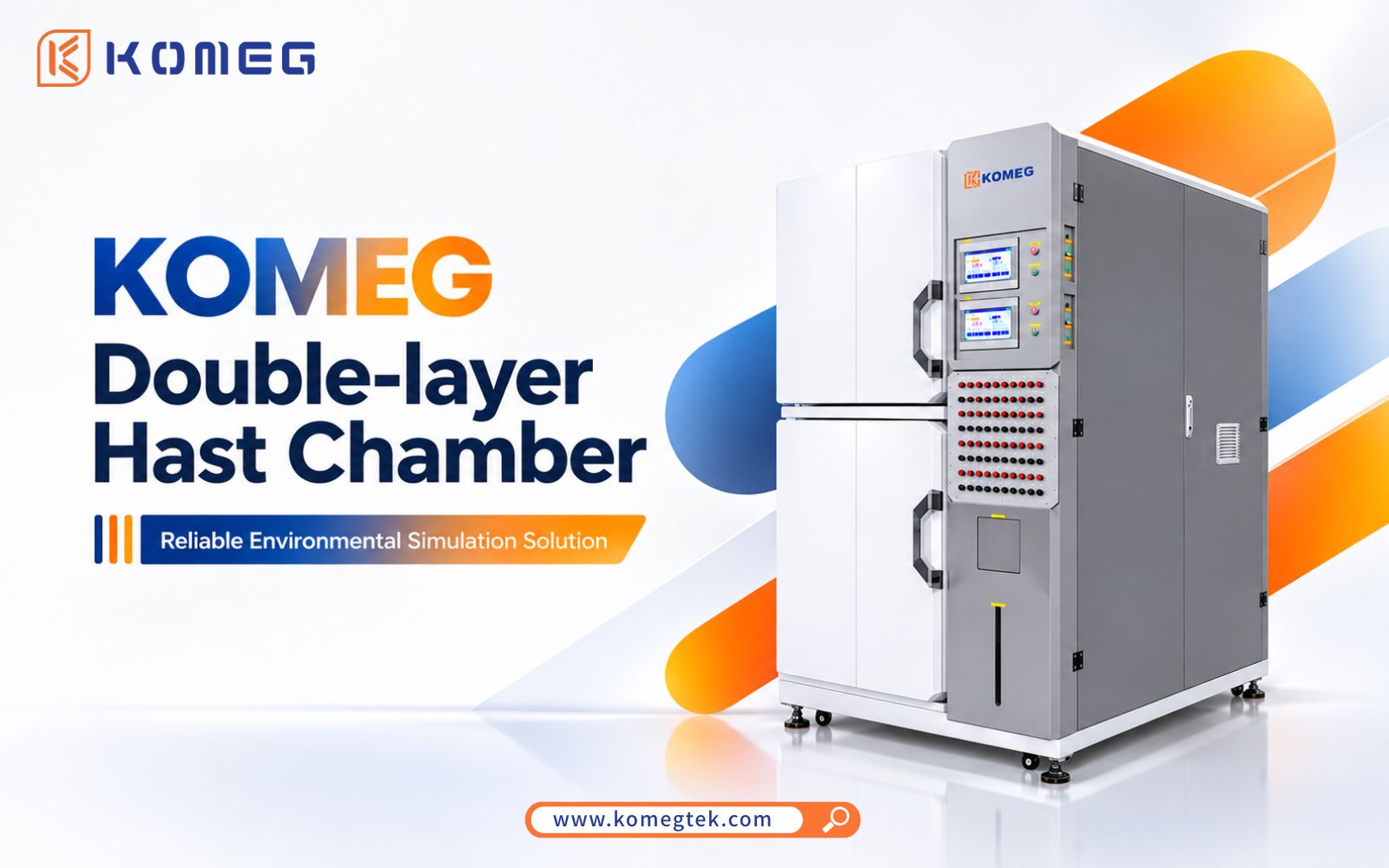
A double-layer HAST chamber is designed with two vertically arranged test areas, typically an upper zone and a lower zone. Each zone is equipped with its own controller, allowing different test conditions to be set and controlled independently.
This configuration supports two different tests running at the same time, depending on the required test conditions and equipment configuration.
It is important to distinguish this design from a conventional HAST chamber with a double-layer arc-shaped inner liner. The latter is designed to help reduce condensation dripping onto specimens. A double-layer HAST chamber with independent test zones is a different concept, focused on test organization and equipment utilization.
For laboratories handling multiple semiconductor or electronic component test projects, independent test zones can provide greater flexibility in daily testing.
2. How Independent Test Zones Improve Efficiency
Run Different Tests in Parallel
With separate controllers for the upper and lower test areas, a double-layer HAST chamber can support different test conditions simultaneously.
This helps reduce the need to wait for one test to finish before starting another, particularly when test projects have different schedules or requirements.
Make Better Use of Laboratory Space
Traditional testing arrangements may require separate equipment for different test conditions. A double-layer configuration integrates two test areas into one system, helping laboratories use their available floor space more effectively.
This can be especially useful in semiconductor and electronics laboratories where equipment space is limited.
Improve Test Scheduling Flexibility
Different test projects may require different temperature, humidity, and pressure conditions. Independent test zones allow laboratories to organize these activities separately, subject to the operating limits of the equipment.
The result is a more flexible testing arrangement—not a guarantee of a fixed productivity increase, but a practical way to reduce scheduling constraints.
3. HAST Applications in Electronics and Semiconductor Testing
Highly Accelerated Stress Testing uses elevated temperature, humidity, and pressure to accelerate moisture-related reliability evaluation.
HAST is commonly used for IC packaging, semiconductor devices, microelectronic chips, magnetic materials, and other moisture-sensitive electronic components.
The test can help identify potential weaknesses associated with moisture penetration, corrosion, insulation degradation, and package integrity. The actual failure mechanisms depend on the materials, package design, and selected test conditions.
HAST is particularly useful during product development and reliability qualification, when engineers need to evaluate how electronic components respond to accelerated moisture exposure.
A double-layer HAST chamber can support laboratories conducting multiple reliability projects by providing separate test areas for different test conditions.
4. Key Features to Consider
When evaluating a double-layer HAST chamber, the independent test zones are only one part of the selection process.
Independent control
Confirm whether the upper and lower test areas have separate controllers and can operate under different test conditions.
Pressure vessel material
SUS316 stainless steel is commonly used for HAST pressure vessels because of its corrosion resistance in high-temperature, high-humidity testing environments.
Temperature and humidity control
Check the required temperature range, humidity mode, pressure range, and control accuracy against the applicable test specification.
Condensation management
The internal chamber structure should help prevent condensation from directly dripping onto specimens, which could affect test conditions and results.
Safety protection
High-temperature and high-pressure testing requires appropriate protection, including over-temperature protection, pressure protection, door interlocks, and pressure relief devices.
Data communication
For laboratory traceability, consider communication and data recording requirements, such as RS485, Ethernet or USB data download.
These features should be evaluated according to the test method and laboratory requirements rather than treated as interchangeable specifications.
5. How to Select a Double-layer HAST Chamber
Before selecting a chamber, define the actual testing plan.
Start by confirming whether the upper and lower zones need to run different test conditions simultaneously. Then consider specimen dimensions, sample quantity, temperature and humidity requirements, pressure conditions, and whether bias testing or additional monitoring is required.
The chamber configuration should also match the laboratory’s available space, operating procedures, and maintenance requirements.
A double-layer HAST chamber is most suitable when independent test zones can support the laboratory’s real testing schedule. If both zones always run the same test under the same conditions, the operational benefit may be different.
The best selection is based on how the equipment will be used—not simply the number of test layers.
6. KOMEG Double-layer HAST Chamber
KOMEG’s Double-layer HAST Test Chamber is designed with upper and lower test areas, each equipped with a separate controller. This configuration allows two different tests to be performed simultaneously, helping laboratories improve testing flexibility and make more efficient use of equipment space.
The HAST2-55 model features a 150 L test volume, a SUS316 stainless steel pressure vessel, a 7-inch color touchscreen, and RS485, Ethernet, and USB communication interfaces.
The chamber supports temperature conditions from +105°C to +135°C, with unsaturated humidity control from 65%RH to 100%RH and saturated testing at 100%RH. The pressure range is specified in both gauge and absolute pressure, allowing test requirements to be matched more accurately.
For laboratories evaluating semiconductor packages, ICs, and other electronic components, the double-layer configuration provides a practical option for organizing multiple HAST testing activities.
Learn more about the KOMEG Double-layer HAST Test Chamber or explore the HAST Chamber Series.
A double-layer HAST chamber is designed to address a practical laboratory challenge: conducting multiple reliability tests efficiently within limited equipment space.
Its value comes from independent test zones, simultaneous testing capability, and more flexible test scheduling.
When selecting a chamber, engineers should evaluate the required test conditions, specimen characteristics, safety features, and independent control capabilities together.
For laboratories with multiple HAST testing projects, a double-layer configuration can be a useful approach to improving test organization and equipment utilization.