

Lithium batteries are subject to stringent safety assessment protocols stipulated by the UN 38.3 standard throughout their transportation and usage processes. As an integral part of the UN Manual of Tests and Criteria, this set of testing specifications lays down the minimum safety benchmarks for all lithium cells and batteries. Only products that meet these criteria are permitted for land, railway, marine and air transportation. Driven by the booming electric vehicle (EV) and portable electronic device markets, an in-depth understanding of UN 38.3 testing procedures has become increasingly essential.
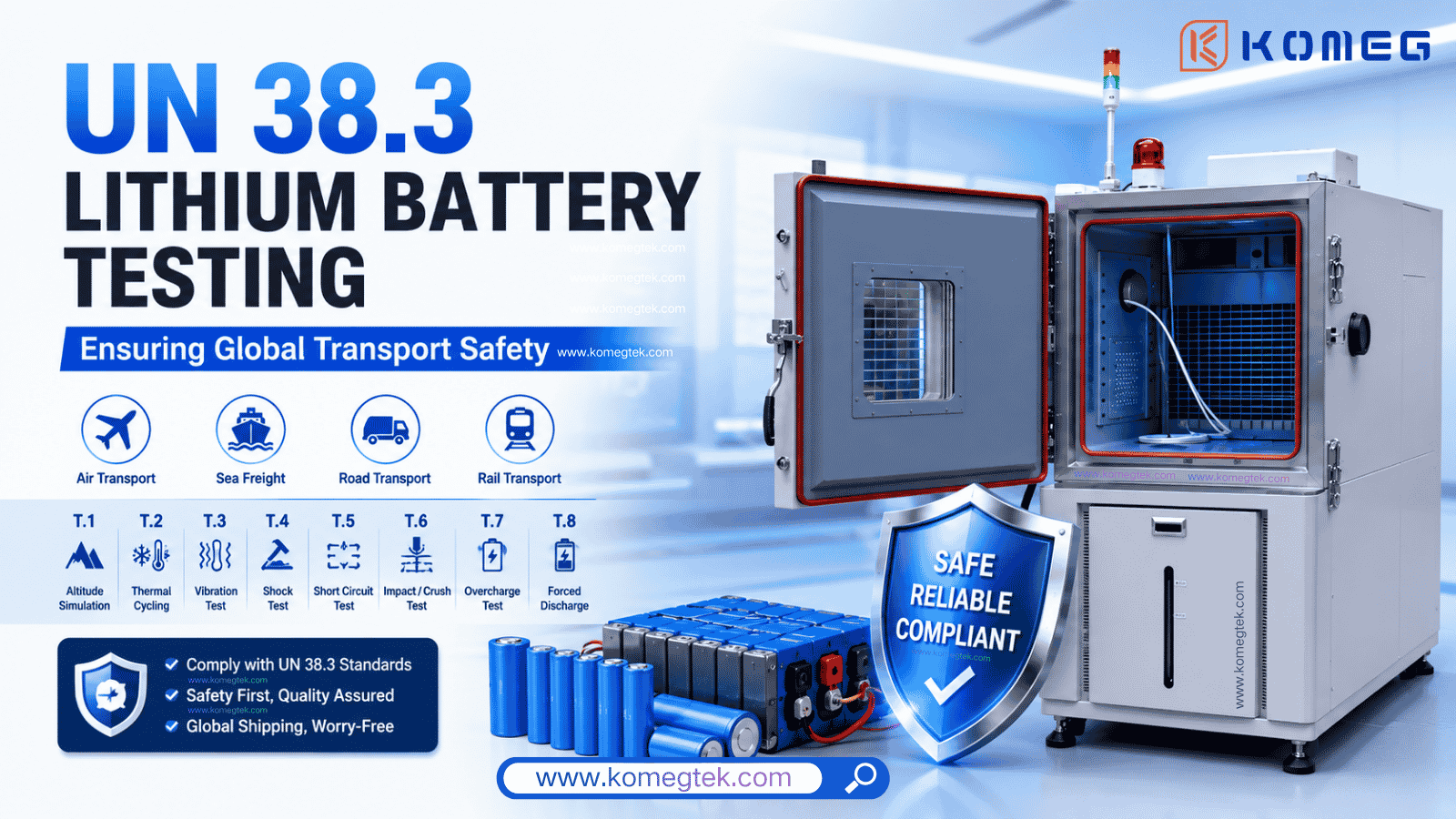
This guide comprehensively elaborates on eight mandatory tests under the UN 38.3 regulation, introduces the commonly adopted IEC 62133 battery safety standard, and explores the indispensable application of professional test chambers in lithium battery performance verification.
An Overview of UN 38.3 and Its Mandatory Compliance Requirements
UN 38.3 corresponds to Section 38.3 of the UN Manual of Tests and Criteria, which serves as a global authoritative guideline for dangerous goods classification. The regulation covers all lithium metal and lithium-ion batteries scheduled for transportation. Since 2003, lithium battery shipments must comply with IATA air transport regulations, ADR European road transport rules, and IMDG maritime transport codes, with successful completion of UN 38.3 tests being a compulsory prerequisite. Additionally, a standardised Test Summary report that validates qualified test results has been mandated for battery shipments starting from 2020.
The core objective of UN 38.3 certification is to confirm that lithium cells and batteries maintain stable performance under conventional transportation conditions. It effectively prevents potential hazards such as combustion, explosion and leakage of toxic substances. Every production batch of lithium batteries must undergo relevant testing before entering the industrial supply chain.
Eight Test Items Included in the UN 38.3 Testing System
T.1 — Altitude Simulation Test
T.2 — Thermal Cycle Test
Batteries are exposed to alternating extreme temperatures to simulate drastic ambient temperature changes during transportation. Samples are stored at 75±2°C for a minimum of 6 hours (12 hours for large-sized cells and batteries), then transferred to a low-temperature environment of -40±2°C for the same duration. The temperature transition time between the two extremes is strictly controlled within 30 minutes, and the whole cycle is repeated ten times. After the cyclic test, samples are kept at 20±2°C for 24 hours for subsequent observation. This test assesses the structural stability and sealing performance of batteries under thermal stress. Professional environmental test chambers deliver accurate and repeatable temperature adjustment rates to meet strict test criteria. Post-test requirements include no mass loss, leakage, rupture or combustion, with the open-circuit voltage maintaining over 90% of the initial value (excluding fully discharged batteries).
T.3 — Vibration Test
Cells are subjected to sinusoidal vibration with a frequency range of 7 Hz to 200 Hz. The vibration treatment lasts for three hours on each of the X, Y and Z axes to simulate mechanical vibration and extrusion stress during road and railway transportation.
T.4 — Mechanical Shock Test
Different acceleration pulses are applied to batteries in three axial directions: small cells bear 150g acceleration for 6 milliseconds, while large batteries withstand 50g acceleration for 11 milliseconds. This test verifies the shock resistance of batteries against accidental collisions and drops during handling and transportation.
T.5 — External Short-Circuit Test
T.6 — Impact and Crush Test
For cylindrical and prismatic cells, a 9.1 kg weight is dropped from a height of 61 cm onto the cell surface with a 15.8 mm diameter pressure bar. For button and flexible pouch cells, a graded crushing test with a maximum pressure of 13 kN is conducted. Both testing methods require no fire or explosion as the qualified standard.
T.7 — Overcharge Test (Applicable to Rechargeable Batteries Only)
Batteries are charged continuously for over 24 hours with a current twice the maximum rated charging current specified by the manufacturer. This test assesses the safety performance of batteries in case of charging circuit failures and abnormal current surges.
T.8 — Forced Discharge Test
Test Item | Simulated Working Condition | Key Test Parameters | Climate Chamber Required |
T.1 | Altitude environment | ≤11.6 kPa, 20±5°C, 6+ hours | Yes (with vacuum module) |
T.2 | Temperature fluctuation | -40°C / +75°C, 10 cycles | Yes |
T.3 | Mechanical vibration | 7-200 Hz, 3 hours per axis | No (vibration table required) |
T.4 | Mechanical shock | 150g / 50g acceleration | No (shock test bench required) |
T.5 | External short circuit | <0.1 Ohm, 55°C, 1 hour | Yes |
T.6 | Impact and extrusion | 9.1 kg weight / 13 kN pressure | No |
T.7 | Overcharge state | 2 times rated current, 24 hours | Optional |
T.8 | Forced discharge | Maximum discharge current | Optional |
IEC 62133: Essential Safety Standard for Secondary Lithium Batteries
- IEC 62133-1: Covers cell-level tests, including continuous low-rate charging, temperature cycling, incorrect installation, external short circuit, free fall, thermal abuse, low pressure and crushing tests.
- IEC 62133-2: Includes both cell and battery testing items, such as constant-voltage continuous charging, forced internal short circuit, overcharging and mechanical shock tests.
Key Test Procedures of IEC 62133
Temperature Cycling Test
Thermal Abuse Test
Low-Pressure Test
Functional Value of Test Chambers in Battery Testing
- UN 38.3 T.2 Thermal Cycle Test: Achieve rapid and stable temperature switching between -40°C and +75°C with controllable heating and cooling rates.
- UN 38.3 T.5 External Short-Circuit Test: Maintain a constant ambient temperature of 55°C throughout the test procedure.
- IEC 62133 Thermal Abuse Test: Support uniform linear heating up to 130°C with accurate temperature control.
- IEC 62133 Low Pressure & Temperature Cycling Test: Simulate extreme low-pressure and alternating temperature environments to verify battery stability.
KOMEG Professional Battery Testing Solution
As a professional lithium-ion battery test chamber manufacturer, KOMEG has accumulated rich industry experience in secondary cell and battery testing. The brand has gained widespread customer recognition for reliable product quality and customised testing solutions, serving scientific research laboratories, battery manufacturers and industrial testing institutions. KOMEG offers a complete lineup of lithium-ion battery test chambers to cover diverse testing requirements:
- Complete Product Portfolio: Includes thermal cycle chamber, thermal shock chamber, explosion-proof industrial oven, vacuum oven, altitude test chamber and temperature humidity chamber.
- High-precision Test Equipment: KOV-384B Explosion Proof Industrial Oven for thermal abuse tests; KUO-64 Vacuum Oven for low-pressure simulation tests; dedicated altitude and temperature cycle test chambers for UN 38.3 compliance.
- Strict Standard Compliance: All equipment fully meets UN 38.3 and IEC 62133 international testing standards, supporting precise temperature, pressure and humidity control.
- Customised Service: Flexible chamber volume design applicable for single cells, battery modules and complete battery packs; compatible with battery charging and discharging cabinets for combined testing.
- High-safety Configuration: Built-in explosion-proof system and high-precision gas detection sensors to ensure laboratory testing safety.
KOMEG provides one-stop battery testing solutions covering various international battery safety standards. If you need to purchase lithium-ion battery test chambers, you can submit your customised standard requirements to KOMEG, and our professional team will deliver tailored testing schemes and competitive chamber quotations.
Frequently Asked Questions About UN 38.3
1. Is UN 38.3 certification mandatory for all lithium batteries?
Yes. All lithium metal and lithium-ion batteries for international transportation must pass eight complete UN 38.3 test items. Moreover, an official Test Summary report has been a mandatory shipping document since 2020.
2. What are the core differences between UN 38.3 and IEC 62133?
UN 38.3 is a mandatory dangerous goods transportation regulation, focusing on verifying battery safety during transit. In contrast, IEC 62133 is a universal industrial safety certification for secondary lithium batteries, evaluating battery safety performance under daily usage and extreme abuse conditions. The two standards are complementary: UN 38.3 is the basic threshold for battery transportation and market circulation, while IEC 62133 is an essential qualification for commercial battery production and application.
3. Which UN 38.3 tests require environmental test chambers?
The T.2 thermal cycle test is an essential item that must be completed with a professional environmental chamber. The T.1 altitude simulation test, T.5 high-temperature short-circuit test, T.7 overcharge test and T.8 forced discharge test also require auxiliary temperature and pressure control equipment. In addition, multiple test items in IEC 62133 are highly dependent on high-precision explosion-proof test chambers.
Extended Reading & Authoritative References
For more professional knowledge of battery environmental testing, please refer to KOMEG UN 38.3/IEC 62133 Lithium-ion Battery Test Chamber.