

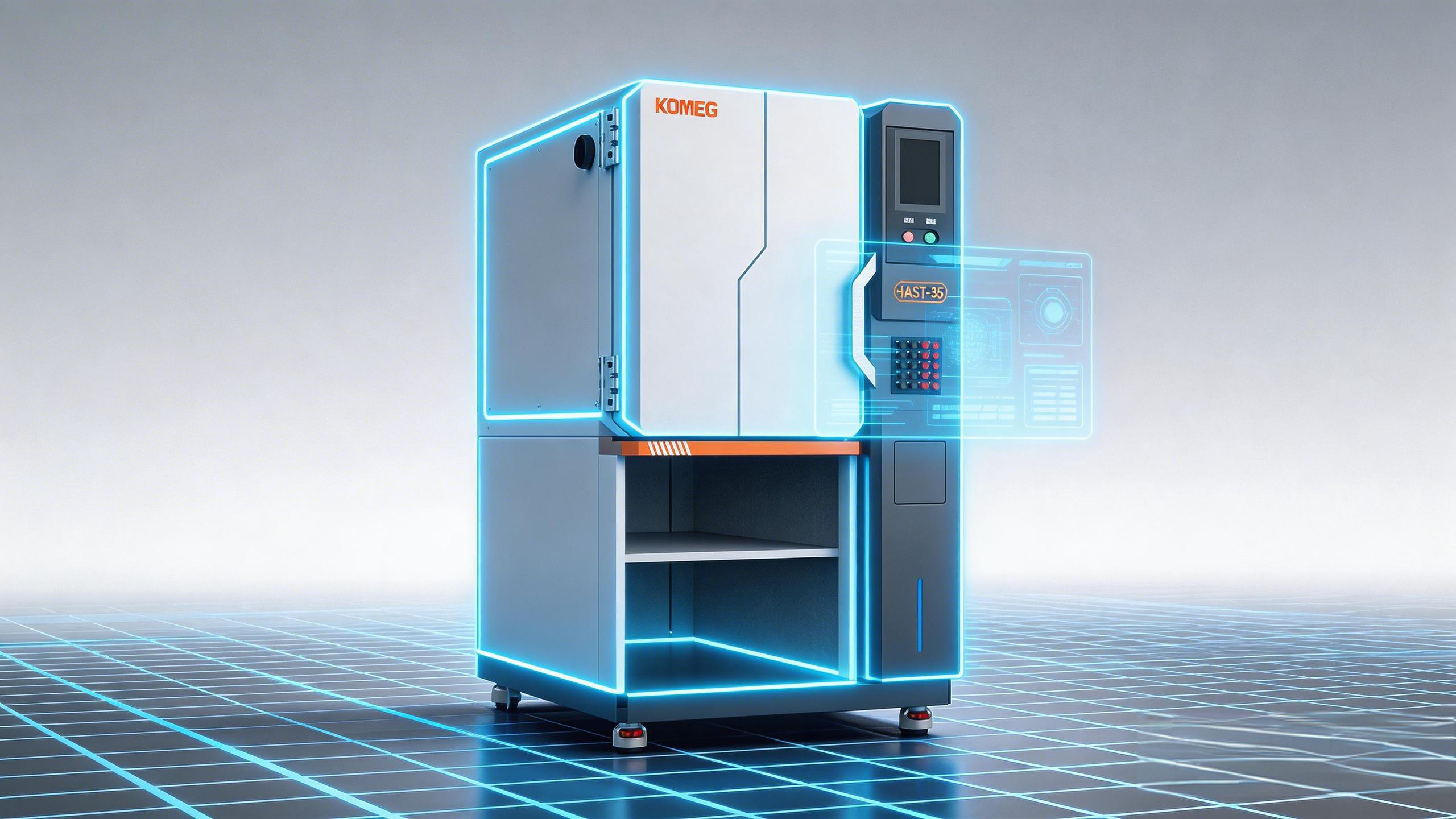
In the electronics manufacturing industry, reliability serves as a core indicator for measuring product quality. A product’s reliability directly determines its performance, service life, and user satisfaction in real‑world applications. Therefore, accurate evaluation and effective improvement of product reliability are critically important. To precisely simulate a product’s actual performance after years of use, engineers typically rely on professional environmental test chambers. Among these, the HAST chamber — short for Highly Accelerated Stress Test Chamber, also known as a highly accelerated pressure aging test chamber — is specialized equipment designed to rapidly assess the reliability of products, especially environment‑sensitive items such as semiconductors and electronic components, under extreme conditions of high temperature, high humidity, and high pressure. Thanks to its exceptional testing efficiency, the HAST chamber stands out among various testing instruments, exposing potential design defects within a very short time and providing critical data for product optimization and improvement.
What is a HAST Chamber?
Highly Accelerated Stress Testing (HAST) is a highly effective reliability testing method, primarily applied in semiconductor packaging and electronic component manufacturing. During the R&D and production of electronic products, ensuring the reliability of semiconductor packages and electronic components in complex environments is essential, and HAST testing was developed precisely to meet this requirement.
Differences Between HAST Chambers and Traditional High-Temperature & High-Humidity Tests
Unlike conventional high‑temperature and high‑humidity test chambers (operating at 85°C / 85% RH), HAST chambers greatly accelerate moisture penetration into products by significantly raising the temperature (typically above 100°C) and increasing pressure. While traditional chambers simulate relatively mild humid environments, HAST chambers replicate far more severe humid conditions. This extreme environment simulation aims to comprehensively and thoroughly evaluate the moisture‑proof integrity of sealing materials and protective coatings, ensuring products effectively resist moisture erosion in actual use.
Core Testing Principle of HAST Chambers
The fundamental principle of HAST is based on unsaturated steam pressure. In a sealed environment exceeding one standard atmosphere, water molecules move at an accelerated rate and quickly penetrate electronic packages. This accelerated penetration allows products to experience moisture damage equivalent to long‑term natural exposure within a short period, rapidly revealing potential defects.
- Acceleration Factor: HAST testing is 10 to 100 times faster than traditional 85/85 testing. This means HAST can complete more test cycles or apply harsher conditions within the same timeframe, enabling more efficient detection of reliability issues.
- Cycle Reduction: Traditional tests that would require 1,000 hours can be finished in just 96 to 264 hours under HAST conditions. This substantial time reduction drastically shortens product development cycles, allowing companies to launch products faster and gain a competitive market advantage.
- Failure Modes: HAST testing mainly detects corrosion (especially electrolytic corrosion), insulation degradation, and delamination of packaging materials. These common and critical failure modes severely impact electronic product performance and service life; HAST testing identifies and resolves them in advance, enhancing overall reliability.
Why Choose HAST Over Traditional THB Testing?
In the fast‑evolving technology industry, time is critical to business success. Product development cycles and market responsiveness directly determine a company’s competitiveness. Compared with traditional Temperature‑Humidity‑Bias (THB) testing, HAST chambers offer distinct advantages:
- Rapid Validation: HAST provides key reliability data to R&D teams in just a few days, whereas traditional THB testing may take weeks or even months. This speed allows teams to adjust designs and manufacturing processes promptly, improving R&D efficiency.
- Harsh Stress Application: HAST imposes more severe stress conditions, identifying minor material flaws that might remain hidden under low‑stress environments. Such imperfections often escape detection in conventional tests but can worsen during actual use and cause product failure. Rigorous HAST testing effectively improves quality and stability.
- Compliance with International Standards: Modern HAST testing strictly adheres to international electronics industry standards, including JEDEC JESD22‑A110 (biased) and A118 (unbiased). Compliance ensures accurate and reliable test results, strengthens product competitiveness in the global market, and facilitates exports and international cooperation.
Key Components of HAST Chambers
To ensure repeatable and precise test results, high‑quality HAST chambers (such as the KOMEG HAST series) generally include the following critical components:
- High‑Pressure Inner Chamber: Constructed from corrosion‑resistant 304/316 stainless steel for stable long‑term operation in high‑pressure steam environments. Stainless steel delivers excellent corrosion resistance and structural strength, withstanding combined high pressure and high temperature to guarantee service life and testing accuracy.
- Dual Temperature Control System: Independently controls dry‑bulb and wet‑bulb temperatures to precisely regulate relative humidity, typically within a range of 65% to 100%. Accurate humidity control is essential for HAST testing; the dual‑temperature system enables precise adjustment to maintain stable and consistent test conditions.
- Automatic Safety Interlock: Equipped with an automatic safety locking mechanism to prevent accidental door opening under pressure, effectively protecting operator safety. Since HAST chambers operate under high pressure, unintended door opening could release high‑pressure steam and cause injury. The interlock automatically detects internal pressure and prohibits door access when pressurized.
- Biased Test Rack: Supports voltage application to components during testing, simulating real‑world operating loads. As electronic components normally function under powered conditions, biased testing more realistically replicates their working environment, evaluating reliability under active operation, and improving test accuracy and practicality.
As an indispensable tool in semiconductor reliability laboratories, the HAST chamber’s importance is self‑evident. It not only reveals potential failure points by accelerating moisture erosion and supporting product improvement, but also significantly cuts testing time and saves valuable R&D costs. In the highly competitive electronics manufacturing sector, HAST chambers have become vital instruments for enterprises to enhance product quality, accelerate development, and strengthen market competitiveness.
Professional Recommendations
When considering purchasing a HAST chamber, besides price, pressure control accuracy, and chamber material corrosion resistance (usually Grade 316 stainless steel required) are key factors determining the stability of test data.
KOMEG HAST‑35 Laboratory‑Type Highly Accelerated Stress Test Chamber
The KOMEG HAST‑35 is a professional instrument specifically designed for unsaturated testing.