

1. Definition and Core Functions
A Xenon Arc Test Chamber is a fundamental instrument in environmental simulation. By utilizing the radiation produced by xenon arc lamps, the equipment replicates the full spectrum of natural sunlight, encompassing ultraviolet (UV), visible light, and infrared (IR) radiation.
Its primary function is to evaluate the weatherability of materials through accelerated testing. By simulating high-intensity light exposure, elevated temperatures, humidity, and rainfall cycles, the equipment facilitates the collection of data on physical and chemical degradation—such as color fading, surface chalking, and loss of mechanical strength. This process effectively reproduces damage in a significantly compressed timeframe that would otherwise take years to occur in a natural environment.
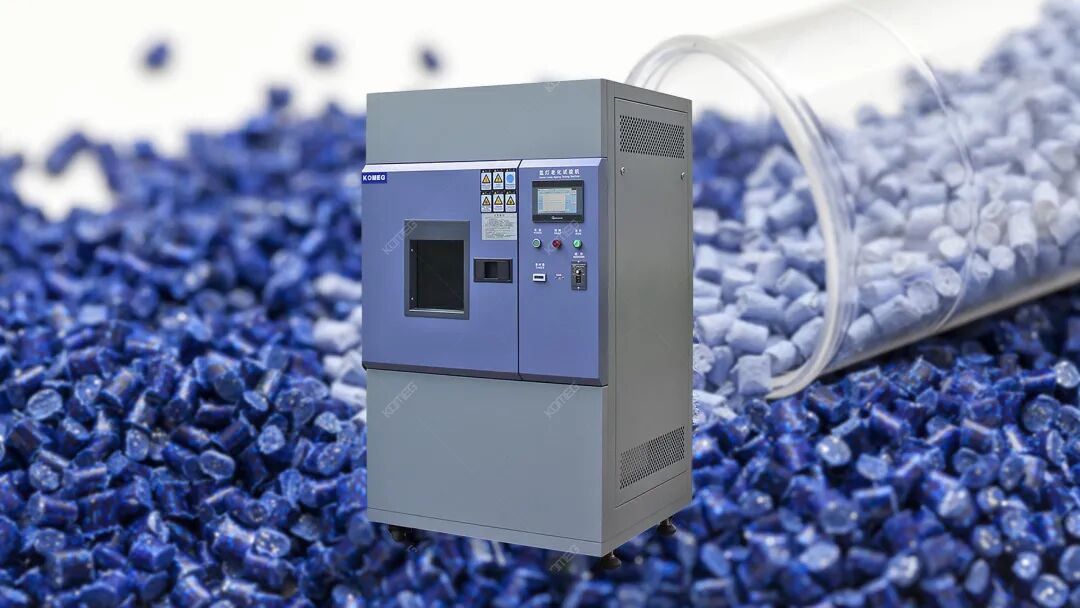
2. Technical Evolution and Control Systems
Light Source Evolution: Early weathering testing relied on carbon arc lamps. However, due to significant spectral discrepancies between carbon arcs and natural sunlight, they have been largely superseded by xenon arc lamps, which offer a much closer spectral match.
Advanced Control: Modern units integrate sophisticated closed-loop control systems. These systems provide real-time monitoring and precise adjustment of irradiance (measured in $W/m^2$), Black Panel Temperature (BPT) or Black Standard Temperature (BST), and relative humidity, ensuring that the test environment strictly adheres to international standards.
3. Structural Classification and Technical Characteristics
3.1 Air-Cooled Flatbed Structure
Air-cooled units typically feature one to three xenon lamps, each with a power rating between $1.8kW$ and $2.5kW$, mounted at the top of the chamber.
Specimen Placement: Samples are positioned statically on a horizontal tray beneath the lamps.
Technical Advantage: This design is ideal for testing three-dimensional, irregularly shaped finished products or large components.
Cooling Mechanism: Forced air circulation dissipates heat from the lamps, resulting in a straightforward and robust structural design.
3.2 Water-Cooled Rotating Drum Structure
Water-cooled units feature a single high-power xenon lamp (typically $4.5kW$ or $6kW$) mounted vertically at the center of the chamber.
Specimen Placement: Samples are mounted on a cylindrical rack (carousel) that rotates continuously around the light source.
Technical Advantage: Rotation ensures that every sample receives highly uniform irradiance. Consequently, the uniformity of this structure generally exceeds that of static designs, making it the preferred choice for precision testing of standard specimens.
Cooling Mechanism: The lamp is cooled by circulating high-purity deionized water, allowing the system to manage significantly higher thermal loads.
3.3 Compact Desktop Structure
Desktop units are streamlined versions utilizing either air-cooled or low-power water-cooled technology. Characterized by their small footprint and ease of operation, they are primarily used for preliminary screening tests or for validating the performance of small-scale samples.
4. Technical Considerations for Selection
When determining the appropriate technical path, the following parameters and cost factors must be evaluated:
Irradiance Requirements: For protocols demanding high irradiance levels (e.g., exceeding $1.5W/m^2$ at $420nm$), water-cooled units are recommended. The superior power of a single water-cooled lamp meets high-intensity requirements more efficiently than multiple air-cooled lamps.
Material Geometry: * Air-Cooled Flatbed: Best for 3D samples, such as automotive electronic components or product housings.
Water-Cooled Rotating: Ideal for flat specimens requiring high data consistency, such as coating color cards, plastic sheets, or textiles.
Maintenance and Water Quality: Water-cooled units require stringent water quality management. The cooling water must undergo deep deionization to prevent mineral scaling on lamps and filters, which could otherwise obstruct radiation and invalidate results. Air-cooled units require deionized water only for humidity and spray systems, leading to simpler maintenance.
Operational Costs: While air-cooled lamps have a lower unit price, multiple lamps may be needed for the same area. Water-cooled units, despite higher individual consumable costs, offer superior energy efficiency and data stability for high-precision, large-scale tasks.
5. Selecting the Optimal Equipment for Your Needs
To finalize your selection, consider these three critical factors:
Sample Geometry: For finished items like mobile phone cases or car door handles, an air-cooled flatbed system is most effective. For standardized samples like fabric swatches, the water-cooled rotating drum is the industry standard.
Testing Standards: Many automotive OEM, ISO, or AATCC standards explicitly mandate the use of either water-cooled or air-cooled technology.
Facility Constraints: If laboratory space or initial budget is limited, a desktop model is a practical starting point. However, for high-precision, long-term testing, a water-cooled system provides a better return on investment through superior data accuracy.
Would you like to explore the specific technical specifications of our series, or do you need a customized testing solution tailored to your industry? Simply provide details regarding the products you intend to test, and I can recommend the most appropriate testing parameters for your application.