

Environmental testing is a critical phase in product development for high-stakes industries including automotive, electronics, aerospace, and semiconductors. The ability to simulate real-world conditions—ranging from extreme temperature and humidity to hazardous abuse testing—is essential for product validation, safety compliance, and meeting global ESG (Environmental, Social, and Governance) commitments.
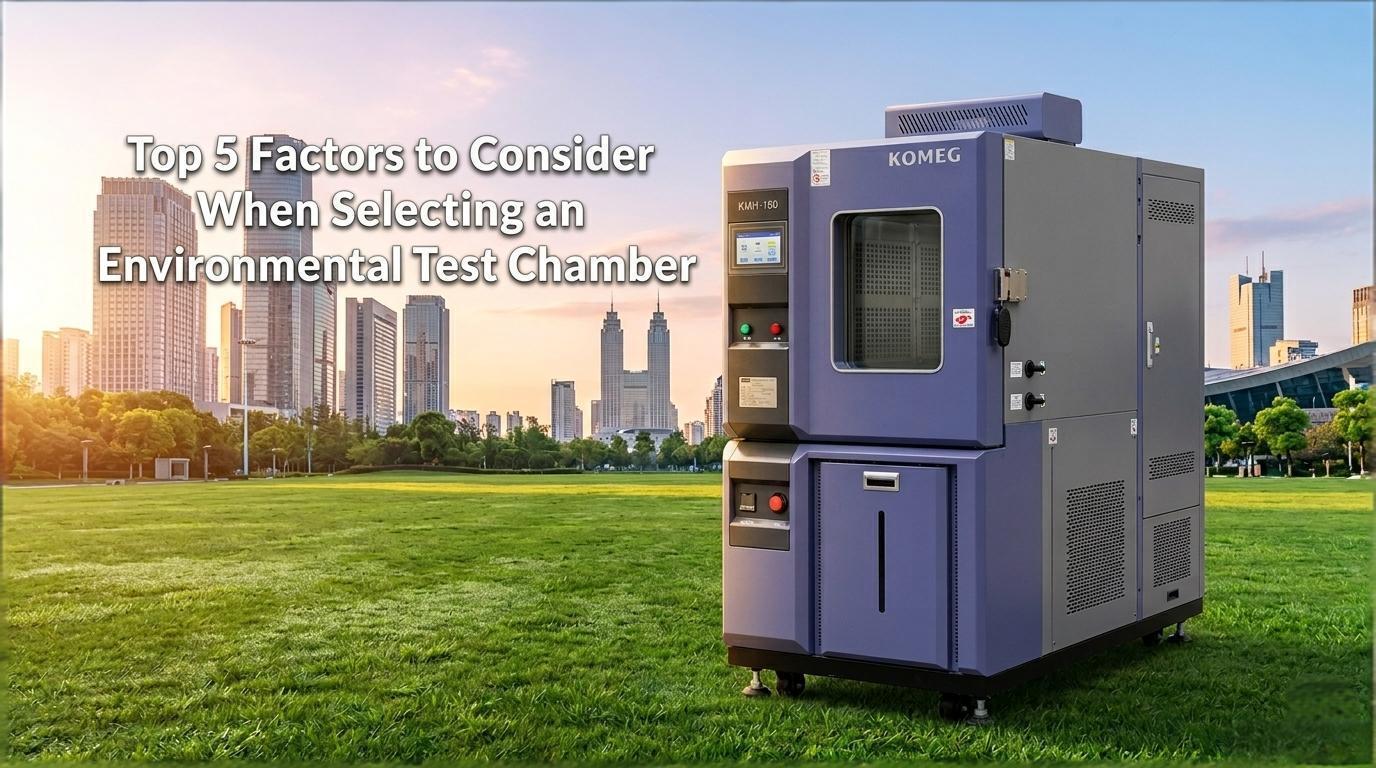
Selecting the incorrect environmental test chamber is more than a financial oversight; it leads to invalidated test data, laboratory safety hazards, product recalls, and expensive equipment obsolescence as environmental standards evolve. This technical guide outlines the five most critical factors to ensure your selection provides precision, safety, and long-term operational viability.
1. Precise Temperature and Humidity Control Dynamics
The foundation of any environmental test chamber is its capacity to maintain specific climatic conditions with absolute precision. This goes beyond reaching raw temperature setpoints.
Critical Technical Considerations:
Temperature Range (High/Low): Standard industrial chambers offer a range from -40°C or -70°C to +150°C or +180°C. For extreme applications such as military-grade testing (MIL-STD-810H), the system must maintain these setpoints consistently under a full test load.
Temperature Change Rate: Standard chambers transition at 2-5°C/min. Accelerated stress screening (ESS) may require rates exceeding 10°C/min. It is vital to verify the specimen temperature ramp rate specifically, as this differs significantly from the air temperature rate.
Humidity Uniformity: Standard humidity ranges from 20% to 98% RH. Maintaining uniformity across large internal volumes is technically demanding. Ensure the system utilizes high-velocity air circulation to maintain ±1.0°C uniformity and ±2.5% RH uniformity to comply with rigorous international standards.
2. Chamber Size and Specimen Load Capacity
Chamber size selection must balance current testing requirements, budget constraints, and available laboratory space. A common error is specifying a chamber that is only marginally larger than the test specimen, which impedes the thermal dynamics.
Critical Technical Considerations:
Usable Working Volume: The industry standard recommends that the test specimen occupies no more than 33% to 50% of the chamber’s internal volume. This ensures sufficient free space for air circulation to maintain even temperature distribution.
Thermal Mass and Heat Load: The energy required to transition air temperature differs from the energy needed to change the temperature of the specimen itself. For specimens with high thermal mass, such as engine blocks or large battery packs, a chamber with a high heat transfer rate is required.
Specialized Access Ports: Modern testing often requires specialized access. Ensure the chamber side walls can accommodate multiple, large-diameter (e.g., 100mm or 150mm) cable ports for high-voltage leads or sensory data cables without compromising the environmental seal.
3. Safety Systems and Explosion-Proof Engineering
Testing energy-dense components such as EV battery cells and modules (UN38.3, UL2580) creates a high risk of thermal runaway. The test chamber must be engineered to contain these hazardous events based on EUCAR Hazard Levels (1-7).
Critical Technical Considerations:
EUCAR Hazard Level Matching: Specify the Hazard Level required for your specific specimen. Level 4 (venting) requires significantly different engineering than Level 7 (explosion).
Explosion-Proof (Ex-rated) Features: Safety features, including pressure relief vents, blow-out ports, safety chains on door latches, and non-sparking fans are mandatory for battery testing. The structural integrity must be certified to withstand a worst-case failure scenario.
Detection and Suppression: Integrated safety should include $H_2$, $CO$, and VOC (Volatile Organic Compound) sensors for early warning before ignition. Automatic fire suppression systems, such as Water Mist or $CO_2$ purging, are essential to extinguish flames and cool the specimen rapidly.
4. Controller Functionality and Data Connectivity
The controller serves as the primary interface for testing precision. Modern industrial requirements demand an intuitive interface that integrates into the laboratory’s digital ecosystem.
Critical Technical Considerations:
Intuitive Interface: A high-definition touchscreen with multi-language support and graphical displays of test profiles and trends is the current industry standard.
Remote Monitoring: Specify controllers that offer Ethernet and Wi-Fi connectivity for remote access via PC or mobile devices. This is crucial for long-duration testing where personnel cannot be physically present at all times.
Audit Trails and Compliance: Data logging must be tamper-proof and support automated report generation. For sectors such as medical or aerospace, ensure the data logging is compliant with relevant auditing and security standards.
5. Build Quality and ESG Regulatory Compliance
Build quality directly correlates with long-term reliability and the total cost of ownership. Strategic selection must also account for future regulatory compliance regarding refrigeration.
Critical Technical Considerations:
Material Integrity: The chamber interior should utilize high-grade, corrosion-resistant stainless steel (e.g., SUS 304 or 316). This material is superior for high-pressure systems and ensures structural integrity for heavy specimens, such as EV battery packs exceeding 500kg.
F-Gas Regulatory Compliance: Traditional synthetic refrigerants have high GWP (Global Warming Potential) and are subject to increasingly strict international regulations. Adoption of CO2 (R744) natural refrigerant (GWP=1) is the preferred strategy to eliminate Scope 3 ESG emissions and protect equipment against future chemical bans.
Operational Efficiency: Evaluate energy consumption, water usage for humidity systems, and noise levels. These factors represent significant long-term operational costs and impact the laboratory environment.
Selecting an environmental test chamber is a sophisticated engineering decision involving thermodynamics, safety engineering, and material science. By evaluating climatological dynamics, load capacity, safety, connectivity, and build quality, manufacturers can establish a precise, safe, and future-proof testing infrastructure.
FAQ
Q: What is the typical temperature tolerance required by international testing standards?
A: Most international standards require the temperature to be within ±1.0°C to ±2.0°C of the setpoint. Uniformity throughout the chamber is more critical for data validation than the raw temperature extremes.
Q: How does natural refrigerant protect against future chemical bans?
A: Natural refrigerants like CO2 (R744) are not subject to the phase-out quotas or bans that affect synthetic fluorinated gases (F-gases). This ensures the equipment remains compliant throughout its 15-20 year service life.
Q: Can safety features for battery testing be retrofitted to existing chambers?
A: High Hazard Level safety features, such as explosion-proof vents and fire suppression, are integrated during the manufacturing process. Retrofitting standard chambers is technically difficult and often fails to meet rigorous safety certifications.