

In the realm of modern industrial reliability testing, the Three-zone Thermal Shock Test Chamber is a critical instrument for evaluating the thermal fatigue performance of products. Simulating extreme temperature gradients, it enables engineers to identify latent defects in material structures or manufacturing processes—such as solder joint failures or sealing breaches—within a very short timeframe.
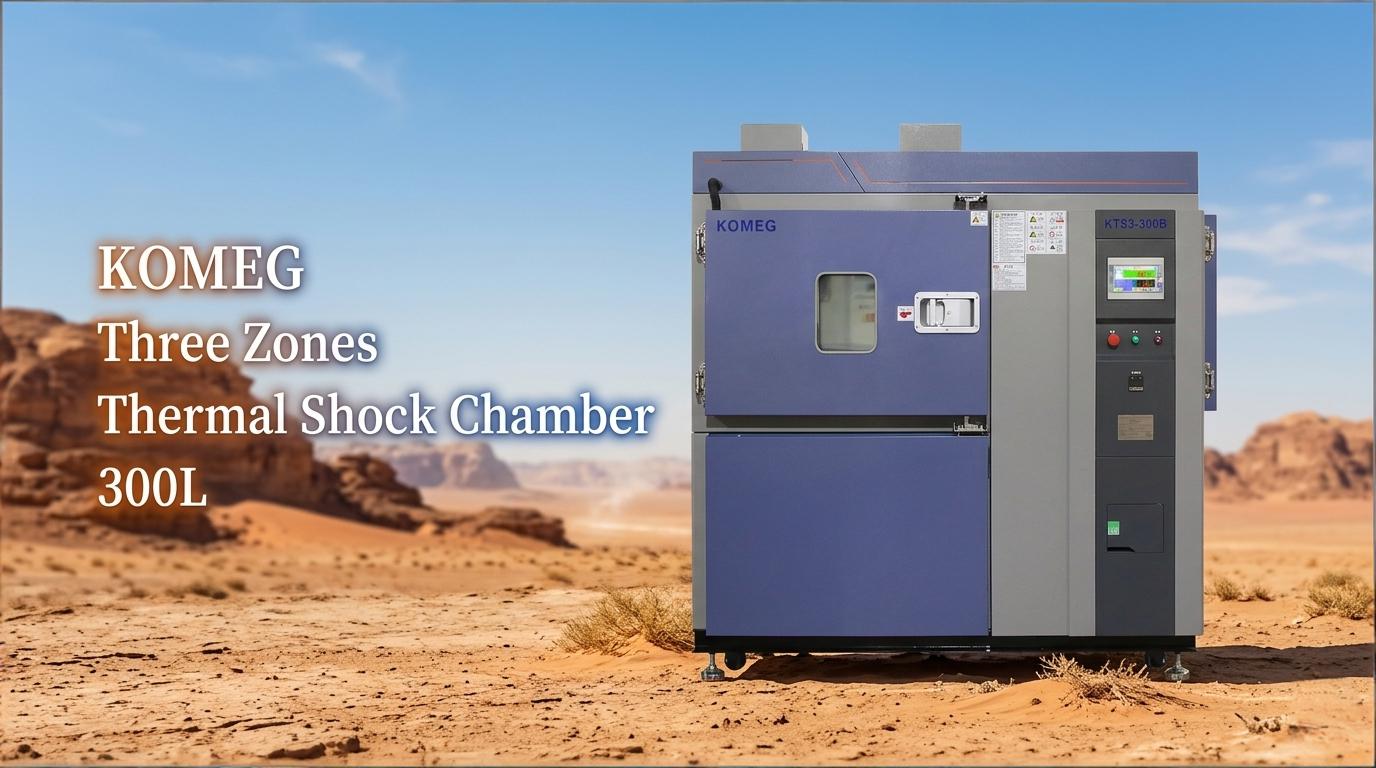
1. Structural Layout: Synergy of Three Independent Zones
The three-zone chamber utilises a unique vertical tri-layer architecture to ensure efficient energy storage and rapid transition:
Hot Zone (Upper Chamber): Equipped with high-performance heating elements and centrifugal fans, this zone remains in a “pre-heating” state. It acts as a thermal reservoir, ready to deliver heat to the test chamber at any moment.
Cold Zone (Lower Chamber): Powered by a cascade refrigeration system (typically using eco-friendly refrigerants like $R404A$ and $R23$), this zone maintains ultra-low temperatures to provide a constant source of cooling energy.
Test Zone (Middle Chamber): This is the core workspace where the specimen remains stationary. It connects to the upper and lower chambers via precision-engineered pneumatic dampers.
2. Operational Logic: The Art of Airflow Switching
The core principle of the three-zone system can be summarised as: “Stationary Specimen, Dynamic Environment.” The process consists of three key cycles:
Pre-conditioning Phase
Before the shock cycle begins, the upper and lower chambers accumulate energy. To compensate for thermal loss during airflow transmission, the hot zone is pre-heated to a temperature higher than the target value, while the cold zone is pre-cooled significantly lower.
Hot Shock Phase
When the program initiates a hot shock, the bottom damper closes, and the top damper snaps open. High-pressure circulation fans force the pre-heated air into the middle test zone. The specimen experiences a violent temperature rise within seconds, simulating a product’s sudden transition from ambient to extreme heat.
Cold Shock Phase
During the transition to cold shock, the top damper closes, and the bottom damper opens. The chilled air stored in the lower chamber is instantly drawn into the test zone, displacing the hot air. This rapid contraction effect creates immense stress at the interfaces of materials with different expansion coefficients.
Unique Feature: Ambient Recovery
Unlike traditional two-zone chambers, the three-zone design allows for an “Ambient Transition.” By closing both the hot and cold dampers and introducing fresh outdoor air, the test zone can return to room temperature between extreme cycles. This is essential for compliance with specific military standards like MIL-STD-810H.
3. Technical Edge: Why “Static Testing” is Superior
When selecting a shock chamber, the “Static” mode of the three-zone system offers distinct physical advantages over traditional “Moving Basket” (two-zone) designs:
Elimination of Mechanical Vibration: The specimen remains fixed on the tray throughout the test. This prevents additional mechanical damage to sensitive components (such as precision sensors or crystal oscillators) caused by the vibrations inherent in a lifting basket.
Ideal for Live Load Testing: For tests requiring the specimen to be powered on (signal monitoring or load testing), the three-zone chamber is far superior. Since the test room is stationary, cables can be routed directly through a fixed access port. In moving basket designs, cables must flex and move, leading to fatigue failure or signal interference.
Superior Temperature Uniformity: By utilizing forced air convection rather than physical movement, the airflow distribution is more consistent, ensuring every surface of the specimen receives a uniform thermal shock.
4. Key Performance Indicators
When evaluating a high-performance three-zone shock chamber, focus on the following technical parameters:
Temperature Recovery Time: The most critical metric. It refers to the time required for the test zone sensor to return to the setpoint range (e.g., $\pm 2$°C) after a damper switch. International standards generally require this to be within 5 minutes.
Pneumatic Damper Response: The switching speed of the dampers directly determines the instantaneous temperature change rate ($dT/dt$).
Standard Compliance: High-quality equipment must be capable of meeting major industry standards, including IEC 60068-2-14, JESD22-A104, and MIL-STD-810H.
5. Typical Application Scenarios
The KOMEG Three-zone Thermal Shock Chamber is an indispensable tool across diverse high-tech industries, ensuring products can withstand the thermal “whiplash” of real-world environments:
Electronics & Semiconductors: Crucial for testing the reliability of smartphones, high-density chips, and complex PCBs (Printed Circuit Boards) under rapid temperature fluctuations, identifying potential solder joint cracking or delamination.
Automotive & Aerospace: Used to validate the structural integrity and performance stability of engine components, sensors, and advanced aerospace materials when exposed to the extreme climatic shifts encountered during high-altitude flight or desert operation.
Materials R&D: Essential for researchers to analyse the physical properties of innovative materials, such as their coefficient of thermal expansion (CTE) and overall thermal shock resistance.
Quality Assurance & Certification: Serves as the standardised testing platform for third-party laboratories to issue authoritative environmental adaptability reports and compliance certifications.
The Three-zone Thermal Shock Test Chamber serves as a guardian of reliability for complex electronics and high-precision industrial goods. Through sophisticated aerodynamic design, it achieves the most realistic and rigorous environmental simulation. For R&D teams striving for high quality and stability, understanding this static transition principle is vital for optimizing test protocols and analyzing product failure modes.