

In the global pharmaceutical regulatory framework, stability testing is a core procedure for validating the physical, chemical, microbial, and biological characteristics of a drug product under various environmental stresses. According to ICH Q1A (R2) guidelines, environmental test equipment must provide continuous, precise, and traceable temperature and humidity control to support New Drug Applications (NDA) and post-market quality monitoring.
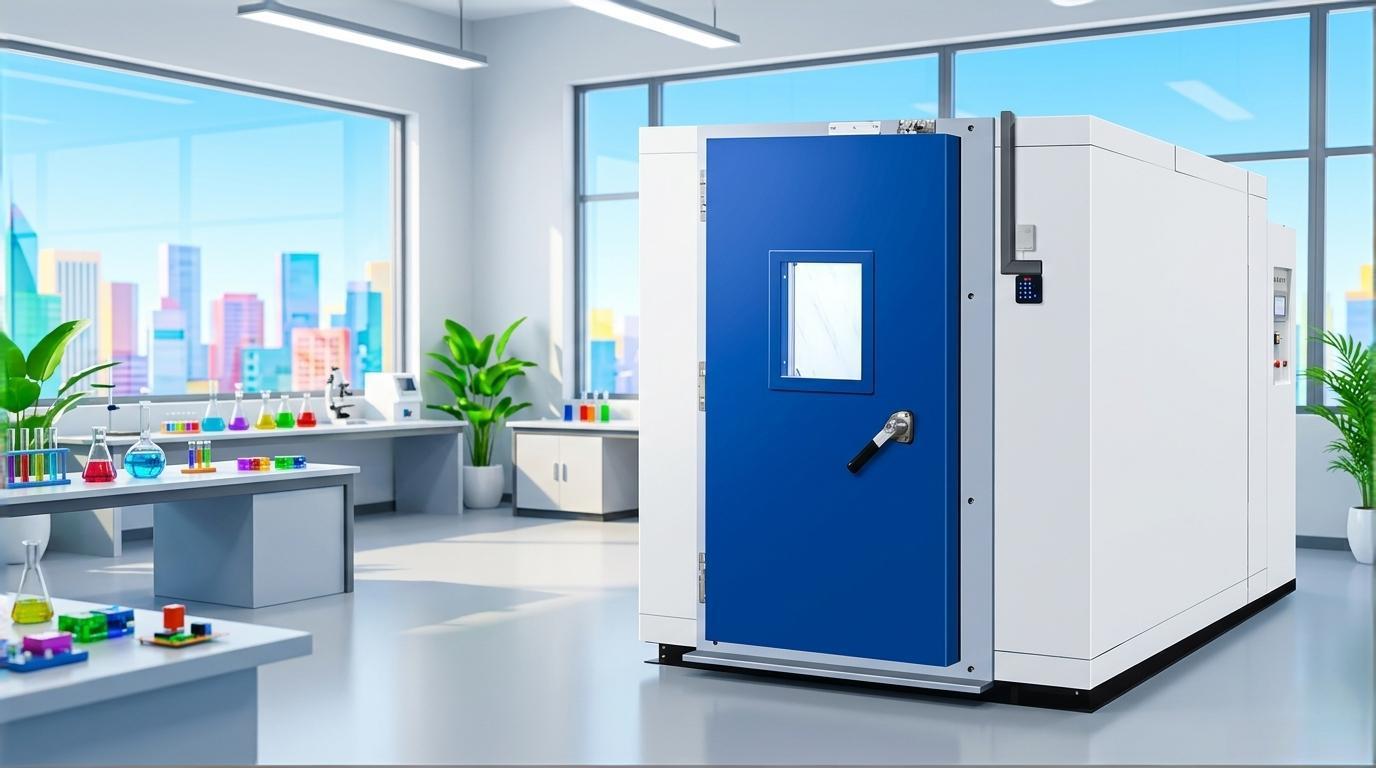
The following is an in-depth technical analysis of high-specification stability chambers from the perspectives of engineering design, regulatory validation, and data management.
1. Regulatory Parameters and Environmental Control Precision
Access to the global pharmaceutical market requires equipment to operate strictly within the defined ICH test conditions. Equipment deviations must be confined to extremely narrow ranges to ensure the validity of experimental data.
1.1 ICH Climatic Zone Test Condition Specifications
Stability chambers must be capable of stable operation across different climatic zones (Zones I-IV):
| Test Category | Temperature Set Point | Allowable Fluctuation/Uniformity | Relative Humidity (RH) | Allowable Humidity Deviation |
| Long-term Testing | $25°C$ or $30°C$ | $\pm 2.0°C$ | $60\%$ or $65\%$ | $\pm 5.0\% RH$ |
| Intermediate Testing | $30°C$ | $\pm 2.0°C$ | $65\%$ | $\pm 5.0\% RH$ |
| Accelerated Testing | $40°C$ | $\pm 2.0°C$ | $75\%$ | $\pm 5.0\% RH$ |
| Refrigerated Testing | $5°C$ | $\pm 3.0°C$ | N/A | N/A |
1.2 Airflow Engineering
To eliminate thermal resistance caused by loaded samples (Sample Loading), the equipment utilizes a forced convection circulation system. Through frequency-controlled fans and precision-engineered air baffles, uniform airflow distribution is maintained throughout the chamber.
Horizontal Laminar Flow Design: Ensures that drug products on every shelf level are exposed to identical microclimatic conditions.
Recovery Time: After door openings for sampling, the control system must restabilize environmental parameters within the established tolerances within 3 to 5 minutes.
2. Core Subsystems and Material Performance
2.1 Balanced Temperature and Humidity Control (BTHC System)
The equipment utilizes the BTHC (Balanced Temperature and Humidity Control) logic. This system employs PID (Proportional-Integral-Derivative) algorithms to simultaneously regulate the output power of the heaters and the refrigerant flow rate.
Humidification System: Utilizes electrode or ultrasonic humidifiers equipped with automatic water replenishment and filtration systems to prevent scale buildup from affecting sensor accuracy.
Dehumidification System: Implemented via the refrigeration circuit’s condensation principle or desiccant rotors to ensure no condensation drips occur in high-humidity environments, protecting drug packaging from contamination.
2.2 Sensor and Detection Technology
Temperature Sensors: Utilize high-precision PT100 platinum resistance thermometers (Class A), with resolution capabilities up to $0.01°C$.
Humidity Sensors: Utilize capacitive polymer film sensors characterized by excellent long-term stability and resistance to chemical contamination, minimizing calibration drift.
2.3 Structural Materials and Thermal Insulation
Interior Material: Constructed from SUS316L stainless steel, which provides superior corrosion resistance compared to SUS304, particularly preventing metallic oxidation during long-term high-humidity exposure ($>75\% RH$).
Insulation Layer: High-density polyurethane foam (CFC-Free) with thicknesses ranging from 80mm to 100mm ensures a low thermal conductivity coefficient (K-value), maintaining internal stability and reducing energy consumption.
3. Data Integrity and Digital Compliance (ALCOA+ Principles)
For international pharmaceutical clients, data integrity is the primary criterion for supplier evaluation.
3.1 FDA 21 CFR Part 11 Compliance
The integrated software of the control system must meet the following functional requirements:
User Authentication: Independent username and password management supporting electronic signatures.
Audit Trail: Automatic system logging of all parameter changes, alarm events, login attempts, and system reboots. These records must be non-deletable and non-overwritable.
Multi-channel Recording: Built-in paperless recorders that support synchronized data logging of temperature and humidity across multiple channels.
3.2 Remote Monitoring and Alarm Systems
Integration of Ethernet or RS485 interfaces allows for centralized management via a Local Area Network (LAN). When parameters deviate “Out of Tolerance,” the system provides immediate notification to laboratory personnel via SMS, email, or local audiovisual alarms.
4. Validation Framework: IQ / OQ / PQ
KOMEG provides comprehensive validation support documentation to ensure equipment complies with GMP (Good Manufacturing Practice) requirements prior to operational commencement.
Installation Qualification (IQ): Verifies that all components, spare parts, and documentation conform to the purchase contract and technical specifications.
Operational Qualification (OQ): Verifies that all functional indicators (e.g., over-temperature protection, fan speed, control accuracy) operate correctly under no-load conditions.
Performance Qualification (PQ): Verifies, through multi-point mapping under full-load conditions, that the spatial uniformity across the chamber consistently meets ICH tolerance requirements.
5. Why Choose KOMEG Environmental Testing Solutions?
With over 30 years of manufacturing expertise, KOMEG (Guangdong KOMEG Industrial Co., Ltd.) has accumulated significant application experience within the pharmaceutical industry.
Engineering Reliability: Critical components (compressors, PLC controllers, sensors) are sourced from top-tier international brands to ensure high Mean Time Between Failures (MTBF) during long-term stability studies.
Customization Capabilities: From benchtop research-grade chambers to large-scale Walk-in Rooms, KOMEG provides flexible engineering solutions tailored to laboratory space and load requirements.
Global Service Network: Mature export experience allows KOMEG to provide remote diagnostics and on-site technical support for pharmaceutical companies worldwide.
Precise environmental simulation is the physical foundation for ensuring pharmaceutical R&D quality and global market access. KOMEG is committed to providing high-performance stability testing equipment that complies with ICH guidelines, assisting pharmaceutical companies in optimizing R&D cycles and mitigating compliance risks.
To obtain technical specification sheets for specific models or 3Q validation protocols, please contact KOMEG Technical Support.