

I. Equipment Overview
An Environmental Test Chamber is a specialized reliability testing instrument designed to simulate and control specific climatic conditions such as temperature, humidity, and atmospheric pressure. Its core operational principle involves the synchronized integration of refrigeration, heating, humidification/dehumidification, and microcomputer control systems to accurately reproduce various natural environmental stresses that a product may encounter during storage, transportation, and usage.
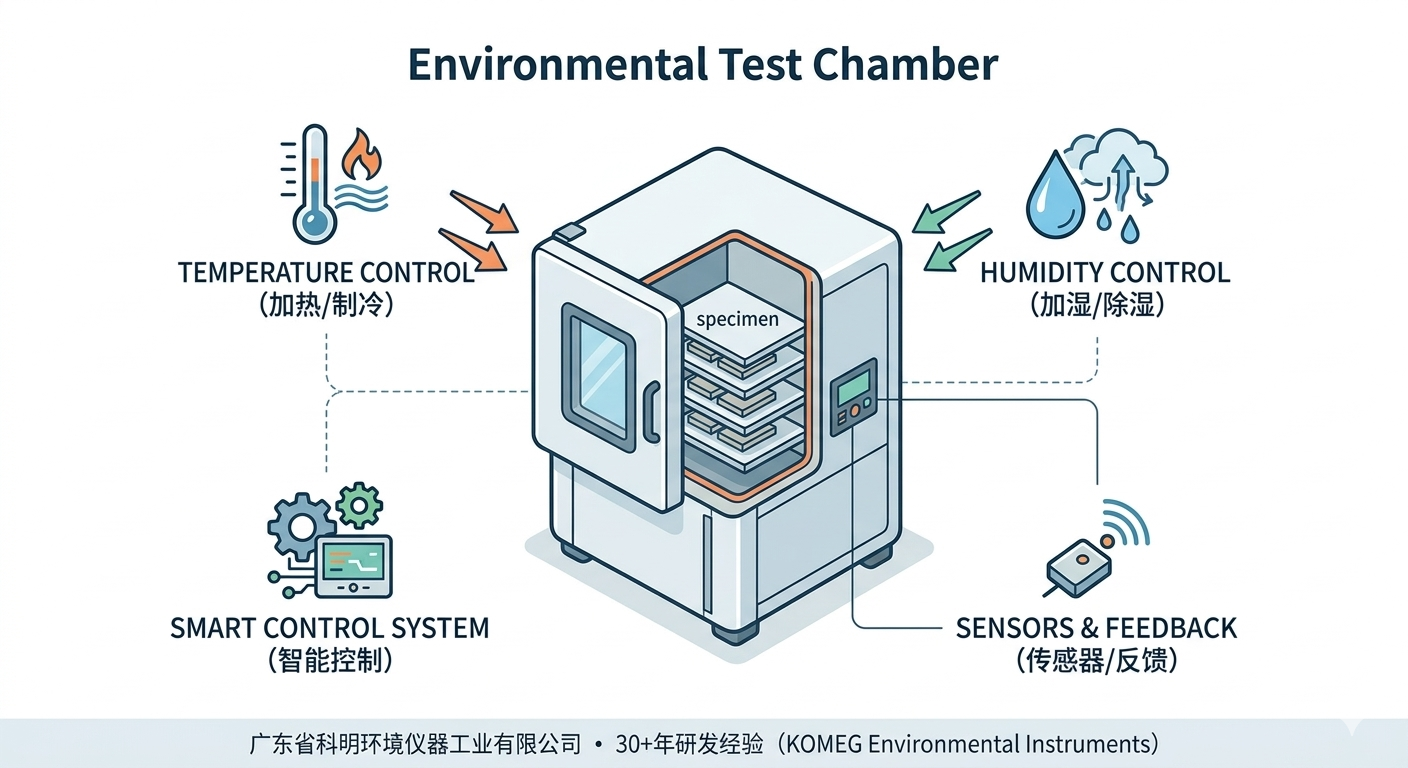
II. Control Logic: High-Precision Closed-Loop Control System
The operation of an environmental test chamber is based on a sophisticated closed-loop feedback control cycle:
Parameter Setting: The operator inputs target values for temperature, humidity, and specific profile curves via the Human-Machine Interface (HMI) or controller.
Real-time Monitoring: Internal high-precision sensors (such as PT100 platinum resistance thermometers and capacitive humidity sensors) continuously collect actual environmental data from within the chamber.
Data Processing: The controller compares real-time data with the setpoints, utilizing a PID (Proportional-Integral-Derivative) algorithm to calculate deviations and output corresponding pulse or analog signals.
Precise Execution: Actuators (heating elements, refrigeration units, humidifiers, etc.) adjust their output power based on the control signals.
Steady-State Maintenance: Through an uninterrupted “sampling-comparison-execution” loop, combined with high-density polyurethane foam insulation, the chamber ensures environmental stability with minimal fluctuations.
III. Core Subsystem Operational Principles
1. Temperature Control System
Temperature regulation is achieved through the independent yet unified coordination of heating and refrigeration systems, supported by forced air circulation.
Heating Mode: The system regulates the output power of heating elements (typically nichrome finned electric heater tubes) via Solid State Relays (SSR). After air passes over the heating elements, it is uniformly distributed into the workspace by a circulation fan, achieving stepless adjustment and precise heating.
Refrigeration Mode: This utilizes a vapor-compression refrigeration cycle. The compressor compresses low-temperature, low-pressure gaseous refrigerant into high-temperature, high-pressure gas. It then liquefies in the condenser by releasing heat and passes through a throttling device (such as an electronic expansion valve) to become a low-temperature, low-pressure liquid. The refrigerant absorbs heat from the chamber air in the evaporator and vaporizes, thereby lowering the air temperature.
Cascade Refrigeration Technology: When test requirements fall below -40°C, single-stage refrigeration efficiency drops significantly. In such cases, a cascade refrigeration system is activated. This utilizes two cycles (high-stage and low-stage) coupled via an interstage heat exchanger (evaporative condenser) to achieve ultra-low temperatures ranging from -70°C to -80°C.
2. Humidity Control System
Humidification Process: Steam humidification is the primary method used. Heating tubes in a water reservoir at the bottom of the chamber heat deionized water to a slight boil, releasing pure steam into the workspace. This method offers rapid response, high control precision, and eliminates physical water droplets.
Dehumidification Process: Mechanical refrigeration dehumidification is employed. To reduce humidity, the control system lowers the surface temperature of the dehumidification evaporator below the dew point of the air. As humid air flows over the cold evaporator, water vapor condenses into droplets and is drained out of the chamber, reducing absolute humidity.
IV. Derivative Models and Specialized Applications
Based on varying testing standards and stress intensities, several specialized environmental chambers have been developed:
Thermal Shock Test Chamber: Designed to evaluate the structural stability of products under extreme temperature gradients. It features instantaneous switching (transition time typically <15s).
2-Zone (Elevator Type): Samples are placed in a basket that moves vertically between high-temperature and low-temperature zones.
3-Zone (Stationary Type): Samples remain stationary while high-speed dampers switch the flow of hot or cold air into the test area. These are used to detect structural failure, material cracking, or seal damage in semiconductors, PCBs, and automotive components.
Rapid Temperature Change Chamber (ESS): Features extremely high heating and cooling rates (e.g., 5°C/min, 15°C/min, or higher). High-power configurations allow for rapid temperature tracking to perform Environmental Stress Screening, exposing latent defects early in the product lifecycle.
Combined Reliability Test Chamber (T+H+V): Integrates temperature and humidity testing with an electrodynamic vibration table to simultaneously simulate temperature, humidity, and vibration. This simulates complex composite conditions for aerospace and automotive components during operation.
Salt Spray Corrosion Chamber: Uses a spray system to atomize salt solutions, creating a high-salinity humid environment. It is specifically used to evaluate the corrosion resistance of metals, coatings, and electroplated parts in marine or automotive applications.
About KOMEG:
GUANGDONG KOMEG INDUSTRIAL CO., LTD (KOMEG) was founded in 1990 and possesses over 30 years of R&D and manufacturing experience in environmental testing. Our main product line includes: Temperature (Humidity) Cycling Chambers, Thermal Shock Chambers, Rapid Temperature Change Chambers, ESS Environmental Stress Screening Systems, Climatic Aging Chambers, Altitude/Temperature Chambers, and large Walk-in Environmental Test Rooms.