

In the world of electronics, automotive, and outdoor equipment manufacturing, “waterproof” is more than a marketing buzzword—it is a critical safety and reliability standard. To ensure a product can withstand the elements, engineers rely on Ingress Protection (IP) testing.
However, choosing the right Rain Test Chamber can be complex. Should you prioritize oscillating tubes or high-pressure nozzles? What is the significance of flow rate precision? In this guide, we break down the technical requirements of IPX3 through IPX6 and how KOMEG’s advanced simulation technology helps you meet them.
1. Understanding the Spectrum: IPX3 to IPX6
The IEC 60529 standard defines different levels of protection against water. For rain simulation, the most common requirements fall between IPX3 and IPX6:
IPX3 (Spraying Water): Simulates water falling as a spray at any angle up to 60° from the vertical.
IPX4 (Splashing Water): Simulates water splashing against the enclosure from any direction.
IPX5 (Water Jets): Simulates water projected by a nozzle (6.3 mm) against the enclosure from any direction.
IPX6 (Powerful Water Jets): Simulates water projected in powerful jets by a nozzle (12.5 mm) against the enclosure from any direction.
2. Technical Requirements for Accurate Simulation
Achieving reliable test results requires more than just “spraying water.” It demands precise mechanical control:
A. The Precision of Flow and Pressure
For critical components, even a minor deviation in water flow can lead to inconsistent results. KOMEG’s KRN Series is engineered for this exact challenge, maintaining a stable flow of 10L/min with a strict ±5% tolerance. Furthermore, with adjustable pressure ranging from 50kPa to 150kPa, engineers can simulate specific environmental stresses beyond basic compliance.
B. Coverage and Automation
A common failure point in rain testing is “blind spots.” To combat this, modern chambers utilize:
Stepping Motor Drives: Precisely controlling the swing angle and speed of the spray ring.
Anti-Winding Rotating Tables: Essential for testing “live” electronic samples, ensuring cables do not tangle as the product rotates during the spray cycle.
3. Scalability: From Sensors to Automotive Modules
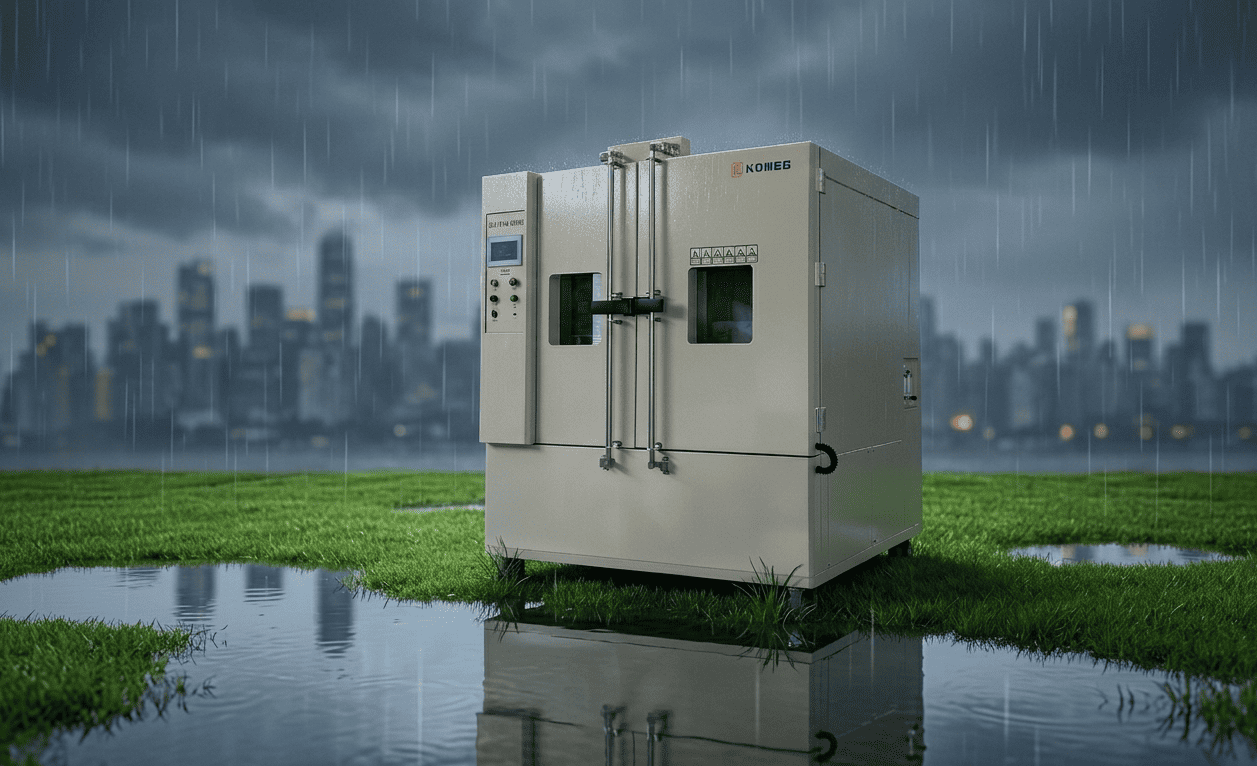
Not every laboratory has the same footprint. When selecting a chamber, volume flexibility is key. KOMEG offers standard models like the KM-FS36BS, but also provides bespoke customization from 50L to 1000L. This ensures that whether you are testing a small IoT sensor or a large EV battery pack, the internal environment remains calibrated and compliant.
4. Why KOMEG for Your Rain Testing Needs?
With over 30 years of R&D experience in environmental simulation, Guangdong KOMEG Industrial Co., Ltd. understands the nuances of international standards. Our chambers are equipped with Panasonic PLC systems and high-definition observation windows with built-in wipers, allowing for real-time monitoring of the test specimen.
As global markets demand higher sustainability, our systems also feature integrated water recycling, reducing environmental impact while maintaining the rigorous testing conditions required by MIL-STD-810 and ISO 20653.
Choosing the right rain test chamber is an investment in your product’s reputation. By focusing on flow precision, pressure adjustability, and volume scalability, you ensure that your “waterproof” claim stands up to the harshest real-world conditions.