

Environmental test chambers are indispensable testing instruments in modern industry. Widely used in electronics, automotive, and aerospace sectors, these chambers evaluate product reliability and adaptability under extreme conditions such as high temperature, low temperature, and humidity.
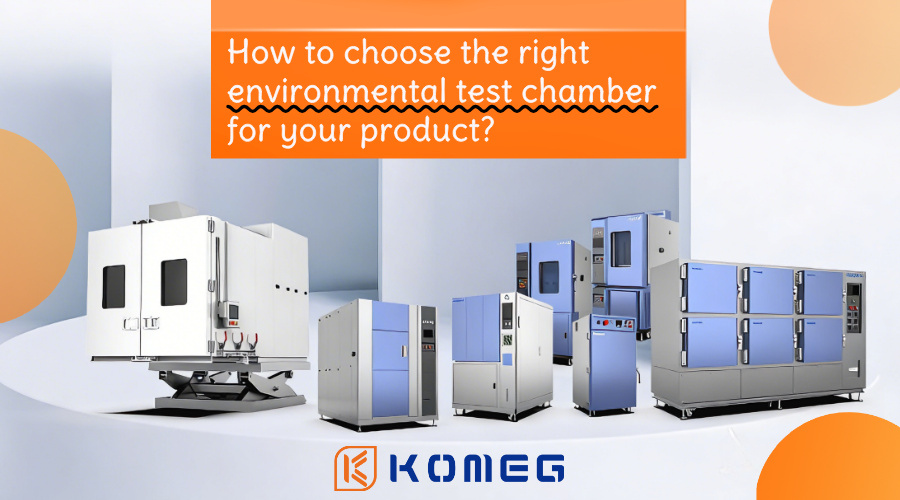
The most common types of environmental testing equipment include:
Constant Temperature and Humidity Chambers
High and Low Temperature Test Chambers
Thermal Shock Test Chambers
Rapid Temperature Change Chambers
For many engineers and procurement professionals, distinguishing between these four can be confusing. Today, KOMEG provides a systematic breakdown of their core differences to help you make an informed decision.
I. General Overview: Functional Comparison
Before diving deep, let’s look at the primary functions of each chamber:
Constant Temperature and Humidity Chamber: Controls both temperature and humidity simultaneously; ideal for simulating damp-heat environments.
High and Low Temperature Test Chamber: Focuses strictly on temperature control.
(Note: A humidity chamber without the moisture function acts as a standard temperature chamber).
Rapid Temperature Change Chamber (Fast Ramp Rate): An upgrade of the standard temperature chamber with significantly faster heating/cooling rates (typically 3°C/min to 15°C/min or higher).
Thermal Shock Test Chamber: Designed for instantaneous temperature transitions (usually switching between extremes within 3 to 5 minutes) to evaluate a product’s tolerance to sudden thermal stress.
II. Deep Dive: High-Low Temperature vs. Thermal Shock Chambers
While both chambers handle extreme temperatures, their testing principles, structural designs, and applications are worlds apart.
1. Purpose and Test Logic
High-Low Temperature Chamber: Used for steady-state testing or gradual cycling. The transition is progressive, typically taking about an hour to move between set points. It monitors how a product performs at a specific temperature.
Thermal Shock Chamber: Used for “stress testing.” It requires the air temperature to recover within 5 minutes after a transition that occurs in seconds (recovery time < 15s). It monitors how a product survives the shock of moving between extremes.
2. Structural Design
High-Low Temperature Chamber: A single-chamber structure where heating and cooling systems work in dynamic balance to maintain a set point.
Thermal Shock Chamber: Usually comes in two configurations:
Two-Zone (Elevator Type): Features separate hot and cold zones; the test sample moves between them via a motorized basket.
Three-Zone (Damper Type): The sample remains stationary in a middle chamber, while hot or cold air is blasted in from separate storage zones via high-speed dampers.
3. Technical Complexity
Standard temperature chambers are a mature technology with lower entry barriers. In contrast, Thermal Shock Chambers require sophisticated airflow logic, superior sealing, and high-performance “energy storage” capabilities, making them significantly more complex to engineer.
4. Cost and Investment
For the same internal volume and temperature range, a Thermal Shock Chamber is typically 3 to 5 times more expensive than a standard High-Low Temperature Chamber. This price gap widens as the chamber size increases.
III. Summary: Which One Do You Need?
Choose a High-Low Temperature Chamber for routine durability testing where the rate of change isn’t critical.
Choose a Rapid Temperature Change Chamber if your testing standards (like MIL-STD or specific automotive norms) require a specific “Ramp Rate” (e.g., 5°C/min).
Choose a Thermal Shock Chamber for rigorous reliability screening to find latent defects caused by sudden thermal expansion and contraction. Why Partner with KOMEG?
At KOMEG, we don’t just sell boxes; we provide environmental simulation solutions. With decades of expertise in eco-friendly and energy-saving testing technology, we help you choose the right equipment that balances your testing standards with your budget.
Still unsure which chamber fits your project? [Contact KOMEG’s Technical Team Today] for a free consultation and customized quote.