

The rapid shift toward vehicle electrification has placed battery safety at the forefront of automotive engineering. Lithium-ion batteries (Li-ion) are high-energy-density components that require rigorous validation under extreme conditions. To ensure global market access, manufacturers must comply with stringent international standards, most notably UN38.3 and UL2580.
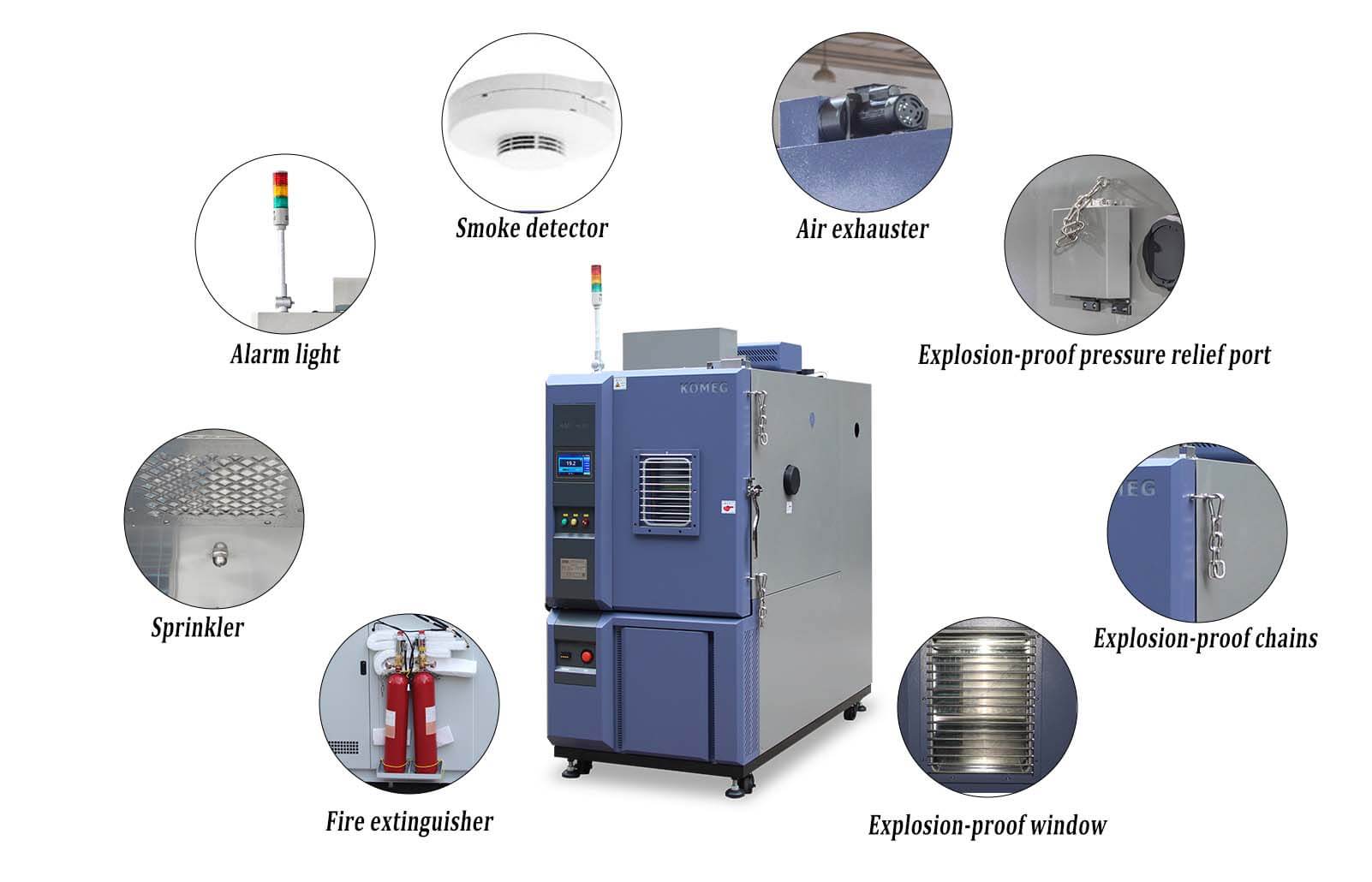
Selecting the right environmental test chamber is not merely about reaching a temperature setpoint; it is about precision, safety integration, and mimicking real-world failure modes.
1. Understanding the Standards: UN38.3 vs. UL2580
Before selecting hardware, it is critical to differentiate between the testing objectives of these two primary standards.
UN38.3: The Transportation Benchmark
UN38.3 is a mandatory requirement for the transport of lithium batteries. It ensures that batteries can withstand the rigors of air, sea, and land transit without leaking, venting, or catching fire.
Key Tests: Altitude simulation (low pressure), Thermal cycling (T1–T8), Vibration, Shock, External Short Circuit, Impact/Crush, Overcharge, and Forced Discharge.
Chamber Focus: Rapid temperature transitions and vacuum stability.
UL2580: The EV Safety Benchmark
UL2580 focuses on batteries for use in electric vehicles. It evaluates the battery’s ability to withstand severe abuse and remain safe for the vehicle’s occupants.
Key Tests: Fire exposure, salt spray, water immersion, external short circuit, and—critically—Thermal Runaway Propagation.
Chamber Focus: Heavy load capacity, advanced fire suppression, and explosion-proof (EX) safety features.
2. Critical Technical Requirements for the Test Chamber
When evaluating a test chamber for these standards, four technical pillars must be considered:
A. Temperature Range and Change Rate
Both standards require thermal cycling, often moving between extreme cold (e.g., -40°C) and extreme heat (e.g., +75°C or higher).
Performance Metric: Look for a chamber with a ramp rate of at least 5°C/min to ensure the battery cells experience the thermal stress required by the standard.
Uniformity: Large battery packs can create “dead zones” in airflow. High-velocity air circulation is essential to maintain ±1.0°C uniformity across the entire specimen surface.
B. Pressure Control (Altitude Simulation)
UN38.3 (Test T.1) requires batteries to be stored at a pressure of 11.6 kPa (simulating an altitude of 15,000m) for at least six hours.
Selection Tip: Ensure the vacuum chamber can maintain precise low-pressure setpoints without fluctuations, as leakage in the seals can invalidate a long-duration test.
C. Mechanical Load and Structural Integrity
EV battery packs are heavy, often exceeding 500kg to 1,000kg.
Floor Reinforcement: Standard laboratory chambers may collapse under the weight of a full EV pack. You must specify a reinforced floor capable of handling high point loads.
Port Holes: Ensure the chamber has sufficient cable ports (e.g., 100mm or 150mm) to allow for the massive high-voltage cables required to charge/discharge the battery during testing.
3. The “Hazard Level” Approach to Safety Features
Testing EV batteries involves the inherent risk of Thermal Runaway—a chain reaction where a cell’s internal temperature rises uncontrollably, releasing toxic gases and fire. Test chambers must be equipped based on the EUCAR Hazard Level (1-7).
| Safety Feature | Function |
| Pressure Relief Vent | Instantly releases internal pressure during a cell explosion to prevent the chamber door from blowing off. |
| Gas Detection | Sensors for $H_2$, $CO$, and volatile organic compounds (VOCs) to provide early warning before ignition. |
| Fire Suppression | Integrated $CO_2$, Water Mist, or Nitrogen purging systems to extinguish flames automatically. |
| Anti-Explosion Chain | Heavy-duty door chains prevent the door from becoming a projectile in a catastrophic failure. |
| Non-Sparking Fans | Specialized motors to prevent ignition of leaked electrolyte vapors. |
4. Future-Proofing: Environmental and Regulatory Compliance
As global regulations evolve, the choice of refrigerant within the chamber has become a strategic decision.
Sustainability: Traditional refrigerants like R23 have extremely high GWP (Global Warming Potential).
The CO2 (R744) Advantage: Modern chambers utilizing CO2 as a natural refrigerant (GWP=1) are becoming the preferred choice. They are exempt from F-Gas bans, ensuring the equipment remains compliant for 15–20 years of service life.
5. Summary Checklist for Selection
When finalizing your specification for UN38.3 or UL2580 testing, use this checklist:
Does the volume accommodate the largest intended pack with 33% free space for airflow?
Is the ramp rate sufficient to meet the “Fast Temperature Change” requirements of the specific test profile?
Are the safety Hazard Levels (EUCAR) matched to the battery’s energy density?
Is the control software capable of integrating with the Battery Management System (BMS) for real-time data logging?
Does the manufacturer provide a structural load certification for the chamber floor?
Choosing a test chamber for EV battery safety is a balance between high-performance thermodynamics and rigorous safety engineering. By aligning the chamber’s capabilities with the specific demands of UN38.3 and UL2580, manufacturers can ensure not only the safety of their products but also the long-term viability of their testing infrastructure in an increasingly regulated “green” economy.