

1. What types of batteries can be evaluated in this chamber?
The Environmental Chamber for Battery Testing is engineered to test a wide range of chemistries, including Lithium-ion (Li-ion), Lead-acid, NiMH, and next-generation Solid-state batteries. Our systems are versatile enough to accommodate everything from individual cells to high-capacity EV battery modules and packs.
2. How does the chamber ensure safety during battery testing?
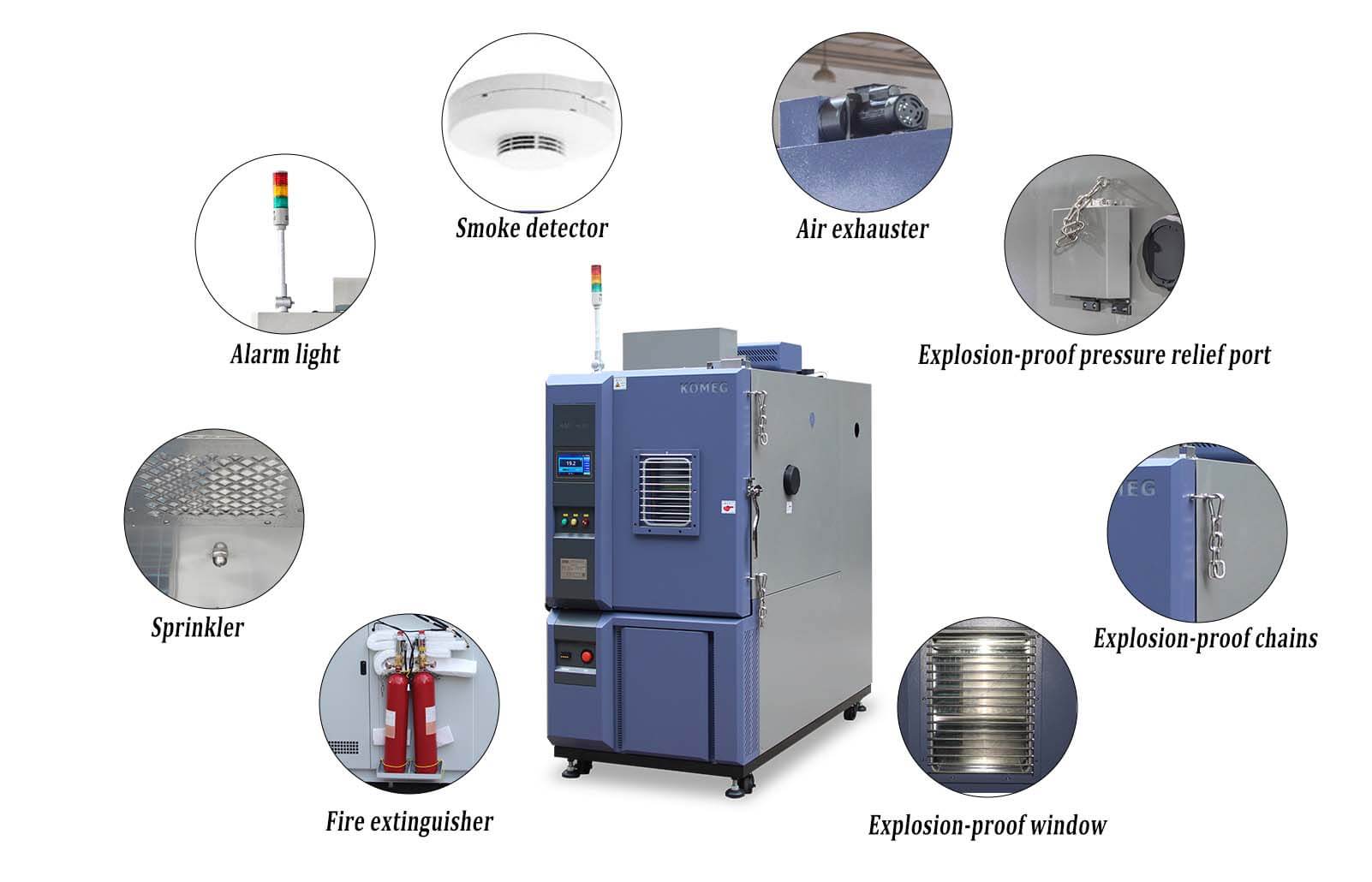
Safety is integrated into our core design. Every Environmental Chamber for Battery Testing features a Multi-level Safety Package, including:
Explosion-proof pressure relief ports and reinforced door latches with safety chains.
Real-time monitoring for smoke, combustible gas, and temperature anomalies.
Automatic fire suppression systems (CO₂ or water mist) to proactively mitigate thermal runaway risks.
3. What temperature and humidity ranges are supported?
Our high-performance Environmental Chamber for Battery Testing typically operates within a temperature range of -70°C to +180°C. For humidity-sensitive tests, it provides a precise control range from 10% to 98% RH, ensuring compliance with diverse global climate simulations.
4. Can the chamber simulate rapid temperature transitions?
Yes. KOMEG’s Environmental Chamber for Battery Testing can be configured for rapid-rate thermal cycling, offering transition rates of 5°C/min, 10°C/min, or 15°C/min. This allows for the precise evaluation of a battery’s thermal shock resistance and long-term durability.
5. Does it comply with Electric Vehicle (EV) testing standards?
Absolutely. The Environmental Chamber for Battery Testing is purpose-built to meet rigorous international standards, including UN38.3, IEC 62133, UL 2580, and SAE J2464. It is the industry-preferred choice for assessing EV battery performance under extreme thermal and mechanical stress.
6. Which industries utilize this environmental chamber?
The Environmental Chamber for Battery Testing is a trusted solution across the Automotive (EV/HEV), Aerospace, Defense, Consumer Electronics, and Renewable Energy (ESS) sectors. With over 30 years of expertise, we support R&D for Tier-1 suppliers and global research institutes.
7. How do humidity levels impact battery reliability?
Precise humidity control is vital; high humidity can accelerate terminal corrosion and insulation failure, while ultra-low humidity allows engineers to test a battery’s resilience against potential electrostatic discharge (ESD) in dry environments.
8. What are the key technical features of KOMEG chambers?
Beyond safety, the Environmental Chamber for Battery Testing features proprietary PLC touch-screen controllers (7″ or 10″) for high-fidelity data logging. Our systems offer Ethernet/USB connectivity for remote monitoring, superior airflow for temperature uniformity, and energy-efficient cooling via Tecumseh or Bitzer compressors.