

Abstract: LiDAR is the core sensing component of autonomous driving systems, and its reliability is directly linked to vehicle operational safety. Due to the integration of high-precision optical components, laser emitter/receiver arrays, and high-performance computing chips, Environmental Stress Screening (ESS) has become an essential methodology for improving Mean Time Between Failures (MTBF). This article analyzes the value of rapid temperature change testing in LiDAR reliability assessment and details how the KOMEG KST series addresses the challenges of automotive-grade environmental adaptation.
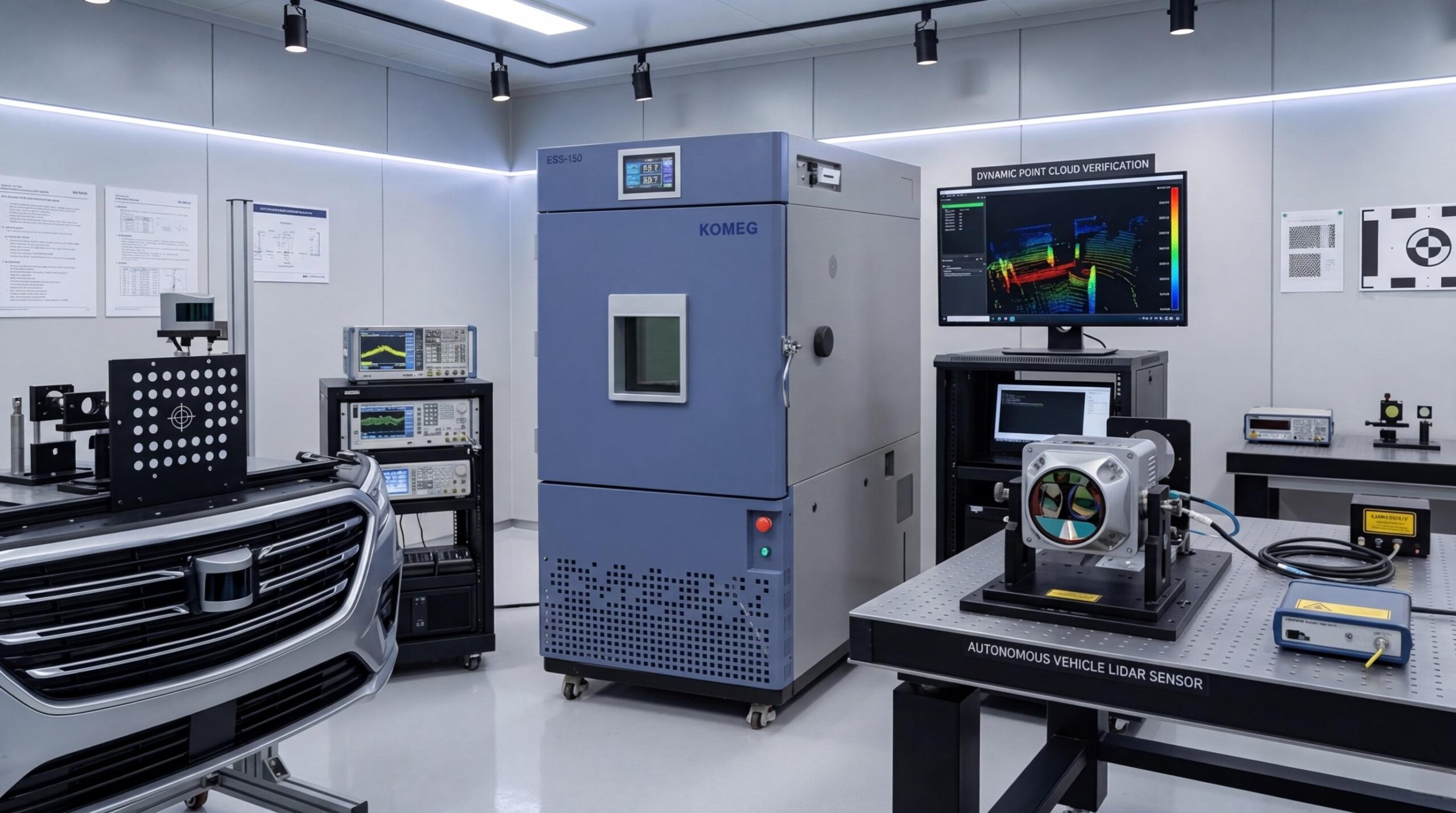
1. Industry Background: The Rigorous Environmental Challenges for LiDAR
The operating environment for automotive LiDAR is exceptionally demanding, covering a thermal span from -40°C in frigid regions to +85°C (or higher) within enclosed vehicle compartments during summer. In real-world scenarios, vehicles frequently encounter drastic temperature shifts, such as moving between heated garages and freezing outdoor air or facing sudden rainstorms. Rapid Temperature Change testing is not a simple static storage test; it utilizes high temperature-transition rates to generate cyclic thermal stress, pre-emptively exposing latent structural defects and performance risks during the R&D and mass production stages.
2. Core Dimensions of Rapid Temperature Change Testing for LiDAR Reliability
2.1 Verification of Thermo-mechanical Reliability: Preventing Optical De-focus
LiDAR units are constructed from glass lenses, aluminum alloy housings, PCBs, and various adhesives.
CTE Matching Challenges: The Coefficient of Thermal Expansion (CTE) varies significantly across these materials. At high transition rates of $10°C/min$ or $15°C/min$, severe instantaneous shear stress is generated at material interfaces.
Reliability Focus: This test verifies whether optical support structures suffer from micron-level creep due to thermal fatigue. This ensures that after long-term thermal cycling, the alignment of the laser transmitter and receiver axes maintains sub-micron precision, preventing point cloud blurring or degradation of ranging accuracy.
2.2 Electronic Packaging and Solder Reliability: Triggering Early Failures
LiDAR internals contain large-scale FPGA/ASIC chips and thousands of SMD solder joints.
Solder Fatigue Simulation: Rapid thermal cycling is an effective method for verifying Solder Fatigue, simulating the cold and heat stresses a vehicle experiences throughout its entire lifecycle.
Process Optimization: This testing effectively identifies process defects such as cold solder joints, BGA solder ball cracks, and PCB warpage, guiding the continuous improvement of production processes before mass manufacturing.
2.3 Consistency Monitoring of Dynamic Electro-optical Performance
Wavelength Drift Compensation: The emission wavelength of lasers drifts with temperature. Reliability testing must verify in real-time whether the internal compensation algorithms can maintain stable signal gain across the entire temperature range.
Sealing Integrity Verification: The pressure differential caused by rapid temperature changes tests the sealing reliability of the LiDAR housing (the “breathing effect”), preventing internal condensation or frosting during long-term operation.
3. KOMEG KST Series: Tailored for LiDAR Reliability
To meet the demanding requirements for high temperature-transition rates, high-precision control, and active power-on monitoring, KOMEG provides a closed-loop technical guarantee:
3.1 Superior Heating/Cooling Rates and Linearity
Extreme Stress Application: The KST series offers various transition rate specifications, including $5°C/min$, $10°C/min$, and $15°C/min$. Utilizing advanced cascade refrigeration technology, it ensures excellent temperature linearity across a wide range from -70°C to +180°C.
Zero Overshoot Control (KBT Technology): Precision optics are extremely sensitive to temperature overshoot. KOMEG’s proprietary KBT (Balanced Temperature) technology, combined with PID auto-calculation, ensures a smooth transition when reaching target temperatures, avoiding invalid thermal shocks that could damage the specimen.
3.2 Intelligent Control System
The KOMEG self-developed control system is specifically engineered for complex reliability testing:
Interactive Experience: Equipped with a 7-inch (optional 10-inch) high-resolution true-color touchscreen, supporting up to 3,200 program cycles with real-time curve display.
Active Monitoring: Featuring professional Ethernet and RS-485 interfaces, the system supports Active Testing while the LiDAR is powered on inside the chamber. Technicians can perform remote monitoring to ensure synchronized analysis of environmental parameters and LiDAR point cloud output.
Extended Data Traceability: The controller includes RAM with battery protection, capable of storing over 3 months of historical curves. Data can be exported via USB with one click, facilitating LiDAR lifetime analysis and failure traceability.
Safety Redundancy: The system includes 88 built-in output logics for comprehensive protection against over-temperature, over-pressure, water shortage, and over-current, ensuring the safety of unattended experiments lasting hundreds of hours.
3.3 High-Quality Materials for Test Environment Purity
High-Grade Interior: The chamber utilizes SUS304/SUS316L high-quality mirror-finish stainless steel, which withstands severe temperature changes without deformation. The material surface remains free of debris or contaminants, ensuring the absolute cleanliness of the optical testing environment.
4. Adherence to Industrial and International Standards
KOMEG has assisted numerous leading LiDAR companies in completing validation based on the following standards:
Automotive Electronics: ISO 16750-4 / AEC-Q102 (Standard for Optoelectronic Semiconductors)
Military/Specialized: GJB 150A / MIL-STD-810H (High-intensity temperature change and thermal shock tests)
General Specifications: GB/T 2423.22 / IEC 60068-2-14
LiDAR reliability is the cornerstone of autonomous driving safety. By utilizing the KOMEG KST series rapid temperature change test chambers, enterprises can accurately assess the physical limits of their products during R&D and effectively eliminate early-stage failures during production. Choosing KOMEG means choosing a partner with over 30 years of expertise in environmental reliability testing.
Technical Inquiry:
For KOMEG LiDAR reliability testing solutions and detailed KM series controller manuals, please contact our KOMEG technical application engineers.