

In high-tech sectors such as power electronics, telecommunications, aerospace, and biopharmaceuticals, High-Temperature Aging Testing (Burn-in Testing) is a critical process for enhancing product stability and reliability. By simulating harsh thermal environments, manufacturers can identify and eliminate early-failure components before products reach the customer, ensuring superior quality and a long operational lifespan.
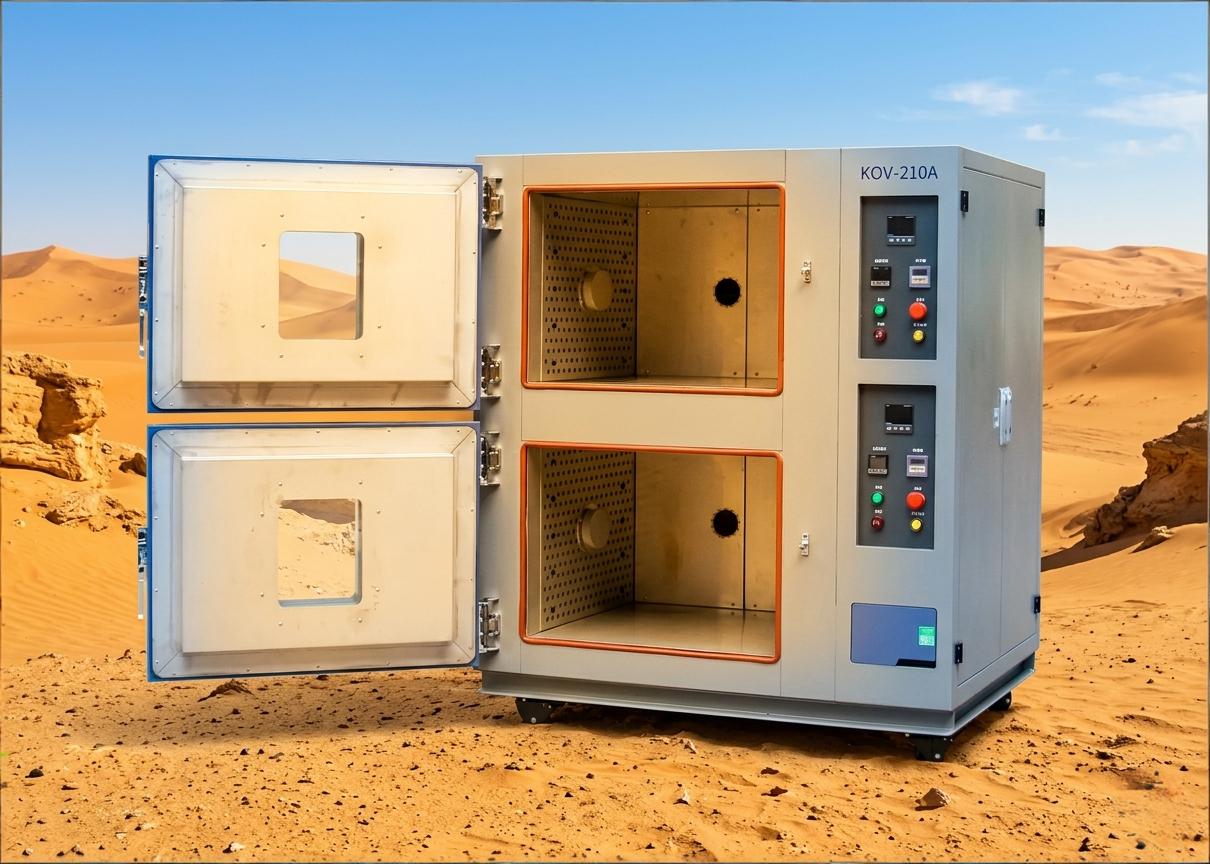
This guide provides a deep dive into the objectives, international standards, equipment categories, and key technical indicators of high-temperature aging.
I. The Core Objectives of High-Temperature Aging Screening
High-temperature aging is more than just a heating process; it is a scientifically controlled application of thermal stress designed to:
Enhance Product Reliability: Accelerate the physical and chemical changes in materials to eliminate residual mechanical stresses and volatile substances (such as residual solvents) from the manufacturing process.
Eliminate Early Failures: High temperatures force defects in components, poor soldering, or process flaws to manifest early. This allows manufacturers to identify and discard faulty units during the production stage.
Ensure a Stable Lifecycle: By pushing products through the “Infant Mortality” phase of the reliability bathtub curve, manufacturers ensure that the units delivered to customers have reached their stable, high-reliability operational phase.
Optimize R&D and Quality: Provide engineers with an effective means to quickly identify design weaknesses and material compatibility issues, significantly improving production efficiency.
II. Key International and Industry Standards
Before conducting a test, it is vital to align with the correct industry standards to ensure compliance and accuracy:
In the Electrical and Electronics sector, the most widely recognized standards are GB/T 2423.2-2008 and the international equivalent IEC 60068-2-2 (Environmental Testing Part 2-2: Test B: Dry Heat). For Polymer Materials, GB/T 3512 / ISO 188 (Accelerated aging and heat resistance tests for rubber) and GB/T 7141 / ASTM D3045 (Standard practice for heat aging of plastics) serve as the industry benchmarks. In the Coatings and Paints industry, GB/T 1735 is the standard for determining heat resistance. Additionally, the German standard DIN 53508 remains a critical reference for rubber acceleration tests.
III. Equipment Requirements and Classification
Based on the scale of the test samples and the required precision, aging equipment is generally categorized into High-Temperature Aging Chambers and Walk-in Aging Rooms (Burn-in Rooms).
1. High-Temperature Aging Chambers: Precision and Stress Testing
These chambers are primarily used for laboratory-scale adaptability tests and thermal stress testing. They typically feature a temperature range from $Rt+20\text{°C}$ to $+300\text{°C}$, with adjustable ventilation times from 1 to 99 hours.
Technical Note: While they may resemble industrial ovens, high-temperature aging chambers require significantly higher temperature uniformity and stability. Standard drying ovens cannot replace professional aging chambers, as insufficient airflow or temperature fluctuations can lead to inaccurate results or damage to the samples.
2. Walk-in Aging Rooms (Burn-in Rooms): Large-Scale Screening
Burn-in rooms are used for bulk screening of finished electronic products before they leave the factory, with typical operating temperatures between $40\text{°C}$ and $70\text{°C}$.
Integral Walk-in Aging Rooms: Utilizing modular isolation panels and PU foam insulation technology, these rooms employ PID+SSR closed-loop temperature control. They offer large internal spaces where carts can be directly rolled in for easy loading and unloading, making them highly energy-efficient and independent of external ambient factors.
Isolated Aging Rooms: These feature a split design that isolates the Product Zone from the Load Zone. This setup is ideal for maintaining load equipment and allows for more precise control of heat distribution, preventing localized overheating caused by the heat dissipation of the products themselves.
IV. Five Critical Technical Indicators for Selection
To ensure the long-term stability of the equipment and the safety of the operators, high-quality aging equipment must meet the following criteria:
1. Heating Efficiency and Thermal Control
Under full power, the chamber should be able to reach its maximum operating temperature from room temperature within 120 minutes. KOMEG’s advanced airflow systems ensure that even during rapid heating, the internal air circulation remains uniform, preventing “cold spots” or “heat pockets.”
2. Surface Temperature and Operator Safety
When the internal temperature is $\le 200\text{°C}$, the external surface temperature of the chamber must not exceed Ambient Temperature + 35°C. For temperatures exceeding $200\text{°C}$, the external shell must adhere to strict thermal insulation formulas to prevent the risk of burns.
3. Electrical and Insulation Safety
Equipment must pass rigorous insulation resistance and strength tests. When the heaters and control systems are in an open circuit state, the shell must withstand $1500\text{V}/50\text{Hz}$ AC for 1 minute without any breakdown, ensuring safety in high-voltage environments.
4. Noise Emission Control
To maintain a comfortable working environment in laboratories and factory floors, total noise levels should be strictly controlled below $75\text{dB(A)}$.
5. Optimization of Temperature Uniformity
Achieving uniformity in large walk-in rooms is a significant technical challenge. Premium equipment should utilize Computational Fluid Dynamics (CFD) air duct design to ensure that even when fully loaded with products, every sample receives identical thermal stress.
KOMEG Conclusion
Selecting the right high-temperature aging equipment is the first step in safeguarding your brand’s reputation. Whether you need a high-precision laboratory chamber or a high-capacity industrial aging room with remote PC monitoring, KOMEG provides customized solutions tailored to your specific product loads.
Looking for efficient and energy-saving high-temperature aging solutions? Contact the KOMEG expert team today for technical support!