

An environmental test chamber is a controlled, enclosed space used to test the effects of specific environmental conditions on industrial products, electronic components, and materials. Essentially, it is a high-tech “stress test” box that mimics the harsh conditions a product might face during its lifecycle.
Manufacturers use these chambers to identify potential weaknesses before a product hits the market, ensuring safety, reliability, and regulatory compliance.
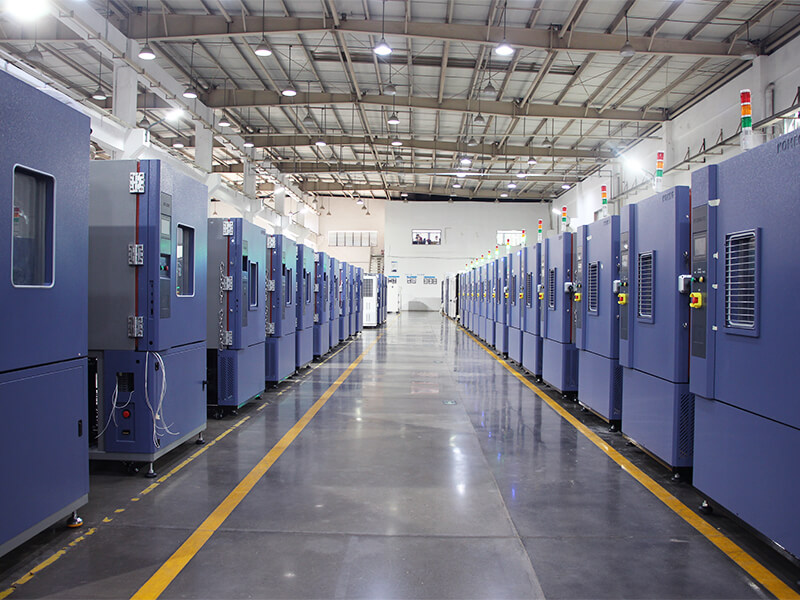
environmental test chamber
How Does It Work?
The chamber functions by isolating an internal environment and using precise mechanical systems to manipulate physical variables. Here is how the core systems operate:
1. Temperature Control
To simulate extreme heat or freezing cold, chambers use a combination of:
Electric Heaters: Fine-tuned heating elements to increase temperature.
Refrigeration Systems: Industrial-grade compressors and coolants (similar to a high-powered freezer) to drop temperatures rapidly.
Air Circulation: High-velocity fans ensure the temperature is uniform throughout the chamber so the product doesn’t have “hot spots.”
2. Humidity Regulation
Moisture is a major enemy of electronics and metals. Chambers control this via:
Steam Generators or Atomizers: To increase humidity levels.
Dehumidification Coils: To remove moisture from the air, simulating bone-dry desert conditions.
3. Pressure and Altitude (Vacuum)
For aerospace or automotive testing, chambers like the Altitude Test Chambers mentioned in your list use powerful vacuum pumps to reduce air pressure, simulating high-altitude environments where air is thin.
4. Stress and Acceleration
Some specialized chambers, such as HAST (Highly Accelerated Stress Test) or Thermal Shock chambers, work by rapidly switching between extremes. For example, a thermal shock chamber might move a product from $-40\text{°C}$ to $+150\text{°C}$ in seconds to see if the materials crack or fail under the sudden expansion and contraction.
Common Testing Scenarios
| Condition | Why Test It? |
| High Humidity | To check for rust, corrosion, or electrical short-circuits. |
| Thermal Cycling | To see if repeated expansion/contraction breaks solder joints. |
| Low Pressure | To ensure batteries or sealed components don’t leak or explode at high altitudes. |
| Salt Spray | To simulate coastal or marine environments for metal durability. |
The Scientific Goal
The objective is summarized by the concept of Accelerated Life Testing. Instead of waiting 10 years to see how a car dashboard fades in the sun, a chamber can simulate that decade of wear in a few weeks by intensifying the environmental stressors.