

In the high-stakes world of industrial manufacturing, product reliability is the final hurdle before market launch. When testing requirements evolve from small components to full-sized vehicles, high-density server racks, or bulk product batches, standard reach-in units reach their limits.
This is where Walk-in Test Chambers become the indispensable “workhorse” of Quality Assurance (QA) and R&D.
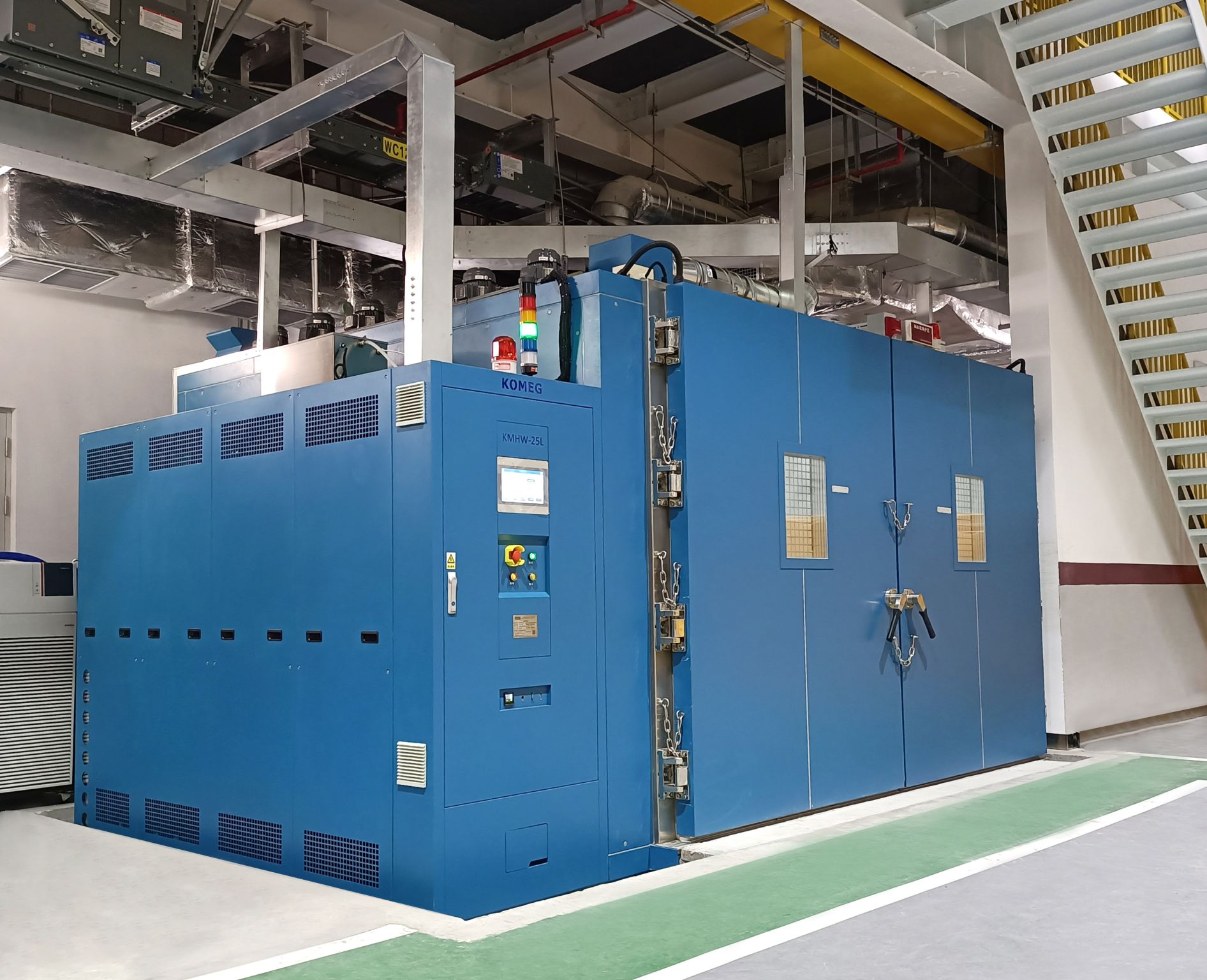
Defining the Walk-in Test Chamber
A Walk-in Test Chamber is a high-precision, high-capacity environmental enclosure designed to replicate extreme atmospheric conditions—including temperature extremes, humidity fluctuations, and rigorous thermal cycling.
The defining advantage is volumetric capacity. These chambers offer an interior workspace large enough for personnel to enter, facilitating the integration of complex test rigs or the evaluation of oversized assemblies that exceed the dimensions of standard cabinets.
How Does a Walk-in Test Chamber Operate?
The functionality of a walk-in chamber is a sophisticated thermodynamic closed-loop process. To maintain a stabilized simulated environment, four core systems must operate in perfect synchronization:
1. High-Performance Airflow Management
Achieving temperature uniformity across a massive volume is a significant engineering feat.
Forced Convection: Industrial-grade centrifugal fans continuously circulate air through a conditioning plenum.
Optimized Air Distribution: Utilizing specialized baffles and perforated air-walls, the system eliminates “thermal pockets” (dead zones), ensuring that temperature deviation remains negligible throughout the entire workspace.
2. Thermal Management (Heating & Cooling)
Refrigeration: Leveraging multi-stage compressors (typically cascade refrigeration systems), the unit utilizes high-efficiency evaporators to extract heat, capable of achieving cryogenic temperatures as low as -40°C or -70°C.
Heating: Heavy-duty, low-watt-density stainless steel heaters provide rapid thermal recovery and high-temperature simulation up to +150°C.
3. Humidity Control & Moisture Regulation
To simulate tropical or maritime climates, the system manages latent heat through:
Humidification: Precise injection of clean steam or ultrasonic water mist into the conditioned airflow.
Dehumidification: Direct expansion cooling coils condense moisture from the air, allowing for ultra-low humidity setpoints required for sensitive electronic testing.
4. The Intelligence Layer: Advanced Control Systems
Modern enclosures feature PLC-based (Programmable Logic Controllers) with intuitive HMI (Human-Machine Interface) touchscreens. Engineers can program complex “stress profiles”—such as ramping from +85°C to -40°C at specific gradients—while the system autonomously modulates power output for surgical precision.
Structural Integrity & Safety Features
Modular Architecture: Built with high-density, tongue-and-groove polyurethane (PU) or rock wool panels, ensuring a superior thermal barrier and structural rigidity.
Pressure Compensation: Automatic relief vents balance internal and external pressure during rapid temperature transitions, protecting the enclosure from structural stress.
Safety Protocols: For Hazardous testing (e.g., Lithium-ion batteries), chambers are outfitted with gas detection, fire suppression, and explosion-proof blast latches.
For more information about KOMEG Walk-in Test Chambers, please read our product introduction.
Strategic Industry Applications
Walk-in Environmental Chambers are the backbone of global innovation:
Automotive & EV: Validating full-vehicle performance and battery life in extreme climates.
Aerospace & Defense: Simulating high-altitude temperature variances on large fuselage sections.
Renewable Energy: Rigorous accelerated aging of large-scale solar arrays and Energy Storage Systems (ESS).
Information Technology: Stress-testing 5G infrastructure and data center hardware under real-world conditions.
A Walk-in Test Chamber is far more than an oversized cold room; it is a marvel of precision engineering and energy management. For industries where failure carries immense cost, these chambers provide the ultimate validation of product durability.